India Launches Hydrogen-Powered Train Fleet in Green Rail Push
India officially joined a small, exclusive club of nations deploying hydrogen-powered rail technology today. A new 10-coach train set departed from the north...
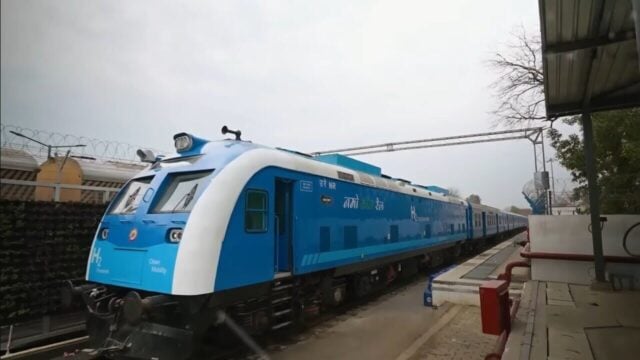
India officially joined a small, exclusive club of nations deploying hydrogen-powered rail technology today. A new 10-coach train set departed from the northern state of Haryana, marking a shift toward cleaner propulsion in one of the world's most extensive railway networks. This hydrogen-fueled locomotive now services the route between Jind and Sonipat, a 90-kilometer stretch that links the industrial region directly to the outskirts of the national capital, Delhi.
The train operates on a 1,200-kilowatt hydrogen fuel cell system. It produces nothing but heat and water vapour. This stands in stark contrast to the thick exhaust plumes typical of traditional diesel locomotives. By replacing carbon-heavy fuels with hydrogen, the Indian government aims to scrub the railway sector of its heavy reliance on fossil fuels. Officials confirmed the entire train set was designed, engineered, and built domestically, showcasing a significant milestone for Indian engineering.
A Strategic Shift for Infrastructure
The new service will run twice daily. Each trip provides a capacity for 2,600 passengers, offering a sustainable commuter option for those traveling between Jind and Sonipat. While the train reaches a maximum speed of 75 kilometers per hour, the primary goal for this initial deployment is to prove the viability of the technology under real-world conditions.
Government statements issued on Thursday emphasized that the project is more than just a locomotive. It integrates advanced propulsion with a dedicated ecosystem of hydrogen storage and localized refueling infrastructure. Building this network was a complex task. It requires precise handling of volatile hydrogen fuel and a robust supply chain to keep the trains running on schedule.
Engineering a Net-Zero Future
India maintains one of the largest broad-gauge railway networks on the planet, spanning roughly 70,000 kilometers. The sheer scale makes the transition to green energy a daunting logistical challenge. To date, the country has electrified nearly the entire network to slash its carbon footprint. However, hydrogen provides a clean alternative for routes where full electrification remains difficult or inefficient.
Prime Minister Narendra Modi flagged the train during its inaugural run. He signaled that this is only the beginning of a broader strategy. The government plans to scrutinize the performance of this pilot route to find ways to drive down operational costs. Scaling up the network is the next logical step. By joining Germany, Japan, China, and the United States in the hydrogen rail space, India is positioning itself to lead in the development of low-emission public transit.
The current project is part of a larger, ambitious mandate to achieve net-zero carbon emissions across all Indian railways by 2030. With the Jind-Sonipat line now active, the focus shifts to whether the technology can handle the high-density requirements of India's massive passenger volume. The rail operator has already successfully electrified over 43,500 miles of track to reach its current environmental targets.