Rising Bond Volatility Diverges From Calm U.S. Stock Market VIX
U.S. Treasury volatility has climbed while the VIX and bitcoin’s implied volatility remain near year-to-date lows. The gap is drawing attention from market…
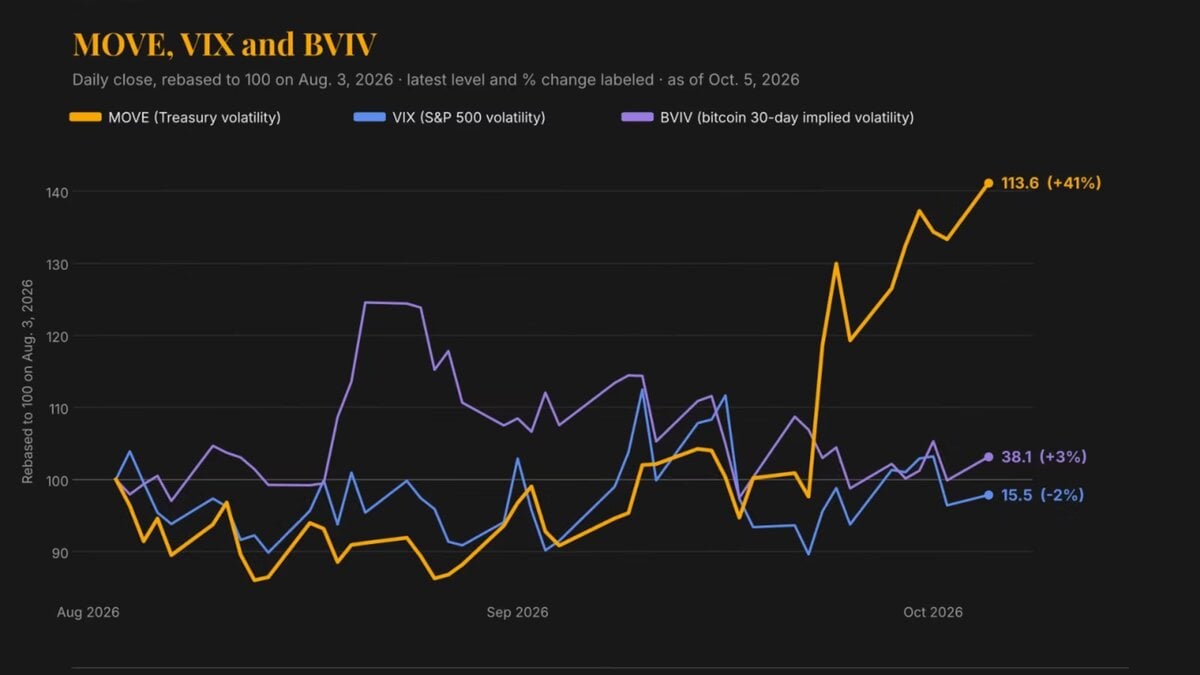
U.S. Treasury market volatility is rising while the VIX remains near a year-to-date low, leaving investors with conflicting signals about risk across markets. The widening gap matters because turbulence in government bonds can affect borrowing costs and may reach stocks and bitcoin later.
“The MOVE index is making higher lows while the VIX makes lower highs. The MOVE leads: it flashed turbulence before the VIX in 2022, in 2023, and at the start of the Iran war. Stocks are usually the last to get the message,” Kurt S. Altrichter, a wealth manager and writer of the RiskSIGNAL Report, said.
The MOVE Index, formally the ICE BofA U.S. Bond Market Option Volatility Estimate, measures expected swings in Treasury yields over the next month. It uses options tied to 2-, 5-, 10- and 30-year bonds, with the 10-year receiving the heaviest weight. The gauge indicates the scale of movement traders expect, not whether yields will rise or fall.
It has climbed sharply. The index jumped 46% in June and is hovering around 116, close to its March high and at its loftiest reading since April 2025, according to CoinDesk.
That rise has reached corporate debt markets. Cboe said on X that investment-grade and high-yield corporate bond volatility had moved from lows in the 6th and 11th percentiles two weeks earlier to highs in the 79th and 84th percentiles, respectively.
The divergence is not a direct forecast that stocks or bitcoin are about to fall. CoinDesk’s analysis found that bitcoin’s daily returns do not closely track the MOVE Index over 60- or 90-day windows. Still, analysts previously told CoinDesk that sudden increases in Treasury volatility can weigh on bitcoin, and that the size of bond-market moves matters more than their direction.
Why the VIX and MOVE gap matters
Treasury securities play a central role in international finance as preferred collateral, and Treasury yields influence borrowing costs across the economy. If volatility in those markets persists, it can tighten financial conditions globally, raise risk premiums and prompt investors to reduce exposure to riskier assets.
For companies, more volatile bond markets can make financing conditions less predictable. For investors, the mismatch offers a reason to watch whether stress in government debt starts showing up in equity and crypto volatility. That connection is a risk to monitor, not proof that a market downturn is imminent.
For now, the VIX and bitcoin’s 30-day implied volatility gauge, BVIV, are hovering near year-to-date lows. CoinDesk said traders may watch whether the MOVE Index clears its March high for signs that volatility could rise in bitcoin and the S&P 500.
Steady exchange-traded fund inflows, fewer whale deposits to exchanges and supportive regulatory tailwinds are among the factors underpinning the current bullish case for bitcoin, according to CoinDesk. The bond-market gauge, meanwhile, is hovering around 116.
Source: coindesk.com