IMF Says AI Investment Is Helping Sustain 3% Global Growth
International Monetary Fund Managing Director Kristalina Georgieva said AI infrastructure investment is helping keep global growth around 3 per cent, with…
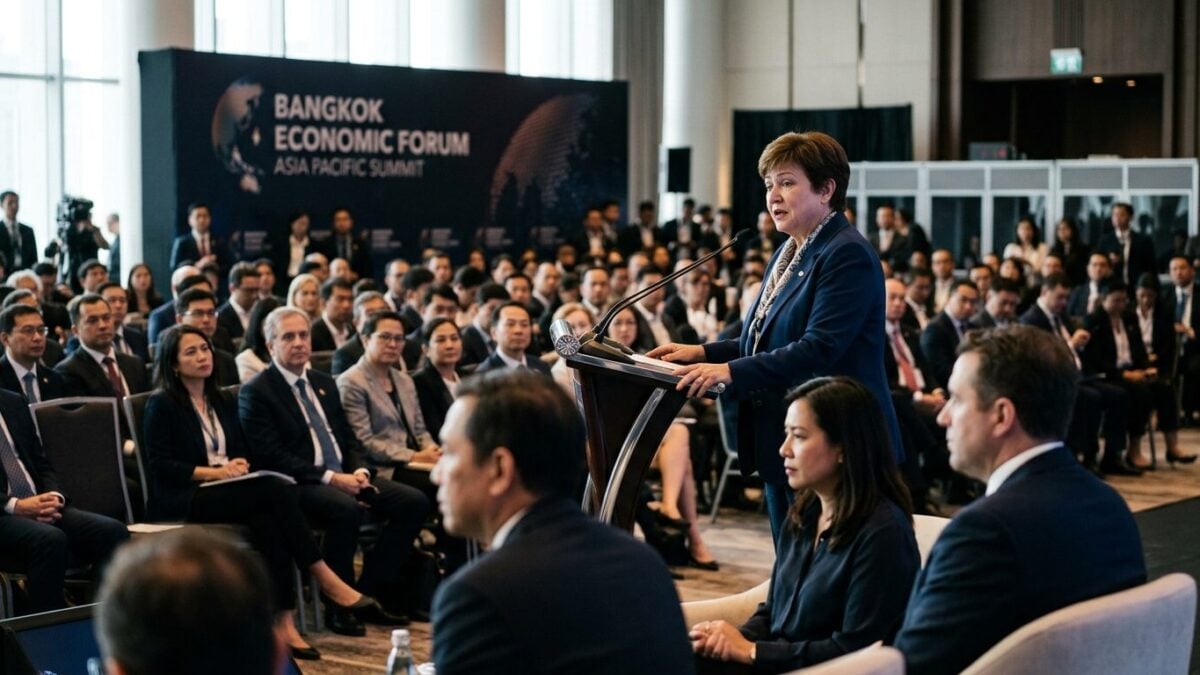
Artificial intelligence investment is helping keep global growth around 3 per cent, International Monetary Fund Managing Director Kristalina Georgieva said in Bangkok on Monday (Oct 12), while warning that the technology could reshape jobs and widen economic divides. Asian economies that supply the hardware stand to benefit, but governments also face questions about work and hiring.
The investment boom is acting as a demand and investment shock, Georgieva said at the first day of a weeklong set of meetings of the IMF and World Bank in the Thai capital. The IMF forecast global growth at 3 per cent in 2026 in July and planned to release an updated outlook on Tuesday.
Asia’s gains come with a jobs challenge
Georgieva said advanced Asian economies could see growth rise by a half to one full percentage point, while emerging Asian economies could gain 0.2 to 0.8 percentage point. Many Asian firms are building the infrastructure needed for AI, she said, naming Thailand as a host country and hardware supplier.
The growth boost is arriving as an energy supply shock weighs on the world economy. “That shift into higher gear is what is keeping the world economy growing at around 3 per cent, despite the fact we are being dragged down by the energy supply shock,” Georgieva said.
AI’s effects will extend beyond investment. Georgieva described it as a “slow-moving tsunami” with consequences for jobs, growth, education and the way governments raise tax revenue as economic activity shifts from labour to capital.
The IMF estimates that AI could augment, downgrade or eliminate 40 per cent of jobs over time, Georgieva said. An initial study found that 10 per cent of jobs in the US already required AI skills. Routine, repetitive jobs were shrinking, while low-paying jobs were growing in construction and data centres.
That shift carries an immediate concern for new graduates. Singapore President Tharman Shanmugaratnam, speaking at the same event, said demand was falling for the first job people typically seek after graduation. “There is a particular problem that we have to address very soon ... and that is that, the first rung in employment, your first job upon graduation, is now seeing less demand,” he said.
Who benefits from the AI investment boom?
The US, China and India are the most important producers in the AI supply chain, Georgieva said. Yet many companies building the necessary infrastructure are in Asia. That gives the region a chance to capture growth through hardware and construction, even as the effects on workers and hiring remain a pressing concern.
World Bank President Ajay Banga said the development bank was focused on using “small AI”, which does not depend on large language models, to lift productivity for farmers, healthcare systems, educators and others in emerging markets. His remarks pointed to a different route for the technology: practical applications in services and work, rather than infrastructure alone.
Georgieva said AI was already part of daily routines, describing an assistant that gives her a 30-second message about her schedule each day. “AI, love it, hate it. It's already here,” she said.
Tharman warned that the benefits could be uneven if governments do not act. “AI is going to widen the divergence if we are too passive about it,” he said. He called for efforts to use AI to create good jobs and help people move up a career ladder despite the technology.
Source: channelnewsasia.com