France Protests Expand as Inflation and Service Strains Fuel Anger
Protests in France that began with student anger have drawn in people frustrated by fuel costs, inflation and falling real wages. The unrest is unfolding amid…
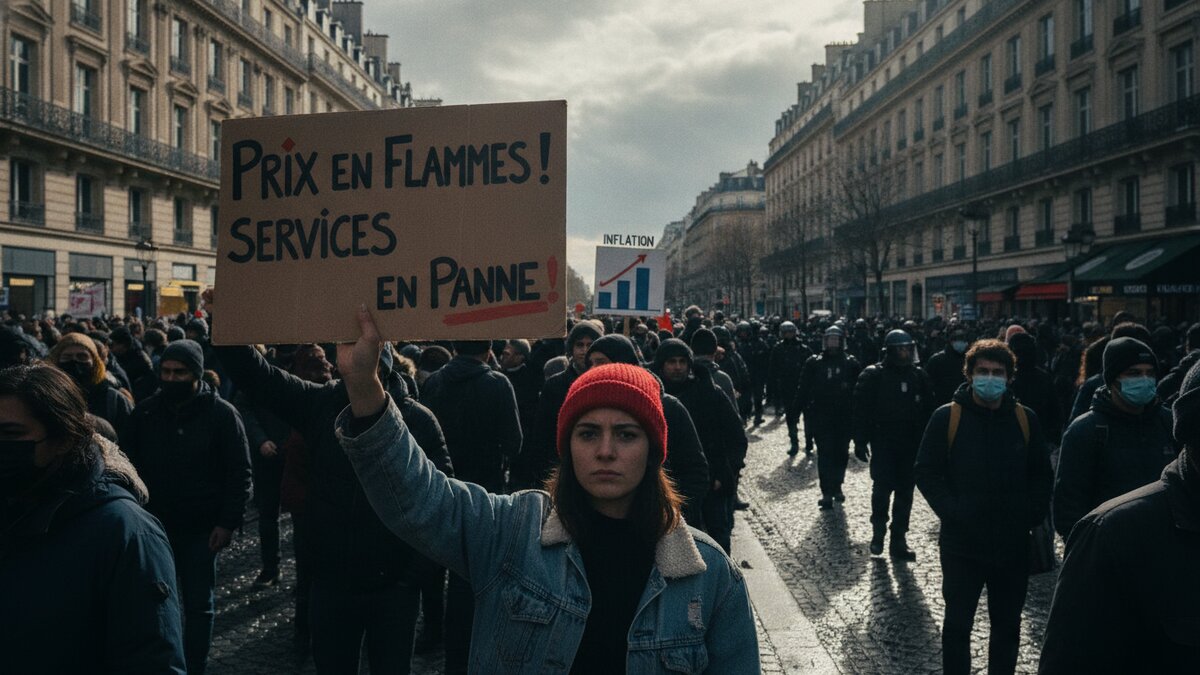
As students and workers take to the streets over rising costs and strained public services, France’s protests fuel wider anger about Europe’s economic direction. The demonstrations began with campus blockages and marches late last month, then drew broader participation by mid-October as high gasoline prices, persistent inflation and declining real wages sharpened frustration.
The unrest has put pressure on President Emmanuel Macron’s government as it confronts demands for public spending cuts alongside a worsening fiscal outlook. France’s state deficit is expected to reach 5.4 percent of GDP in 2026, the highest level in the eurozone, according to the report by Jacobin.
Students’ grievances include pressure on the education system. On October 26, the government made its first overtures, hinting at a possible replacement for the university selection platform Parcoursup, limits on classroom sizes and state support for building renovations.
Those proposals have not erased the broader discontent. The protests have also drawn attention to a violent police response that has alarmed protesters and observers in France and abroad, while Macron’s allies have sought to protect his pro-business tax cuts, which the Jacobin report identifies as a factor often left out of debate about the fiscal crisis.
Fuel costs deepen pressure on households
Energy prices have become a visible part of that pressure. Diesel in France hovered at around €2.36 per liter in October, or around $10 per gallon, according to the report. It links the price turbulence to global energy-market disruption following the latest war on Iran, launched by the United States and Israel, and to residual inflation after Europe’s efforts to reduce reliance on Russian oil and gas following Moscow’s 2022 invasion of Ukraine.
The price comparison with an earlier French revolt is stark. In November 2018, when the Yellow Vest protests began, gasoline cost €1.50 per liter, the report said.
For households, the significance is direct: higher fuel costs add to inflation and eat into purchasing power, while proposals to rein in deficits raise the prospect of cuts to public services. The report says France’s real wages have declined since 2019. Citing Le Monde, it notes cumulative inflation of 21.7 percent against an average salary increase of 18.7.
Macron argued that the loss of purchasing power stems from external shocks affecting the European Union. He made the case while traveling to Gulf states last week to negotiate short-term energy purchases. The Jacobin report presents that explanation alongside the domestic pressures facing protesters, including the cost of living and the condition of public services.
Discontent stretches beyond France
France’s demonstrations are part of a wider pattern of unrest. In Spain, protests over housing costs prompted Prime Minister Pedro Sánchez to call snap elections for late November. Youth protests have also disrupted cities in Italy, Belgium and Greece.
Some commentators have described the youth mobilization as a “Gen Z” revolt, linking it to economic insecurity, uncertainty over artificial intelligence and what they see as an inadequate political response to climate change. The grievances differ across countries, but the Jacobin report frames them as converging around a loss of confidence in improving living standards.
Economic pressure is also playing out against changes to Europe’s industrial position. The report says trade globalization that supported European growth from the 1990s through the 2010s is breaking down amid US tariffs under Donald Trump and competition from Chinese companies moving up the value chain. It adds that European firms are falling behind US and Chinese corporations in high technology and artificial intelligence.
Warnings have come from within the European Union’s policy establishment, too. Former Italian Premier Mario Draghi authored a report on the EU economy in September 2024, warning of a “slow agony” as weak investment in infrastructure, green technology and public services combines with low wages.
The Organisation for Economic Co-operation and Development expects eurozone GDP growth to level out between 0.8 and 1 percent in 2026, according to the report. France’s deficit forecast, meanwhile, stands at 5.4 percent of GDP.
Source: jacobin.com