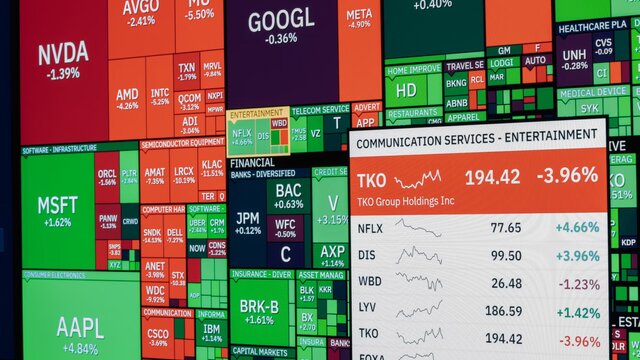
AI Stocks Lost $5 Trillion as Other Shares Gained
Major AI and chip stocks shed about $5 trillion in market value since Oct. 6, while 625 other large US stocks added about $1.3 trillion, according to Yahoo…

AI stocks just lost $5 trillion in market value since Oct. 6, while 625 other large US stocks added about $1.3 trillion, according to Yahoo Finance calculations published Sunday. Nvidia and Alphabet each shed roughly $835 billion in market value, and Intel lost nearly half its value in October.
The contrast widened even as the S&P 500 slipped during the week. Nine of its 11 sectors gained about 1% or more, a weekly breadth not seen since at least 1999, according to the calculations.
That split leaves investors weighing a sharp retreat in prominent technology shares against gains across much of the broader market. The semiconductor sector remains volatile, and analysts cited in the report disagree on whether the sell-off offers an opening or signals further risk.
What happened to semiconductor stocks?
The iShares Semiconductor ETF fell about 17% in October but remained up more than 50% this year. On Friday, it dropped as low as $460, below its $464 low from July 29, before closing at $472.
That recovery above the earlier low resembles what traders call a bear trap: prices break below a level, then rebound and catch investors positioned for more losses. The reversal has not erased the decline, but it has put the July price level back at the center of the debate.
Jeff Hirsch, editor of the Stock Trader’s Almanac, called the pattern “Octoberphobia” and said he bought during the sell-off. “The damage isn't as bad as the headlines are,” Hirsch said on Friday.
Hirsch pointed to a historical seasonal pattern. From the final October close in a midterm election year through the end of the following June, the S&P 500 rose in 19 of 19 periods since 1950, with a median gain of about 15%. Chip stocks were positive in eight of eight comparable cycles since 1994, with a median gain of about 22%.
Those historical results did not mean the path was smooth. Chip stocks fell another 11% or so before recovering in 2002 and 2018, and the eight-cycle record is a relatively small sample. Hirsch said his firm placed a new buy in the sector on Friday.
Which price levels are investors watching?
The levels in the semiconductor funds offer a concrete measure of the divide. Bulls would first need to reclaim about $524, the top of the previous week’s bounce, and then the early-October high near $596. If the July low gives way, the February-April range near $370 could come into play, about 21% below Friday’s close.
Michael Hartnett of BofA took a more cautious view, saying it was “risk-off until global rate hike ends.” He pointed to 42 central bank rate hikes worldwide over the past six months. The Federal Reserve held rates on Wednesday, while two officials voted to hike.
Hartnett’s key level for chip shares was $520 on the VanEck Semiconductor ETF, which closed Friday near $522. On the iShares fund, that level corresponds to about $469, just above the July low it narrowly held.
The consequences extend beyond a handful of high-profile AI names. The other 625 large US stocks in the tally gained about $1.3 trillion while the biggest AI and chip shares lost about $5 trillion, showing that the week’s weakness in the headline index did not reflect losses across every sector. For anyone following broad US market performance, the split matters: sector gains can coexist with steep losses in heavily watched technology stocks.
Hirsch said he would change his view if the S&P 500 decisively broke its mid-September low near 7,550, less than 1% below Friday’s close. The midterm vote is scheduled for Tuesday, followed by November, which the report identifies as the index’s best month of the year.