Indonesia’s Big Banks After the Market Crash: BCA, BRI and Mandiri Under the MSCI Cloud
Indonesia's index is down 41% this year. MSCI risk, politics, foreign selling, Q3 earnings and key chart levels for BCA, BRI and Mandiri shares.
Indonesia's three biggest banks are still making money. Their shares are trading as if they were not.
Bank Central Asia (BBCA) closed at 4,980 rupiah on Monday, November 2, Bank Rakyat Indonesia (BBRI) at 2,820 and Bank Mandiri (BMRI) at 3,700. Over the past month BCA has lost 19.4%, Mandiri 9.8% and BRI 9.6%, dragged down by a sell-off that handed the Jakarta Composite Index its worst October in a decade.
The question for investors is whether the damage is close to done. The answer depends less on the banks themselves than on a decision in New York, a set of reforms in Jakarta and the patience of foreign money.
A market that has lost two-fifths of its value
The Jakarta Composite Index (IHSG) closed at 5,096.83 on November 2, up 0.79% on a better-than-expected trade surplus. The bounce barely registers against the bigger picture: the index fell roughly 16.7% in October and, as of October 30, was down more than 41% since January.
Foreign investors have done most of the selling. Exchange data show net foreign outflows of about 124.7 trillion rupiah ($6.9 billion) from the regular market this year, including 13.9 trillion rupiah since mid-October. The rupiah has weakened alongside, closing near 18,137 per dollar at the end of October.
That matters for banks in particular. BCA, BRI and Mandiri are the market's most liquid and most widely held stocks among global funds. When money leaves Indonesia, they are sold first, whatever their earnings say.
The MSCI shock and the politics around it
The trigger came from MSCI, whose indexes guide trillions of dollars in passive investment. In mid-October the index provider opened a consultation on whether to reclassify Indonesia from an emerging market to a "standalone" market, citing the transparency of shareholder structures, free-float disclosure and suspected coordinated trading.
A downgrade would force some index-tracking funds to exit. Large, liquid names such as the banks would carry the heaviest share of that selling.
The issue quickly became political. On October 29, Hashim Djojohadikusumo, the president's special envoy for energy and climate and his brother, warned that the rupiah could slide toward 20,000 to 22,000 per dollar if MSCI's concerns were not addressed. He said the government would keep a close watch on capital-market regulators and urged business leaders not to "fry" stocks, local slang for pumping share prices.
Markets heard two messages at once: political will to clean up the market, and a senior figure openly discussing a far weaker currency. The second did little to calm nerves.
Regulators have started to act. The stock exchange is phasing in a 15% minimum free float, widening disclosure of shareholders above 1% and tightening trade surveillance. The Financial Services Authority (OJK) has imposed fines totalling 2.1 trillion rupiah over market manipulation and listing violations.
Two dates now loom. MSCI's index review announcement is due on November 11, while its final decision on Indonesia's market status is expected by June 30, 2027. Uncertainty may hang over the market well into next year.
A quiet tailwind from the index rebalancing
From November 2, the exchange removed 81 stocks with highly concentrated ownership from the IHSG calculation until January 29, 2027. One side effect has drawn little attention: the big banks now carry more weight. BCA's share of the index rose to 9% from 8.75%, and BRI's to 9% from 7.93%. Funds that track the index must hold more of both. It is a cushion, not a rescue.
Earnings: still growing, with caveats
BCA reported net profit of 45.2 trillion rupiah for the first nine months of 2026, up 4.2% from a year earlier. Loans grew 12.6% to 1,063 trillion rupiah and the non-performing loan ratio eased to 1.8%. The weak spot is margin: net interest margin narrowed to 5.4% from 5.8% as competition for deposits intensified. Single-digit profit growth is why the market no longer pays the premium it once did.
Mandiri grew fastest. Nine-month net profit rose 20.7% to 45.5 trillion rupiah, with 15.1 trillion earned in the third quarter alone, and management lifted its 2026 loan-growth target to 9% to 11%. Yet loans at risk climbed 93 basis points in the quarter to 6.76%, and net interest margin slipped to about 4.2%. Gross NPLs remain low at 1.02% with 235% coverage, but rising loans at risk tend to show up before bad debts do.
BRI posted first-half net profit of 31.2 trillion rupiah, up 17.5%, with loans up 16.2% to 1,646 trillion rupiah and NPLs down to 2.9%. Its third-quarter figures could not be verified from official sources at the time of publication; they will show whether the recovery in micro-lending is holding up as consumer demand slows.
On a rough JournalArta estimate, annualising earnings to date, BCA trades at about 10 times earnings, BRI at about 7 and Mandiri at about 6, well below their historical averages. Cheap, but cheap for a reason: until the MSCI risk clears, global investors are likely to demand a deeper discount for Indonesian assets.
What the charts say
All three stocks are in downtrends, trading below their 20-day moving averages, which in turn sit below their 50-day averages. Volatility is extreme, with average daily ranges of 5% to 6% of the share price. One shared signal stands out: trading volume on November 2 was roughly half the 20-day average, often a sign that selling pressure is fading, though not proof of a turn.
BBCA (4,980 rupiah)
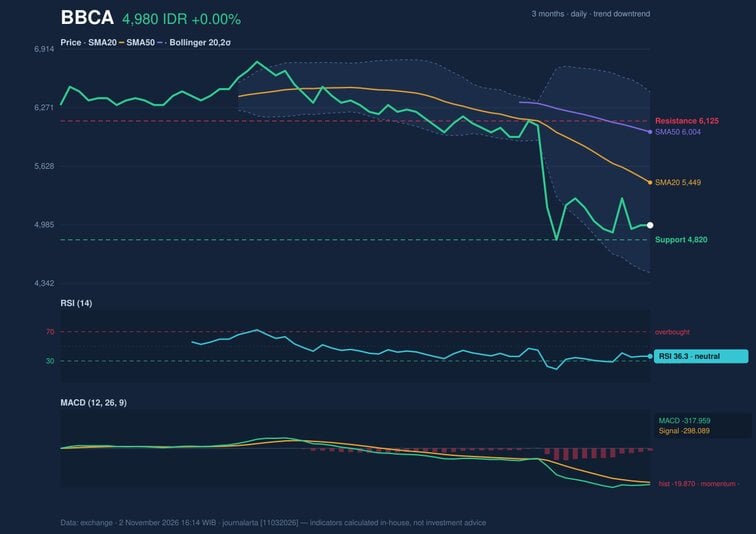
The most oversold of the three, sitting in the bottom 12% of its 20-day range with a 14-day RSI of 36. The MACD histogram is still negative and widening. Support sits at 4,820, then 4,740, the three-month low; the lower Bollinger band is near 4,460. Resistance is at the 20-day average around 5,450, then near 6,000.
BBRI (2,820 rupiah)
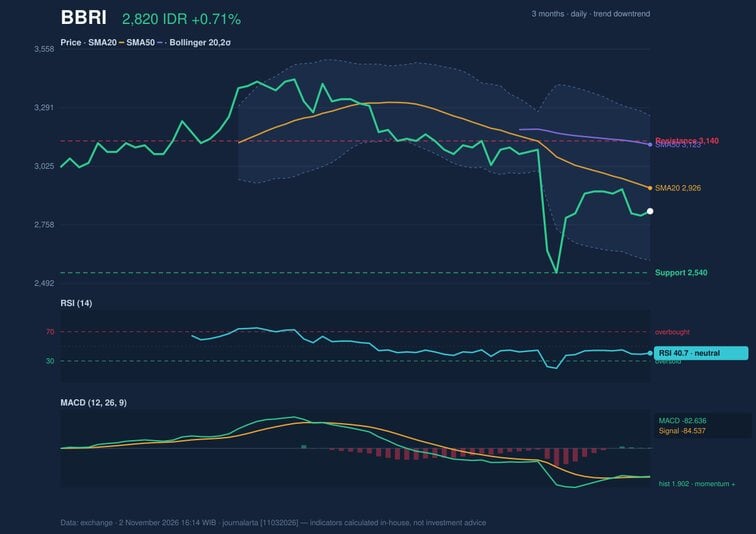
Mid-range with an RSI of 41, not yet oversold. The MACD histogram has just turned marginally positive, an early hint that downward momentum is slowing. Support at 2,540, then 2,460; resistance at 2,925, then 3,140.
BMRI (3,700 rupiah)
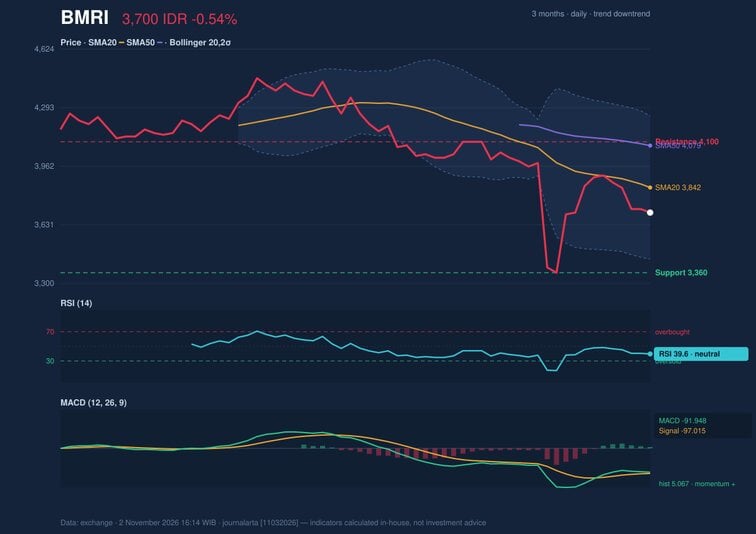
Mid-range after a 5.4% weekly drop, RSI 40. Its MACD histogram is positive and strengthening, the best momentum reading of the group. Support at 3,360, then 3,200; resistance at 3,840, then 4,080 to 4,100.
Three ways this could play out
A technical bounce before November 11. If the IHSG holds the 5,000 area and foreign selling slows, the banks could retrace toward their 20-day averages: about 5,450 for BCA, 2,925 for BRI and 3,840 for Mandiri. An index RSI below 30 and shrinking sell volume support this in the short term.
Further pressure. A fresh slide in the rupiah or a discouraging signal from MSCI would put support levels to the test. A break below 4,740 for BCA, 2,460 for BRI or 3,200 for Mandiri would remove the three-month floor and leave room for a deeper fall.
A structural recovery. A lasting turn needs more than a bounce: clarity from MSCI, governance reforms that hold up in practice and the return of foreign capital. If that comes, today's valuations offer the most upside. With MSCI's final ruling due by mid-2027, that is a story of months, not days.
What to watch
- November 11: MSCI's index review announcement.
- Daily foreign flows in BCA, BRI and Mandiri.
- The rupiah, which feeds directly into funding costs and borrower stress.
- BRI's third-quarter results and micro-loan quality.
- Further steps by OJK and the exchange on ownership transparency, the core of MSCI's objections.
Rarely has the gap between what Indonesia's big banks earn and what investors will pay for them been this wide. Whether it closes through a recovery in prices or a fall in profits may be decided on November 11 and in the months that follow.
Disclaimer: This article is for general information and analysis only and is not a recommendation to buy or sell any security. Prices and technical indicators are as of the November 2, 2026 close.