AI Preacher Goes Viral: Who’s Responsible for Its Teachings?
A TikTok AI preacher with millions of followers raises urgent questions about religious authority, sanad tradition, and who's accountable when a machine teaches Islam.
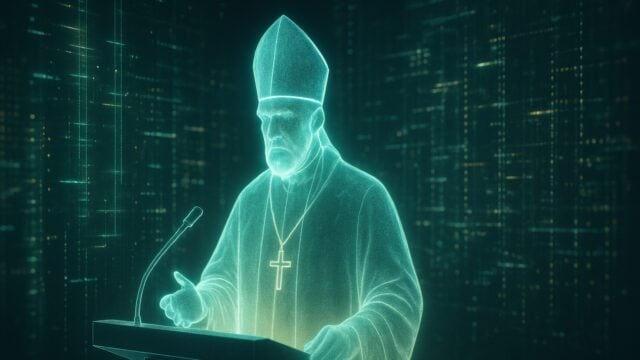
JAKARTA — Millions watched her preach. Her voice was gentle, her face convincing, and her words flowed like those of a real scholar. But there was no human behind that screen. Only an algorithm.
In recent days, social media has been buzzing over the revelation that an "ustazah" with millions of TikTok followers was entirely created by artificial intelligence. Not a re-upload. Not a parody account. Pure machine.
This story may soon be buried by the next viral wave. But the question it leaves behind won't disappear so easily: when people can no longer tell a real religious teacher from a digital replica built by a machine, what happens to trust itself?
Sanad, Knowledge, and Moral Accountability
For centuries, Islamic scholarship has stood on a foundation that cannot simply be replaced — human-to-human connection. A student learns directly from a teacher. That teacher received knowledge from an older mentor. And so on, forming a chain of transmission known as sanad.
In Islam, religious knowledge is not judged solely by its content. Equally important is who delivers it, what their daily character looks like, and where their learning comes from. Religious authority is not something earned overnight. It is built through years of study, lived example, and the moral responsibility that accompanies every word taught.
AI has none of that. It can quote Quranic verses fluently. It can cite hadith, explain scholarly opinions, and even display an expression that looks devout. But it carries no amanah — no moral trust. There is no fear of God. No consequence if it gets something wrong.
When Appearance Beats Depth
This is the real shift happening right now. People used to trust someone because of the depth of their knowledge. Increasingly, many trust something simply because it looks convincing.
Authority is migrating — away from scholarly tradition and toward algorithmic reach. Digital popularity now competes with credibility built over decades in pesantren and study circles.
This isn't a problem unique to the world of Islamic preaching. Across many fields, people have grown accustomed to consuming information without first asking who stands behind it. Faces can be fabricated. Voices can be cloned. In seconds, AI can produce thousands of sermon clips with visual quality almost indistinguishable from a real human.
The hardest challenge is no longer spotting what's fake. It's ensuring that whatever knowledge we receive can be held accountable — by whoever, or whatever, delivers it.
Tabayyun in the Age of Deepfakes
Islam already has an answer for this. The Quran instructs believers to practice tabayyun — verification — whenever they receive information. This is not merely social etiquette. It is the epistemological backbone of Islamic thought: every piece of knowledge must be tested before it is trusted.
In the AI era, tabayyun takes on new weight. What needs verifying is not just the content of a sermon, but its source, how it was produced, and who bears responsibility for it.
Ulul Albab, Chair of ICMI East Java for the 2021–2026 period, argues the issue runs far deeper than the mere existence of an AI ustazah. "What matters far more is this question: what happens if one day humans can no longer distinguish between a real religious teacher and a digital representation created by a machine?"
That's not a rhetorical question. Deepfake technology and generative AI have reached a point where the visual gap between human and machine is nearly invisible. In a religious context, the consequences can be severe — from the spread of fabricated fatwas, to the manipulation of belief, to the exploitation of vulnerable communities who place deep trust in whoever stands at the pulpit.
AI Is Not the Enemy — But It Is Not a Teacher
One thing deserves to be said plainly: none of this means Muslims should treat AI as an adversary. Not at all.
The technology holds enormous promise for Islamic scholarship — translating classical texts, making Quranic learning more accessible, widening access to Islamic literature previously limited to a narrow few, and supporting research that once took years to complete. The potential benefits are real and significant.
But the limits are equally real. AI can process data, but has no moral consciousness. It can construct beautiful sentences, but has no spiritual experience. It can imitate the way humans speak, but it does not know the fear of God.
A teacher carries the weight of amanah over every piece of knowledge they share. If they err, there is accountability — in this world and before God. AI bears none of that. It simply cannot.
The Future of Dakwah Is Not an Either/Or Choice
The future of Islamic preaching is not about choosing between humans and machines. That framing is wrong from the start.
What's true is this: AI should strengthen the role of scholars, not replace them. It should extend the reach of knowledge, not obscure its origins. It should help people learn more easily, not erode a scholarly tradition passed down across more than fourteen centuries.
Technology is always neutral in the hands of its creators. What determines its impact are the values guiding its use. In the context of Islamic preaching, those values are already clear — honesty, trust, and responsibility for every word spoken.
The AI ustazah on TikTok may be a small event in the long arc of technological history. But it has opened a crack through which a far bigger question slips in — now that machines can preach more convincingly than many humans, are we, as a community, becoming wiser about who we choose to learn our religion from?
That answer lives in no algorithm. It lives with us.
3-Point Summary:
- A TikTok "ustazah" with millions of followers turned out to be entirely AI-generated — sparking a crisis of trust around religious authority in digital spaces.
- The Islamic sanad tradition holds that religious knowledge cannot be separated from who delivers it and the moral responsibility they carry — something AI is fundamentally unable to fulfill.
- AI can be a powerful tool to support preaching and scholarship, but it cannot replace the role of a human teacher who bears moral accountability for what they teach.
Quick FAQ:
Can AI-generated sermons be used as religious references?
They can be a starting point, but must be verified against primary sources (Quran, hadith, classical texts) or confirmed with a scholar whose chain of knowledge is traceable.
How do you tell AI preaching content from real human content?
Check who manages the account, whether a real identifiable person takes responsibility for it, and whether there is a verifiable scholarly background. If none of that exists, skepticism is warranted.
Is AI forbidden in Islamic outreach?
There is no prohibition on using AI as a tool — for translation, research, or content distribution. The problem arises when AI is presented as an independent religious authority with no accountable human behind it.