NASA Finds Donaldjohanson Asteroid Spinning Irregularly
NASA’s Lucy mission reveals the Donaldjohanson asteroid’s odd spin, peanut shape, and clues to ancient water and collisions.
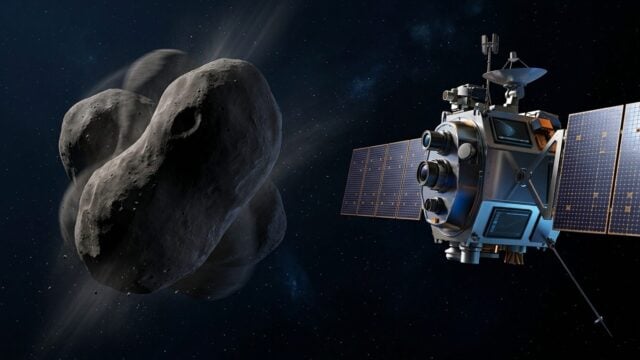
JAKARTA — Donaldjohanson asteroid turns out to spin nothing like a normal space rock. The small main-belt object, photographed by NASA’s Lucy spacecraft, wobbles like a tilted top, has a peanut-like double-lobed shape, and preserves clues about an ancient collision, the gentle push of sunlight, and traces of liquid water that once reached its surface.
The finding comes from Lucy’s closest approach on April 20, 2025, when the spacecraft passed about 650 miles from Donaldjohanson. Results reported by researchers in Science on June 18 suggest the asteroid’s history is far more complex than astronomers first inferred from Earth-based observations.
Lucy reveals Donaldjohanson asteroid spinning irregularly
For years, observations from Earth only showed a repeating brightness pattern. From that, astronomers thought Donaldjohanson was an elongated body rotating once every 10.5 Earth days. That guess was not entirely wrong. But it was incomplete.
Once Lucy moved in close, its cameras and science instruments told a different story. Donaldjohanson does not just tumble end-over-end every 10.5 days. It also rocks back and forth around its long axis every 26.5 days. The motion looks like a top that has lost its balance. Not stable. Still orderly.
That is what makes scientists pay attention. A rotation pattern like this offers clues about an object’s internal history and the tiny mechanical forces acting on it over millions of years. From one asteroid, researchers can read signs of impacts, changes in spin, and the slow shifting of surface material.
Double-lobed shape and evidence of an old collision
Lucy also captured Donaldjohanson’s shape in striking detail. The asteroid is not a single chunk, but two joined pieces meeting at a narrow neck. Scientists call this a bilobate shape. It usually forms when two fragments from a collision drift together and merge through their own gravity.
Researchers estimate Donaldjohanson formed about 155 million years ago. That makes it young on solar-system timescales, especially compared with Bennu and Ryugu, two asteroids visited by sample-return missions and thought to be 1 billion to 2 billion years old.
That age gap matters. Donaldjohanson offers a look at a “younger” asteroid that still carries a long record of change. Its surface shows craters, ridges, and areas that appear softened, as if loose material once flowed slowly downslope.
Sunlight also changes the Donaldjohanson asteroid’s spin
That change did not happen on its own. The researchers say the YORP effect, a tiny push caused by sunlight, likely altered Donaldjohanson’s spin little by little. As the asteroid’s surface warms, it reradiates that energy as infrared light. The recoil is extremely small, but it keeps acting over millions of years.
Because Donaldjohanson is not symmetrical, those tiny pushes do not cancel out. Its rotation slowly shifts. The team estimates the asteroid once spun at least 10 times faster when it first formed. Over the last 20 million to 60 million years, the spin has slowed.
As rotation slows, the balance between centrifugal force and gravity changes. Loose rocks and dust move downhill. Craters that once looked sharp become softer. The surface changes, slowly, without a single big explosion.
The YORP effect is not new. Bennu and Ryugu are also thought to have undergone similar changes, though the direction of the effect can differ. Bennu rotates about once every four hours, while Ryugu spins once every seven. Both likely moved much more slowly before YORP sped them up.
Ancient water traces on the surface
Even more intriguing, Lucy’s instruments detected iron-rich clay minerals on Donaldjohanson’s surface. Minerals like these form only when liquid water is present. That means the asteroid once came into contact with water. Not for long, according to the researchers. Just briefly.
The clue lies in the mineral makeup. If water flows for a long time, the iron in clay tends to be replaced by other elements, such as magnesium. On Donaldjohanson, the clay is still rich in iron. That suggests water was there, but did not stay long.
Bennu and Ryugu tell a different story. Both contain magnesium-rich clay, which points to longer exposure to water, possibly for millions of years, when they were still part of larger parent bodies. The comparison suggests these bodies formed in different places or at different times.
For general readers, that may sound far removed from daily life. It is not. From a small asteroid, scientists can piece together how the ingredients of planets moved, broke apart, reunited, and stored records of water and heat in different corners of the solar system.
Practice run before the Jupiter Trojan mission
The flyby of Donaldjohanson was not just a quick visit. It also served as a dress rehearsal before Lucy heads toward the Jupiter Trojans, with its first target, Eurybates, scheduled for August 12, 2027. The team used the encounter to test the spacecraft’s systems and operational procedures before the mission’s more ambitious leg.
Simone Marchi, Lucy’s deputy principal investigator and lead author of the study at the Southwest Research Institute in Boulder, Colorado, said comparisons across asteroids help scientists reconstruct the solar system’s origin. “Every small difference is another clue in the story of our origins,” he said.
That line fits the Lucy findings well. Donaldjohanson is small. Still, its peanut shape, unstable spin, and water-bearing minerals open a much larger conversation about the solar system’s past. One short flyby. Many new answers.