NASA Says Donaldjohanson Asteroid Spins in an Unusual Way
NASA says the Donaldjohanson asteroid spins unusually, revealing ancient impacts and clues that liquid water once existed briefly.
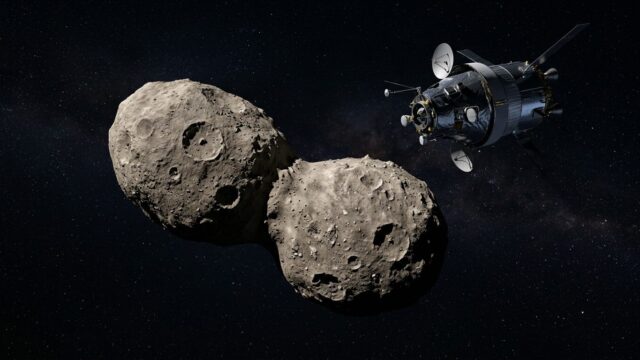
JAKARTA — the Donaldjohanson asteroid turns out to spin unlike most asteroids. NASA's Lucy spacecraft found the peanut-shaped rock wobbling as it rotates, carrying signs of an ancient collision and traces that it once came into contact with liquid water.
The discovery came from Lucy's close pass on April 20, 2025, when the spacecraft flew about 650 miles from Donaldjohanson on its way to the Jupiter Trojan asteroid group. The first close-up observations gave scientists a far more detailed view than Earth-based telescopes could, from its double-lobed shape and pitted surface to its complicated rotation pattern.
Researchers reported the early findings on June 18 in the journal Science. For the mission team, this flyby was not just a warm-up before Lucy meets its next Trojan asteroid on August 12, 2027, when it approaches Eurybates. But the data from Donaldjohanson delivered a major bonus: a new comparison point for understanding how asteroids formed in the solar system.
The Donaldjohanson asteroid and its unusual rotation
Until now, observations from Earth showed a repeating brightness pattern every 10.5 days. From that, astronomers assumed Donaldjohanson was simply elongated and rotating in a straightforward way. Lucy proved otherwise.
With close-range measurements, scientists saw that the asteroid does not rotate like a stable top on a single axis. Donaldjohanson behaves more like a wobbling top. It spins end over end every 10.5 days, while rocking back and forth around its long axis every 26.5 days.
That behavior matters. An unstable rotation can offer clues about internal composition, impact history, and how the surface changes over time. For scientists, small details like that often become the key.
A peanut shape and traces of ancient collisions
Lucy also showed that Donaldjohanson is not one solid lump. The body consists of two lobes connected by a narrow neck. Researchers call that kind of form bilobate.
That shape likely formed from two fragments created in a major collision that slowly moved closer together and then merged under their own gravity. The asteroid is estimated to have formed about 155 million years ago. In solar system terms, that is still young. Very young.
After forming, Donaldjohanson is believed to have spun at least 10 times faster than it does now. But over the past 20 million to 60 million years, the rotation slowed gradually. As the spin slowed, the balance between centrifugal force and gravity shifted. Loose rocks and surface debris slid down slopes, helping shape the smoother-looking terrain in some areas.
The likely cause of that slowdown is the YORP effect, a very small push created by sunlight. Sunlight heats the asteroid's surface, then the surface re-emits that energy as infrared radiation. The push is tiny. But it acts continuously, for millions of years without stopping. Because Donaldjohanson is not symmetric, those small pushes do not cancel out and slowly steer the asteroid's rotation in a different direction.
The Donaldjohanson asteroid and signs of liquid water
As Lucy flew by at a speed of about 30,000 mph, its instruments detected iron-rich clay minerals on Donaldjohanson's surface. That is an important clue. Minerals like that can form only if liquid water was present, even if only for a short time.
Researchers say the water exposure did not last long. If water had remained for a longer period, the iron in the clay minerals would usually have been replaced by other elements, such as magnesium. Because the clay on Donaldjohanson remains rich in iron, scientists conclude that liquid water was once present, but only briefly.
That is different from Bennu and Ryugu. Both contain magnesium-rich clays, a sign that they likely experienced water exposure for longer periods, possibly for millions of years while still part of a larger parent body.
The comparison matters because it shows that small bodies in the solar system did not all follow the same path. Some formed in different environments, at different times, and later migrated to their current locations. Donaldjohanson has remained in the main asteroid belt since it formed, while Bennu and Ryugu later shifted into near-Earth orbits.
Why the finding matters for scientists
Lucy is headed toward the Jupiter Trojans, but Donaldjohanson offered a real-world rehearsal for the spacecraft and mission operations. In the process, scientists gained a new object to study at a resolution never available before.
“It is important for scientists to compare Donaldjohanson with asteroids like Bennu and Ryugu, which look similar, because every small difference is another clue about the story of our origins,” said Simone Marchi, Lucy's deputy principal investigator and lead author of the study, based at the Southwest Research Institute in Boulder, Colorado.
That kind of comparison helps scientists trace how small bodies in the solar system formed, changed, and stored water. From there, the larger picture of the ingredients that built planets starts to come into focus. Not just about asteroids. About the early cosmic environment that eventually produced Earth, too.
Lucy still has many targets ahead. But for now, one fact is clear: the Donaldjohanson asteroid holds a much more complicated history than the peanut-like shape seen in its images suggests. And the most striking number remains the same — the closest approach came within just 650 miles of NASA's spacecraft.