Microsoft off-grid project in Texas signals AI power demand
Microsoft off-grid project in Texas shows AI power demand is still rising, with Chevron and GE Vernova at the center.
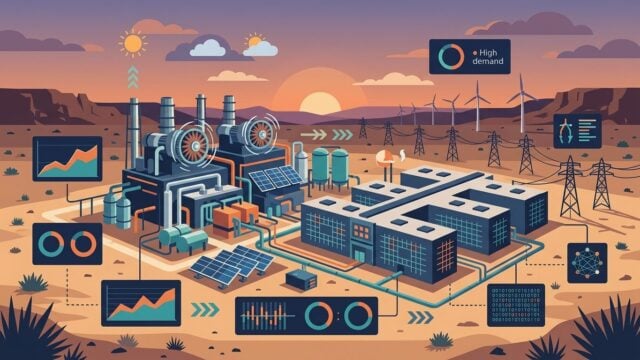
JAKARTA — Microsoft off-grid project in Texas is giving investors a fresh read on how much power the AI boom still needs. Chevron and Microsoft have signed a long-term energy deal for a West Texas data center that will draw electricity from a plant outside the public grid, with GE Vernova supplying much of the turbine equipment.
The project, known as Project Kilby, is planned for Reeves County in West Texas and is expected to come online in 2028. CNBC reported that the facility could generate about 2.7 gigawatts, a scale often compared with the electricity needs of roughly 2 million households.
Why the Microsoft off-grid project matters
Data centers have traditionally leaned on the public grid. That model is getting harder to use at the pace AI companies want. Training models and running cloud services require huge, steady power loads, and local grids can be slow to expand.
This is where the off-grid model changes the math. A developer can place generation beside the data center, feed the site directly, and avoid waiting for transmission upgrades or utility queues. It is faster. It is also expensive. But for hyperscale tech firms, time matters almost as much as cost.
In this case, the energy source will be natural gas. Chevron is planning the power plant, and GE Vernova will provide most of the large gas turbines. Caterpillar is expected to supply the rest, according to the reporting cited in the market notes. The setup gives Microsoft a dedicated power path for a major AI buildout without depending fully on local grid capacity.
GE Vernova gets a boost from demand
For GE Vernova, the project is more than one contract. It is another sign that the market for large turbines remains tight. The company has been riding a heavy order backlog as utilities, industrial buyers and tech firms all chase equipment that can support rising electricity demand.
Wells Fargo said the project supports its bullish view on the company. In a Tuesday note, the bank said skeptics are getting louder, but its core stance has not changed. “We expect GEV to continue to work as long as the company maintains its beat and raise momentum,” the analysts wrote.
The bank kept an equal-weight rating, which it described as buy-equivalent in the note, and set a $1,259 target price. That still implied about 20% upside from Tuesday’s closing level. Even so, GE Vernova shares fell more than 7% that day, dragged down by broader pressure across tech and chip stocks.
A short line explains the mood. Demand is still there. Supply is not.
AI power demand is reshaping the equipment market
Wells Fargo said GE Vernova remains sold out on large turbines through at least 2028, with very limited room in 2029 and 2030. That matters because tight supply gives manufacturers more pricing power. When buyers are competing for the same heavy equipment, prices tend to move up rather than down.
Bernstein reached a similar conclusion. Analyst Sunaina Ocalan called Project Kilby “another proof of strong power demand” driven by AI. She said the higher demand is improving GE Vernova’s pricing power and widening margins.
That picture is important well beyond Wall Street. AI services may look digital to users, but they depend on a very physical chain: land, cooling, generators, turbines and fuel. When one project alone can consume power on the scale of millions of homes, the pressure on infrastructure becomes obvious. Consumers may not see the plant, but they will feel the effects in how fast companies can expand cloud services, launch new products and secure computing capacity.
Why Chevron and Microsoft chose this route
Jeff Gustavson, president of Chevron New Energies, told CNBC the arrangement does not compete with local electric customers because the project does not rely on the public grid. “There is no competition with local electric customers,” he said. Gustavson added that excess power could later be sent to the grid to help stabilize it.
That flexibility is part of the appeal. A dedicated plant can serve the data center directly, while any surplus electricity may still help the wider system. But the trade-off is clear: this kind of build requires major capital, specialized permits and years of planning.
Chevron, Microsoft and GE Vernova have all been tied to the project since it was announced in January 2025. The long timeline underlines how difficult it is to bring AI infrastructure online at scale. The software may move fast. The power infrastructure does not.
Microsoft is not expected to start receiving electricity from the facility until 2028. That delay gives the market a long runway to watch whether more tech companies follow the same path. Analysts at Club, including Jeff Marks, said other hyperscalers often move once one company secures supply, since no one wants to be left short of power when AI demand keeps climbing.
For now, the clearest fact is the size of the bet: Project Kilby is designed around 2.7 gigawatts, and the first electrons are still years away.