Warehouse Automation Reshapes Logistics Operations
Warehouse automation is changing logistics with AI, digital twins, and robots that improve inventory accuracy and speed up decisions.
JAKARTA — Warehouse automation is changing how logistics companies work, from counting stock to responding to shipping disruptions. The push comes from two directions at once: demand is rising, and labor is tight.
A survey by the UK Warehousing Association found that only 13 percent of employers were not struggling to hire staff. More than half of companies also expect critical skill shortages in the next few years. At the same time, McKinsey estimates warehouse automation adoption is growing by more than 10 percent a year as operators chase efficiency, resilience, and tighter cost control.
Warehouse automation is shifting toward autonomous systems
What is changing is not just robotic arms or conveyor belts. The biggest shift is happening in autonomous systems that keep capturing operational data, process it immediately, and help managers make faster decisions. TechRadar Pro says this is no longer just about using isolated automated tools.
In traditional warehouses, automation usually works in neat, fixed, and predictable environments. The problem is, today’s warehouses are the opposite. Layouts change, product types keep multiplying, and order volumes swing with seasons, promotions, or supply chain disruptions.
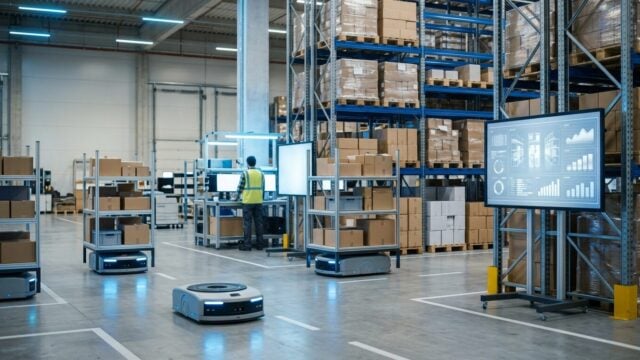
At this point, artificial intelligence, sensors, and mobile robots take on a different role. They do not just replace physical labor. They read conditions on the floor and signal trouble when bottlenecks appear. The warehouse does not wait for problems to grow. It spots them earlier.
Digital twin brings sharper stock visibility
One of the costliest problems in a warehouse is visibility. Many decisions still depend on periodic stock checks, incomplete system data, or manual inspections that take time. Small errors can pile up into big costs.
A digital twin is increasingly being used to close that gap. By combining continuously collected data with a virtual model of the warehouse, operators get a real-time picture of inventory, storage, and item movement. Misplaced goods can be flagged quickly. Congested areas can be fixed sooner.
Deloitte says better inventory visibility can reduce inefficiency and improve order fulfillment accuracy, especially in large distribution centers. For workers and managers, that lands very close to day-to-day pain: picking the wrong item, stock showing up as available when it is not, or safety stock growing for no clear reason.
If stock accuracy is poor, the damage spreads. Orders run late. Costs rise. Customers get frustrated. The warehouse becomes less efficient, and the company covers the gap with more labor and thicker buffer inventory.
Autonomous mobile robots are easier to adopt
Autonomy is also pushing a more flexible work model. Autonomous mobile robots, for example, can operate in existing warehouses without major infrastructure changes. That makes adoption more realistic for companies that do not have the budget to build new facilities from scratch.
For many operators, that is the appeal. They do not have to tear out everything already running. Robots and software can be added step by step, starting with the areas that clog up most often: material movement, stock checks, or monitoring unused space.
McKinsey says the combination of advanced analytics and automation can lift warehouse productivity significantly when deployed well. The logic is simple. When data arrives faster, decisions follow faster. When decisions are faster, disruptions are easier to contain.
That matters because growth usually brings new complexity. Higher volume almost always forces companies to add people, supervision, and manual processes. Autonomous systems try to break that pattern. Operations can scale up without a matching jump in manual work.
Worker roles shift, not disappear
Warehouse automation is often seen as a threat to workers. Yet the direction described in recent research is more complicated than that. Repetitive and physical tasks are indeed being handed over to machines. But people are still needed for oversight, exception handling, and process improvement.
That means human contribution is shifting. Not disappearing. In many facilities, humans and machines already work side by side: robots handle movement, while staff review anomalies, solve non-standard cases, and look for ways to improve the workflow.
Gartner even predicts that by 2030, half of new warehouses in advanced markets will be designed as human-optional facilities, supported by robotics and digital twins. But that does not mean warehouses without people. It means systems are built so human decisions are more accurate because they are backed by fresher data.
“This is a shift toward systems that can support human decision-making with more timely data,” Gartner said in its projection.
Workplace safety gets a lift
Another issue that matters is safety. Warehousing remains a high-risk work environment. Industry data cited by TechRadar Pro says the transportation and storage sector, which includes warehouses and distribution, records above-average nonfatal injury rates and around 38,000 workplace injuries a year.
Automation can help reduce manual contact with heavy and repetitive tasks. When robots take over some goods movement and systems warn about congestion or crowded spots, the risk of incidents can be lowered. Not eliminated. But reduced.
For companies in Indonesia, the lesson is relevant. E-commerce distribution centers, retail warehouses, and food logistics facilities face the same kind of pressure: orders must move fast, stock must stay accurate, and costs have to stay in check. In a market like this, warehouses that are slow to read data will fall behind.
Looking ahead, the biggest value does not lie in the robots alone. What will matter most is a company’s ability to connect automation, artificial intelligence, and real-time operational intelligence into one system. A warehouse that can track stock continuously, spot inefficiencies, and respond to changing conditions will be better prepared for the next disruption.
The logistics race is not over. And the winner is likely to be not the one with the most machines, but the one that turns operational data into action the fastest.
Quick summary
1. Warehouse automation is moving from isolated tools to autonomous systems that read data and help make decisions in real time.
2. Digital twins and autonomous mobile robots improve stock visibility, make operations more flexible, and help control costs.
3. Worker roles are not disappearing, but shifting toward oversight, exception handling, and process improvement.
FAQ: Does warehouse automation mean no workers? No. The main direction is human-machine collaboration. What is the fastest benefit? Better inventory accuracy and faster responses to disruptions.
In the next few years, the most competitive warehouses will likely be the ones that read their data best. That is where the next contest begins.