Zelenskyy Moves to Replace Ukraine’s Top General in Latest Military Shake-Up
President Volodymyr Zelenskyy has decided to replace Ukraine’s top general, Oleksandr Syrskyi, in the biggest military shake-up in Kyiv since 2024. The move ...
President Volodymyr Zelenskyy has decided to replace Ukraine’s top general, Oleksandr Syrskyi, in the biggest military shake-up in Kyiv since 2024. The move elevates 43-year-old Mykhailo Drapatyi, a sign of a generational shift at the top of Ukraine’s wartime command.
The change, announced on Tuesday in Kyiv, comes after days of political tension and public protest over earlier leadership changes in the defence establishment. It puts fresh pressure on Zelenskyy to show that he can keep the military command united while war with Russia grinds on.
A swift change at the top
Zelenskyy’s decision to replace Syrskyi lands at a sensitive moment. Ukraine’s military leadership has been under scrutiny for months, and this latest move marks the most significant reshuffle since last year. By turning to Drapatyi, Zelenskyy is reaching for a younger figure who has built a reputation inside the armed forces as part of a new generation.
That generational shift matters in Kyiv. Ukraine has been fighting a full-scale war for well over two years, and the strain on commanders is visible. Leadership changes at this level do more than shuffle names. They affect battlefield coordination, morale, and the political balance around the presidency itself.
For Zelenskyy, the calculus is delicate. He needs a command structure that can fight effectively and present unity to the public. He also needs to show that changes at the top are not signs of drift. They are being cast, instead, as a reset.
Protests and political backlash
The shake-up follows six days of protests after the ouster of Ukraine’s defence minister, Mykhailo Fedorov, last week. Zelenskyy removed him after citing what he described as an irreconcilable feud between the minister and Syrskyi, the commander-in-chief of the armed forces. That dispute exposed deep friction inside Ukraine’s wartime leadership.
Zelenskyy acknowledged the problem publicly. “I wanted unity very much. The sides did not achieve it. And that isn’t just their problem, but mine as well,” he told journalists in Kyiv last week. “And in such a situation, the way out is either one side or the other, because without me they don’t sit down together.”
That admission carried weight. It framed the dispute not as a narrow personnel clash, but as a failure of coordination at the highest level of government. And it gave the protests a clear target: a leadership team seen by many Ukrainians as divided at a time when the country can ill afford it.
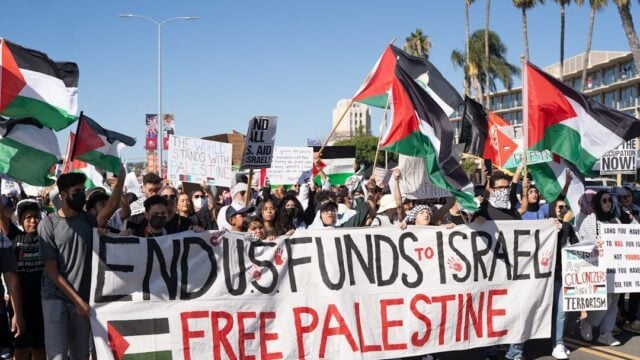
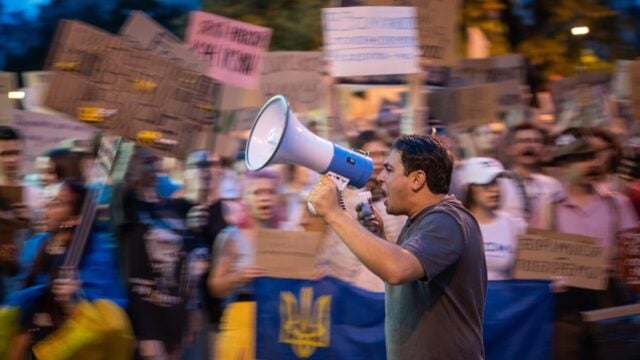
There was broad pushback across Ukrainian society over Fedorov’s dismissal. Protesters gathered in cities across the country, carrying signs demanding that he be reinstated and that Syrskyi be removed. The public anger was especially sharp among younger Ukrainians.
Why Fedorov’s dismissal stung
Fedorov, 35, had become a familiar face in Ukraine for a different reason. Before entering government, he was a tech entrepreneur. In office, he won support for ambitious technological reforms and for efforts to root out corruption in the military. That profile made him popular with younger Ukrainians who wanted a faster, cleaner state during wartime.
His removal did not just trigger a political row. It touched a nerve. In a country under attack, technology has become part of the national effort — from battlefield communications to public services that keep the state running. So when a reform-minded figure is pushed out, people read it as more than an internal personnel adjustment. They see a fight over the direction of the war state itself.
The protests showed that wartime loyalty in Ukraine is not automatic. Citizens may rally behind the country, but they still want results and accountability from those running the defence apparatus. That tension now sits behind the leadership change at the top of the armed forces.
Drapatyi steps into a harder job
Drapatyi’s promotion places him at the centre of those expectations. At 43, he is younger than the man he is set to replace, and that age gap fits the broader message coming out of Kyiv: a military leadership that looks less like the old guard and more like the wartime Ukraine that has emerged since Russia’s full-scale invasion.
But youth alone will not solve the problem. The new top commander inherits an armed forces under immense pressure, and he will be judged quickly on whether he can rebuild trust inside the chain of command. The job also carries a political edge. Every major battlefield decision will now sit within a wider story about reform, loyalty and the president’s grip on his team.
For Zelenskyy, the stakes are plain. He is not simply swapping one senior officer for another. He is trying to steady a system that has been jolted by internal feuding and public anger. The question now is whether this new appointment calms the pressure or opens another round of scrutiny over how Ukraine’s military is being led.
The next test will come from the field, not the podium. And the message from Kyiv is already clear: the president wants a different kind of command at the top, one that can hold together when everything else is under strain.
“I wanted unity very much,” Zelenskyy said. “The sides did not achieve it.”