Yayoi Kusama Dies at 97, Leaves Infinity Rooms Legacy
The Japanese artist behind the Infinity Mirror Rooms and polka-dot works, has died at 97 in Tokyo, according to a statement on her official website.
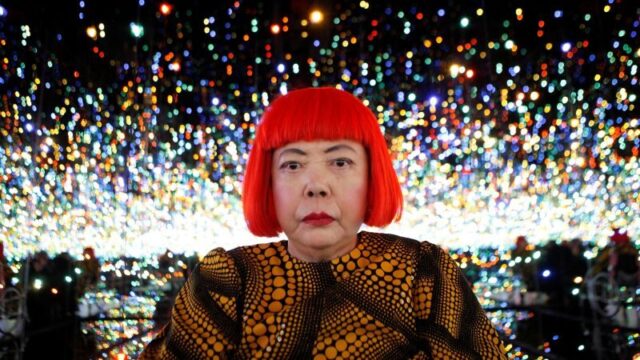
TOKYO — yayoi kusama, one of the world’s best-known and best-selling artists, has died at age 97, according to a statement on her official website. The statement said she died at a hospital in Tokyo on August 14 and was posted on Thursday.
Her death closes a career that turned hallucinations, trauma and repetition into a global visual language. Kusama’s Infinity Mirror Rooms drew millions of visitors, while her pumpkin sculptures and polka-dot paintings brought in millions of dollars at auction.
From childhood visions to global fame
Kusama was born in 1929 into a dysfunctional and abusive household, and spent much of her childhood in a military factory sewing parachutes for Japan’s imperial army during World War II, CNN reported. By then, she was already experiencing vivid hallucinations that filled her world with polka dots.
Those early visions became the core of her art. She worked with abstraction and repeated dot patterns from the start, developing the “Infinity Nets” paintings that later helped define her name in contemporary art.
She had little formal training and little apparent interest in Japanese art traditions. After briefly studying the modernist nihonga style in Kyoto, she chose a path that pushed her far beyond it.
Life in postwar Japan frustrated her, and a letter exchange with American artist Georgia O’Keeffe helped push her toward the United States. Kusama moved to America in the late 1950s, arriving first in Seattle before relocating to New York as the pop art movement was taking shape.
There, she built a reputation by flooding the city’s abstract expressionist world with dots, flowers and phallic protrusions. It was a sharp break from the expected. And it worked.
Why her work mattered
Kusama’s reach widened in later years because her installations were made for the camera as much as the gallery. Her Infinity Mirror Rooms, built with mirrors, lights and reflective surfaces, created the feeling of endless space and became a major draw for visitors.
That mattered beyond the art market. Her work helped museum attendance, shaped social media culture around exhibition photos and gave a new generation an easy entry point into avant-garde art. The appeal was immediate. The message was not simple.
Her company, Yayoi Kusama Inc, said in a statement that she pursued “an internationally acclaimed career as a pioneering avant garde artist whose creative practice encompassed visual art, performance, fiction, and poetry.” It added: “She continued to paint until her final days, never setting aside her brush, and continued exploration of forever love and eternal soul.”
The statement also said, “We will carry forward Kusama’s wishes and, through art, continue to bring hope and strength for the future to people around the world.”
That leaves museums, collectors and visitors facing the absence of a figure who remained commercially powerful and widely recognized into her late years. Kusama’s 2024 show in Australia was described by The Guardian as the most popular exhibition in the country’s history, a sign of how far her influence had traveled.
Even after decades in and out of obscurity, she stayed visible. She stayed active. And now the last confirmed detail is the one her own company shared on Thursday: Kusama died in Tokyo on August 14.