Experts Warn of Rising Risks from Indonesia’s Mount Semeru and Merapi
Geophysics experts warn Mount Semeru and Merapi pose greater threats than Anak Krakatau due to their proximity to dense population centers in Java.
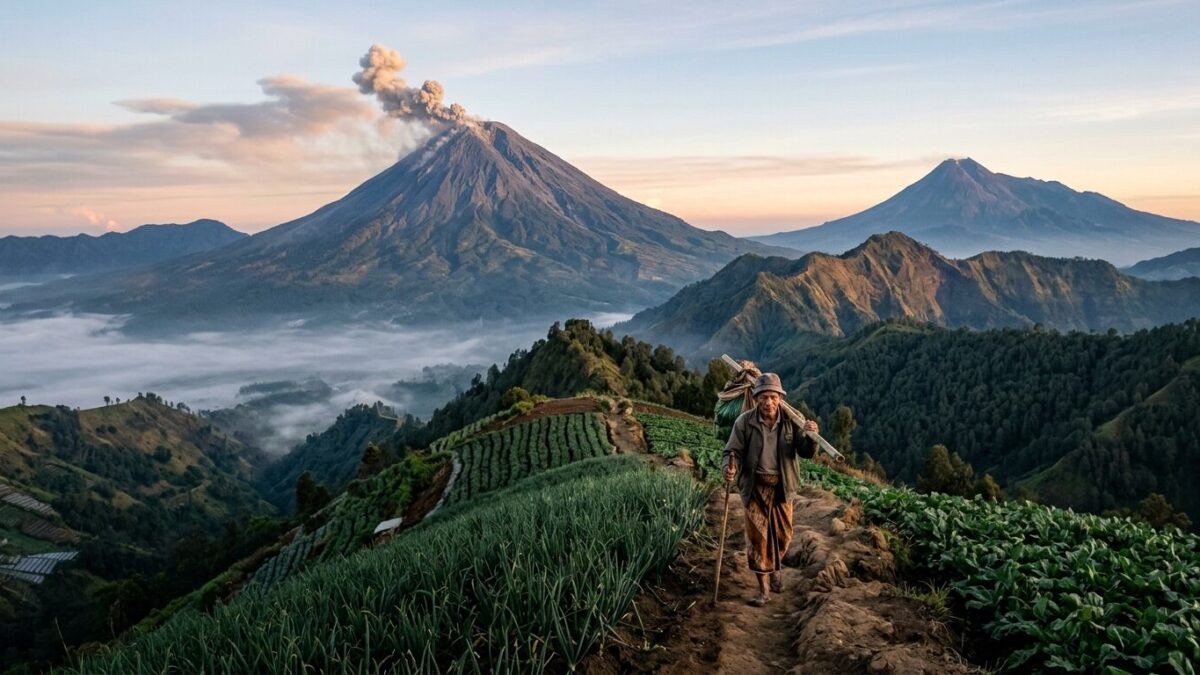
SURABAYA — Volcanic activity across the Indonesian archipelago requires a strategic shift in focus, with experts identifying Mount Semeru and Mount Merapi as higher-priority threats than the frequently monitored Anak Krakatau. According to geophysicists, the immediate danger stems not only from seismic activity but from the geological proximity of these peaks to some of the country’s most densely populated regions on Java Island.
"Mount Semeru and Mount Merapi require the most attention because of their location near major population centers," said Alutsyah Luthfian, an expert from the Department of Geophysical Engineering at the Sepuluh Nopember Institute of Technology (ITS), during a briefing in Surabaya on Monday. While public concern often spikes during multi-volcano activity, Luthfian clarified that simultaneous eruptions are not necessarily indicative of a deeper, interconnected geological phenomenon.
The Unpredictable Threat of Semeru
Mount Semeru remains a primary concern for disaster mitigation officials due to its volatile and erratic eruption patterns. As the highest peak on Java, it frequently exhibits signs of activity with little to no advanced warning, leaving residents in the surrounding areas with minimal time to react. The combination of unpredictable explosive events and the high density of residential zones creates a persistent, layered risk profile that demands constant vigilance from local communities.
Merapi’s Proximity to Urban Centers
Mount Merapi, situated on the border of Central Java and the Special Region of Yogyakarta, is categorized as a high-stakes priority due to its sustained activity and extreme proximity to urban settlements. The volcano’s historical record of frequent, often significant eruptions necessitates a robust, real-time monitoring infrastructure. Authorities have emphasized that strict adherence to established evacuation routes and early warning systems remains the primary defense strategy for the millions of residents living within its immediate reach.
Reevaluating Anak Krakatau and Seismic Misconceptions
While Anak Krakatau continues to be closely monitored by Indonesia’s Center for Volcanology and Geological Hazard Mitigation (PVMBG), Luthfian argues its threat profile is fundamentally different. Unlike the terrestrial risks of Semeru and Merapi, the primary danger from Anak Krakatau arises from potential submarine landslides. A massive flank collapse in 2018 triggered a lethal tsunami in the Sunda Strait, a scenario that remains a focal point for maritime safety experts.
Luthfian pushed back against the common public assumption that concurrent volcanic activity suggests a cascading seismic chain reaction across the islands. "Every volcano operates on its own magmatic system and cycle," he stated. "We cannot conclude that one mountain triggers another simply because their eruption windows overlap in time."
To mitigate unnecessary public panic, experts urge citizens to disregard speculative analysis on social media and rely exclusively on official data released by the PVMBG. Professional geological assessment, rooted in subsurface data, remains the only reliable metric for understanding the complex volcanic dynamics of the region.