Universities mark graduation season with AI, disability and social research themes
From Cape Town to California and Seattle, universities have spent the past few months sending off graduating classes with ceremony, applause and a clear mess...
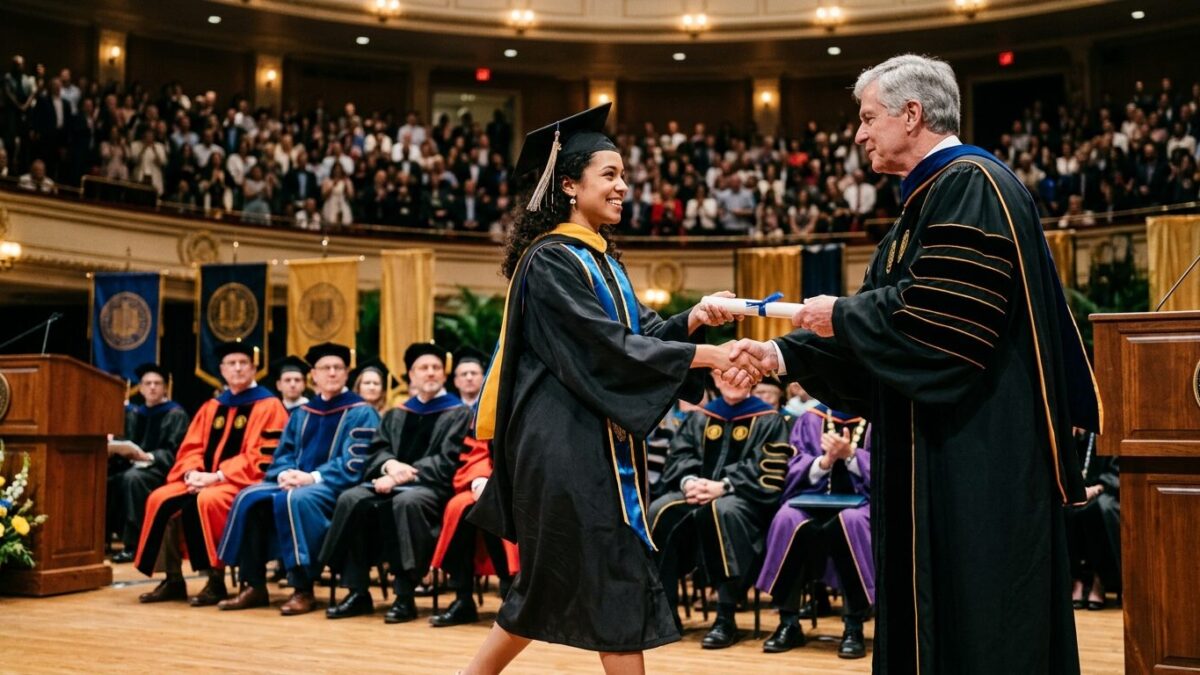
From Cape Town to California and Seattle, universities have spent the past few months sending off graduating classes with ceremony, applause and a clear message: the next chapter starts now. At the University of Cape Town, graduation ceremonies ran from Monday, September 7, to Wednesday, September 9, 2026, with a cross-section of students whose work ranged from disability studies to artificial intelligence.
The South African university said its news team had profiled several graduands whose stories stood out. Among them was Lucky Geluk, whose plush toy carried memories of a difficult first year at UCT and later became a reminder of resilience. Ncikazi Nyoka was due to receive a master’s degree in disability studies on Wednesday. Nice and sharp.
Research topics stretch from AI to breastfeeding mothers
The range of final projects at UCT pointed to how graduation season now doubles as a public window into the questions universities are asking. Féranaaz Farista’s PhD work focuses on the lived experiences of Muslim breastfeeding mothers, including those who returned to work after childbirth. Nokuthula Olorunju’s dissertation looks at what a constitutional approach to AI and the rule of law might mean. Ayanda Vilakazi, a marketing executive who drew on neuroscience to study consumer decision-making, was set to graduate with his second doctoral degree on September 9.
There was also Charl Johannes van der Merwe, a sheep farmer whose graduation was noted by the university. UCT did not give the full details of his story in the source material, but his inclusion underlined the breadth of the graduating class. Each of these profiles pushed beyond a simple roll call. They showed how academic work is landing in families, farms, workplaces and policy debates far from campus walls.
Other campuses turn commencement into a public event
At Cal Poly, the scale was different but the message was familiar. The university said 7,526 students were eligible to graduate at commencement ceremonies on June 13 and 14, 2026, at Alex G. Spanos Stadium in San Luis Obispo. About 57,000 guests were expected across six college ceremonies, which were scheduled for 8:30 a.m., 12:30 p.m. and 4:30 p.m. each day. Each session was expected to run two to 2.5 hours and would be livestreamed, with expanded language interpretation services available.
The school said the Class of 2026 would join more than 230,000 Cal Poly Proud alumni across California, the United States and beyond. “Commencement is a great day for our graduates,” President Jeffrey D. Armstrong said, adding that families, teachers, mentors and peers also deserved recognition for helping students get there.
Elsewhere in the United States, the Jackson School of International Studies at the University of Washington held its spring convocation on June 13 in the HUB Ballroom, where 186 students marked the end of their studies in front of more than 700 family members and friends. The school said it granted degrees to 150 undergraduates, 34 master’s students and two Ph.D. students.
And at the University of Florida, keynote speaker Joe G.N. “Skip” Garcia told doctoral graduates on April 30 that the degree marked not just the end of a long academic path, but the start of work that would call for integrity, empathy and ethical judgment. That same note ran through many of this year’s ceremonies. Different campuses. Same charge.
At UCT, the last of the spring ceremonies was set for Wednesday, September 9, closing three days of graduations with stories that reached from artificial intelligence to sheep farming.