AI Uncovers Forgotten Meteorite Reports in Millions of Archive Pages
AI sifted millions of archive pages for forgotten meteorite reports and other clues. Researchers still checked every lead against original scans.
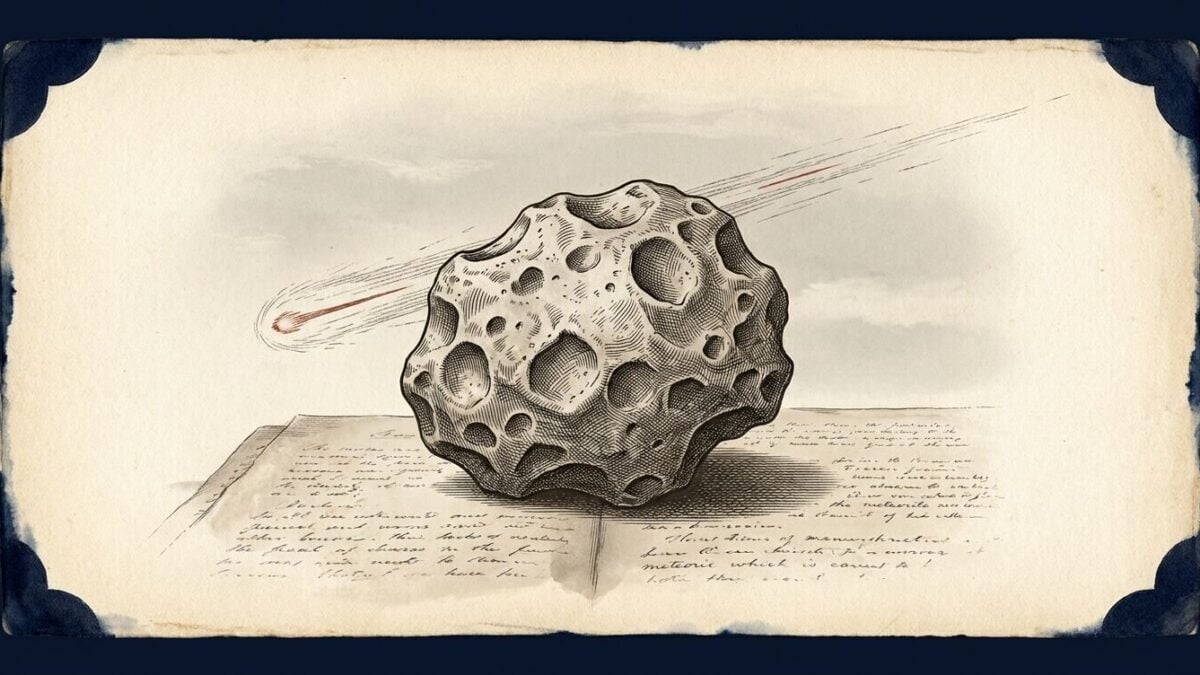
THE HAGUE — Artificial intelligence has helped uncover historical clues buried in millions of digitized pages, including a forgotten meteorite report, records of three rhinos long missing from documentation and evidence pointing to an unrecorded volcanic eruption. The project shows how machine-assisted searches could help researchers navigate vast archives, while underscoring that original documents—not AI-generated answers—must support historical claims.
A software engineer behind the project built a system to find records, filter promising passages, translate selected text and compare transcriptions with scans of handwritten pages. A result did not count as a discovery simply because an AI system surfaced it.
AI searches millions of historical pages
The project drew inspiration from historian Benjamin Breen, who wrote about using AI to search records of the Dutch East India Company. In work discussed in the project account, Breen found a ship’s journal from 1615 that recorded sailors in Mauritius catching turtles and dodos.
The journal offered a previously overlooked account of the extinct dodo. The document was already in a collection, but locating it without a large-scale search would have been difficult.
Following that approach, the engineer asked an AI research assistant to suggest historical questions that might be answerable using online material. The candidates were assessed for the availability and accessibility of sources, the likely usefulness of AI and whether researchers could verify a result against the underlying documents.
The search explored several mysteries: animals mentioned in Dutch East India Company records, a possible major eruption in 1808 whose location remains unknown, earthquakes described in old newspapers, meteorite falls absent from existing records and ships that disappeared without a trace.
From text search to handwritten scans
The source material included GLOBALISE transcriptions of Dutch East India Company records, digitized newspapers from the Dutch national library, two centuries of U.S. newspapers and ship logbooks. The GLOBALISE archive contains 4.35 million pages of handwritten material dating from the 1600s through the 1790s.
The engineer estimated that reading every page personally at two minutes per page, for eight hours a day and five days a week, would take about 70 years. The system processed the archive in a single overnight session lasting 12 hours.
Ordinary keyword searches can miss historical references. Spellings changed, handwriting posed challenges and text-recognition systems introduced errors. A Dutch word for “rhinoceros,” for example, could appear in many variations in 17th-century records. The project therefore converted passages into mathematical representations of their meaning, allowing searches to find related language without requiring an exact match.
That process covered 5.7 million text segments from the Dutch East India Company archive alone. Semantic searches, however, still returned too many candidates for a person to inspect individually. A smaller model called Jev narrowed the results by answering focused questions: Was the reference to an animal? Was it wild? Where was it located?
AI narrows the field; researchers verify the evidence
Jev screened the initial results before a larger model reviewed the most promising passages. The engineer said checking 59,000 references to elephants cost about $3. Claude Haiku then read selected passages, translated them and extracted dates and locations.
Next, an agent using Claude Code opened scans of the handwritten pages so the engineer could compare the original with its transcription. Candidate discoveries were also checked against catalogs used by specialists before being described as new findings.
The method addresses a central risk in AI-assisted historical research: a model can give a confident-sounding answer that is wrong. Checking the original page helps expose transcription mistakes and makes a claim traceable for other researchers. The tool speeds up the hunt; it does not establish what happened.
That distinction matters when archives are too large for scholars to review page by page. AI can direct attention toward promising evidence, but researchers still choose which questions deserve attention, judge whether a lead makes sense and decide when a search has reached a dead end. The engineer described the project as research assisted by AI, not an investigation operating entirely on its own.
For searches that returned no result, the engineer set a further test: before trusting a conclusion that something was absent, the system had to demonstrate that it could find something known to exist.