Physicists Say Black Holes Can Split in Two Only at Maximum Spin
A new study in Physical Review D suggests a single black hole could divide into two, but only if it spins at close to its maximum possible rate. Physicist…
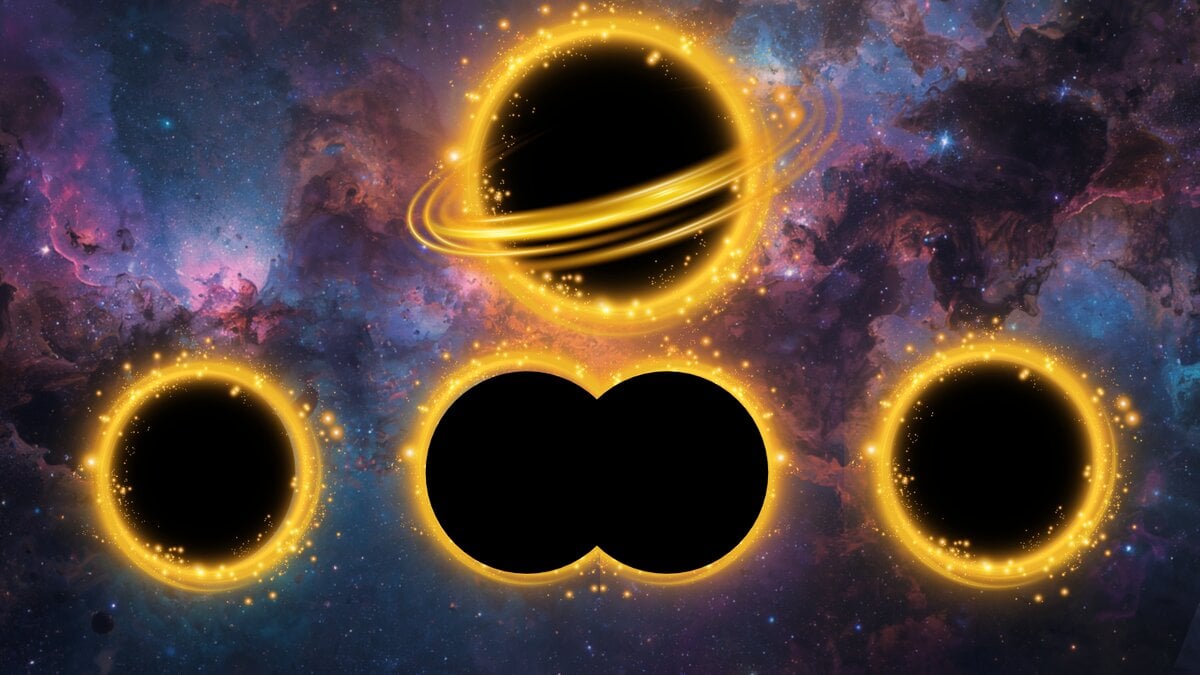
A team of physicists says black holes can split in two, but only if the original black hole spins at the maximum possible speed. The research was published on Oct. 22 in the journal Physical Review D.
Scientists have long known that colliding black holes merge into a more massive one. Those collisions are violent enough to send ripples called gravitational waves through space. The new work asks whether the process can run in reverse.
Why splitting is normally forbidden
Physical laws usually block it. One of the main obstacles comes from thermodynamics. Black holes have a property called entropy, a measure of disorder within a system.
Entropy cannot be reduced without outside energy being added to the system. A non-rotating black hole splitting in two would represent a decrease in entropy, which the laws of thermodynamics strongly disfavor. The situation could differ for a rapidly rotating black hole, and the team looked for conditions under which these laws can be temporarily bypassed.
They found a loophole. But it is narrow.
The two new black holes must also be able to move apart rather than immediately fall back together. "When we include this requirement, the window largely closes again, except possibly for black holes rotating close to their maximum possible rate," said team member Francesco Sannino of the University of Naples Federico II in Italy.
The 'pair-of-pants' shape
The researchers calculated how such a split could unfold. The division of the black hole's outer boundary, known as the event horizon, takes an oddly trouser-like shape, with one resulting black hole slipping down each "leg." The team called this "pair-of-pants topologies."
They also determined that a split is more likely if one of the resulting black holes is considerably smaller than its newly born twin.
No single probability yet
The team cannot yet put a number on the odds. "We cannot yet give a single probability for a black hole to split. It depends on how gravity behaves beyond Einstein's theory, and we are working to quantify this," Sannino said.
He added that small primordial black holes should be more prone to splitting than much larger astrophysical black holes.
Detection may be possible, if indirectly. "We may detect a split indirectly: gamma-ray telescopes such as Fermi-LAT can search for signals from tiny black-hole fragments that might form during mergers," Sannino said.
Source: space.com