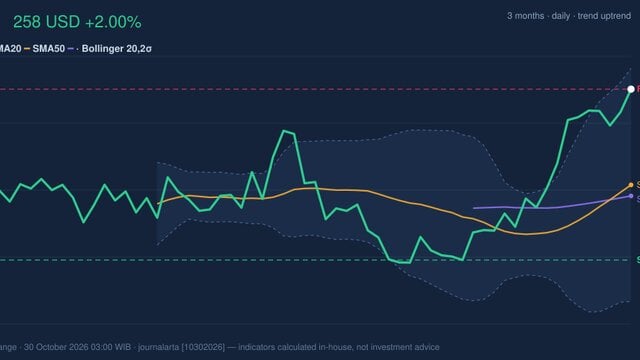
Exxon, Chevron Earnings Get a Lift From Stronger Refining Margins
Higher refining margins helped ExxonMobil beat third-quarter earnings expectations, while results from Chevron offered a second test of how the oil majors ar...

Higher refining margins helped ExxonMobil beat third-quarter earnings expectations, while results from Chevron offered a second test of how the oil majors are benefiting from fuel-market conditions. Exxon reported adjusted earnings of $4.23 per share, above the $4.13 consensus estimate.
Both companies reported before the market opened on Oct. 30. The figures put refining performance in focus as investors assess results across the energy sector and a broader S&P 500 earnings season that has delivered strong growth so far.
Refining lifts Exxon’s result
Exxon’s earnings were supported by a jump in refining margins as gasoline and diesel prices rose. Ongoing conflicts in the Middle East and Ukraine were cited as factors behind the stronger margins.
The reported figures show the benefit to Exxon’s overall result, but do not quantify how much margins increased or provide a breakdown comparing refining with production and other segments. Exxon’s adjusted earnings per share beat expectations; the available result details do not give a comparable Chevron earnings figure.
Production has also faced pressure from geopolitical disruption. In the second quarter, Exxon Chief Executive Darren Woods said the Middle East conflict had temporarily reduced upstream output by about 10%. He also highlighted production near 900,000 barrels a day in Guyana and record Permian volumes above 1.8 million oil-equivalent barrels a day.
Results land in a strong earnings season
Nearly a quarter of S&P 500 companies had reported third-quarter results, with earnings growth at 29.5%, FactSet data showed. If that pace holds, it would mark a third consecutive quarter in which growth exceeded 25%.
The reporting slate has ranged from technology to pharmaceuticals and industrial companies, including Microsoft, Alphabet, Amazon, Intel, Boeing, Ford and Eli Lilly. Exxon and Chevron’s results add an energy-sector measure to that mix, with refining margins showing how fuel-market conditions can bolster oil-company earnings even as production faces disruption.
The supplied figures do not establish how investors responded to the two reports or provide company guidance for the next quarter. Exxon’s reported adjusted earnings per share came in 10 cents above the consensus estimate.