Giant Eagles Once Ruled the Skies and Hunted Primates
Giant predatory birds hunted primates for millions of years, and marks on the Taung child’s skull resemble damage found on modern monkeys killed by eagles…
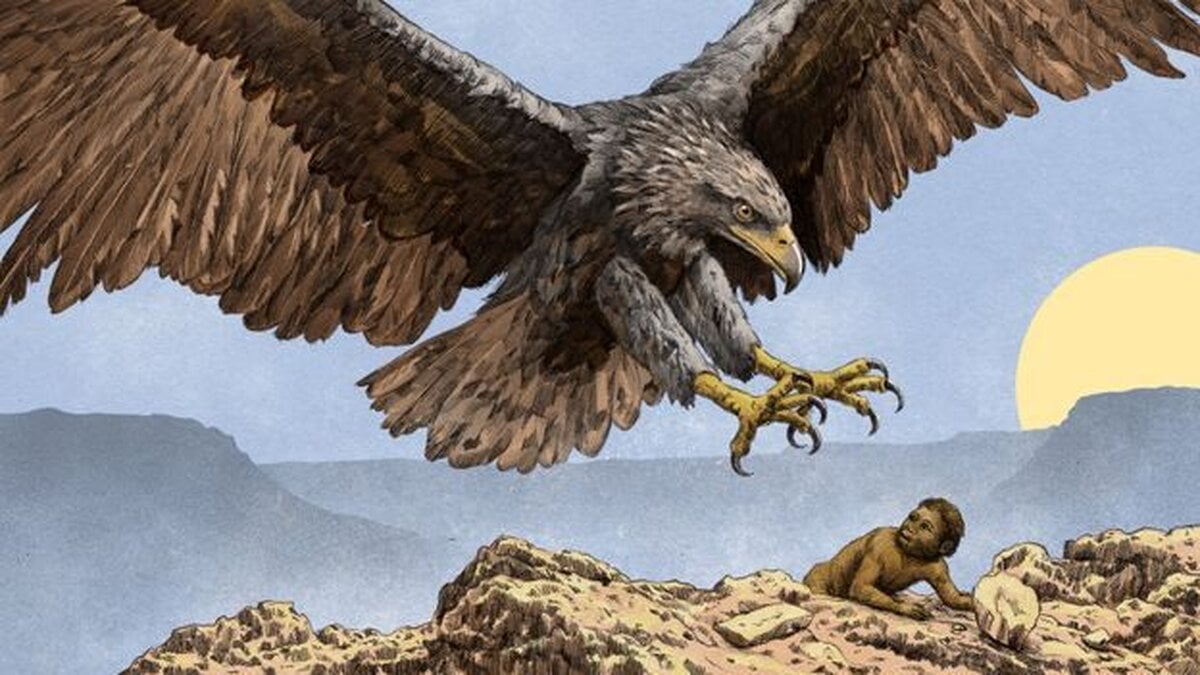
Giant eagles once ruled the skies for tens of millions of years, and researchers say early human relatives were among the primates they hunted. Marks on the skull of the Taung child, a young Australopithecus africanus who lived 2.8 million years ago in South Africa, resemble injuries found on monkeys killed by eagles today.
The child, who was three years old and still teething, died after an attack by a large bird of prey, according to the account of the fossil evidence. The exact species is unknown. Puncture marks beneath the eye sockets are consistent with eagle talons, which can strike prey around the face.
The finding connects a fossil from the distant past with observations of modern predators. It also raises a question about how often raptors hunted human ancestors, and whether that danger influenced the evolution of primates.
What links the Taung child to modern eagle attacks?
Primatologist Scott McGraw of Ohio State University compared the Taung child’s remains with skulls from more than 600 modern primates killed by birds of prey in Ivory Coast’s Taï Forest. The animals included monkeys killed by African crowned eagles.
McGraw found damage around the eye sockets that resembled marks on the ancient child’s skull. The damage affected the orbital floor, the bony surface inside the socket. He said the injuries could result from an eagle pecking out an eye with its beak or tearing it out with a talon.
“One of our reviewers went down to the fossil vault, pulled out the Taung child, and found that the damage was identical,” McGraw said.
That comparison does not establish exactly how the child died. But it gives researchers a way to assess possible raptor attacks on other fossils. McGraw said examining existing collections with those signs in mind could reveal further evidence.
Predators in a changing world
Large birds took on new ecological roles after the extinction of the non-avian dinosaurs. The impact left dust in the atmosphere and most plants died, leaving seeds among the few available food sources. Some surviving ground-dwelling birds later evolved into giants.
Not all followed the same path. Australia’s Dromornithidae were plant-eaters, while Pelagornis sandersi, found in South Carolina, was a huge ocean-going predator. Its wingspan reached 7m (24ft), making it the largest known flying bird described in the account.
Other giant birds filled roles left open when top land predators disappeared. The result was a long period in which large raptors shared the landscape with early primates and humans.
“As long as primates have been around, there have been raptors,” McGraw said. “And raptors have always been preying on primates – including us and our relatives.”
The threat was not necessarily limited to rare encounters. McGraw believes birds of prey routinely hunted human ancestors, and argues that predation may have been an important selective force in primate evolution. If more fossils show the same characteristic damage, it could help researchers test how widespread those attacks were.
James Cole, an archaeologist and dean of applied sciences, also discusses the evidence in the account. The fossil record, he says, leaves little doubt that early humans were prey.
For now, the Taung child’s skull and the damaged primate remains offer a striking point of comparison: McGraw found matching orbital injuries in both.