Government Keeps Subsidized Fuel Prices to Protect Purchasing Power
Government keeps subsidized fuel prices unchanged to help protect purchasing power and ease pressure on household spending.
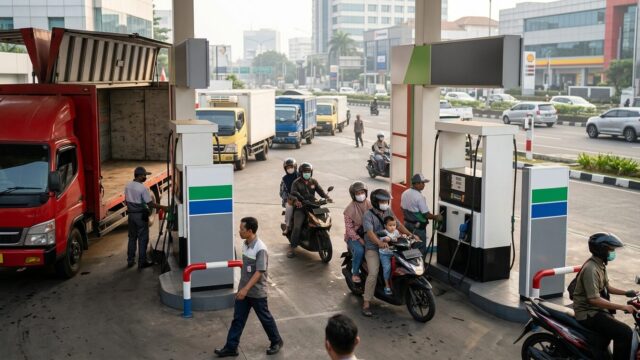
JAKARTA — The government keeps subsidized fuel prices unchanged to protect purchasing power, with Pertalite, Bio-Solar, and 3-kilogram LPG still affordable for households that depend on them every day. The policy comes as energy costs remain sensitive to global oil swings and domestic inflation pressure.
Abdul Rahman, Secretary of the Economic Policy Division at Golkar’s central board, said in Jakarta on Sunday that holding prices steady is important because fuel sits at the center of transport, logistics, and basic household spending. For many families, that means the difference between manageable monthly costs and a tighter budget.
Why the subsidized fuel price freeze matters
Abdul Rahman said the decision helps keep inflation in check because public transport, freight movement, and goods distribution still rely heavily on subsidized fuel. If fuel prices do not rise, the pressure does not easily spread through the supply chain.
“This policy shows the government’s support for the wider public,” he said. He added that the choice not to lift subsidized fuel prices is relevant because it touches daily needs, from commuting to shipping basic goods.
The effect is not always visible in one day. But it matters over time. When transport costs stay stable, retailers, small traders, and logistics firms have less reason to pass higher costs to consumers. That gives households some breathing room at a time when food, transport, and utility bills already compete for the same wallet.
Abdul Rahman also argued that the role of subsidized fuel in Indonesia remains too large to ignore. In his view, public transportation and goods distribution still depend on fuel that receives state support, so keeping prices steady can help prevent wider price pressure in the market.
Pertamax increase and inflation risk
On the increase in Pertamax prices, Abdul Rahman urged the public not to overread its impact. Pertamax is a non-subsidized fuel, he said, and its pricing follows economic value, including movements in global crude oil prices and the Indonesian Crude Price, or ICP.
He pointed to international tension as one of the forces driving oil markets higher, including conflict in the Strait of Hormuz. That kind of pressure, he said, makes fuel pricing adjustments harder to avoid for products that do not receive subsidies.
“The increase in Pertamax prices was not an easy decision,” he said. “The longer Pertamina holds prices below economic value, the greater the financial burden borne by Pertamina and the government.”
He also said Pertamax users generally come from middle- and upper-income groups, which gives them more room to absorb changes. Because public transport and goods distribution still lean on subsidized fuel, he said the direct inflation impact from a Pertamax adjustment is relatively limited.
“The increase in Pertamax will not significantly affect inflation because public transport, both for people and goods, still uses subsidized fuel,” he said.
Supply stability is the real test
The bigger issue, Abdul Rahman said, is not just price but supply. He urged the government to make sure Pertalite, Bio-Solar, and 3-kilogram LPG cylinders remain available in all regions so people do not face shortages or long queues at fuel stations.
That point matters on the ground. When subsidized fuel runs short, the delay ripples fast. Motorists wait longer, deliveries slip, and small shops lose time that should have gone to sales. For workers who depend on daily mobility, a queue is not a small inconvenience. It is lost hours.
“We also urge the government to continue ensuring that subsidized fuel supplies remain available and accessible to the public. Do not let shortages or queues occur in a way that burdens people,” Abdul Rahman said.
He said stable supply matters as much as frozen prices. A cheap fuel price means little if stock is thin and access is uneven. People want certainty. They want to know the pump will have fuel when they arrive, not just a number on a signboard.
Pressure on the middle class
Abdul Rahman also called for stronger policy packages and economic incentives to keep business activity moving, especially for the middle class. He described the group as one of the main engines of domestic consumption in Indonesia.
That is where the policy reaches beyond fuel stations. When middle-class purchasing power holds up, small and medium-sized businesses keep seeing demand. When it weakens, spending slows quickly, and shops, transport operators, and service businesses feel it almost at once.
He said the government should widen incentives so economic activity does not lose momentum under global pressure. “That way, the purchasing power and economic activity of the middle class can continue to be maintained amid various global economic challenges,” he said.
ANTARA reported Abdul Rahman’s remarks as the government keeps subsidized fuel prices in place while global energy markets remain unsettled. For households, the immediate message is simple: the price at the pump stays steady, and so does one of the few buffers against a more expensive month.