
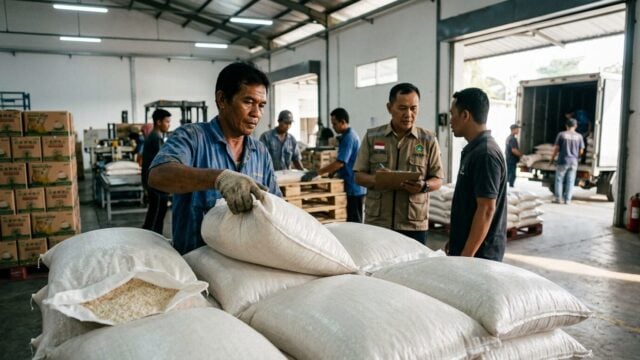
PANGKALPINANG — The Bangka Belitung Islands provincial government added 24.1 tons of rice supply from South Sumatra this week. The move immediately lifted total stock to 4,161.1 tons — a significant amount to secure prices during the school holiday season and rising consumption.
Head of the Bangka Belitung Provincial Industry and Trade Office, Subekti Saputra, said rice price stabilization remains a priority because of its direct impact on low-income families’ budgets. “With this addition, our total rice stock has reached 4,161.1 tons,” he said when interviewed in Pangkalpinang on Wednesday, while stressing that prices remain under control even as demand may rise.
Rice Spread Across 17 Warehouses, Prices Stay Normal
The rice stock is now stored in 17 distributor warehouses covering seven administrative areas: Pangkalpinang, Bangka, Central Bangka, West Bangka, South Bangka, Belitung, and East Belitung. This even availability ensures there are no distribution gaps that could trigger local shortages and speculative price increases.
In the field, rice prices remain stable. The “cap sendok” brand rice (medium quality) is sold at Rp14,400 per kilogram, premium “RM” rice at Rp15,700 per kilogram, and Bulog SPHP rice at Rp12,600 per kilogram — all still within the normal range without sharp spikes.
Subekti said the office team routinely monitors prices in traditional and modern markets to detect deviations early. “Praise be to God, so far rice stock and prices are still safe,” he said.
Why Rice Stabilization Matters for Bangka Belitung
Rice is not just a staple food — it is a barometer of household economics. A Rp1,000 increase per kilogram can cut an average family’s grocery budget by Rp30,000–Rp50,000 per month, depending on household consumption. For families with incomes below Rp3 million per month, this burden is real and felt immediately.
The situation is more critical in an archipelagic region like Bangka Belitung. Limited access, high logistics costs, and dependence on local imports make price volatility easy to occur. The provincial government’s supply addition is not only about stock — it is about preventing panic buying that could trigger a price bubble effect.
The school holiday period does not necessarily cause a drastic surge in demand. But anticipatory buying by consumers and retail speculators, if left unchecked, could create artificial scarcity that pushes prices up without fundamental reason.
Local Production Lags by 15 Percent
Bangka Belitung’s fundamental problem is its dependence on imports, which cannot be eliminated in the near term. Local farmers can supply only 85 percent of total needs — the rest, around 600–700 tons per month, must be brought in from South Sumatra or other areas.
The reason is simple: fertile land is limited. The archipelago’s hilly topography, extreme weather, and slow access to agricultural technology keep productivity low. Bangka Belitung farmers are not lacking in spirit, but geographic conditions limit their maximum potential.
Subekti acknowledged this reality: “We continue to maintain supplies from outside to ensure the price stability of this commodity.” In regional trade terms, Bangka Belitung is a net importer with no choice — except to keep relying on imports while building long-term production capacity.
What’s Next: Tight Monitoring and Long-Term Plans
Over the next seven days, the local government will increase monitoring frequency. Rice demand during the school holiday peak will be analyzed every two or three days to detect upward trends. If consumption exceeds projections, additional supply will be released without waiting for stock to reach a critical level.
The price survey team will also become more active in checking traditional markets, minimarkets, and wholesale distributors. The early-detection target: if any stall or shop begins raising prices without justification, direct intervention can be carried out through coordination with trader associations or supply chain monitoring.
Over the next three to six months, the provincial government’s focus will shift. The reason is that supply additions are only a short-term solution. The long-term strategy is to increase local production through intensive farmer training programs, irrigation infrastructure improvements, and the provision of certified superior seeds. If production can rise from 85 percent to 95 percent of total needs within the next two years, dependence on imports will drop significantly and price volatility will naturally decline.
The challenge remains the same: the geography of an archipelago cannot be changed overnight. But with the right stock anticipation today, Bangka Belitung is buying time to build a healthier food-security future.
📝 Leave a Comment
Comment as . Reviewed by an admin before it appears.