
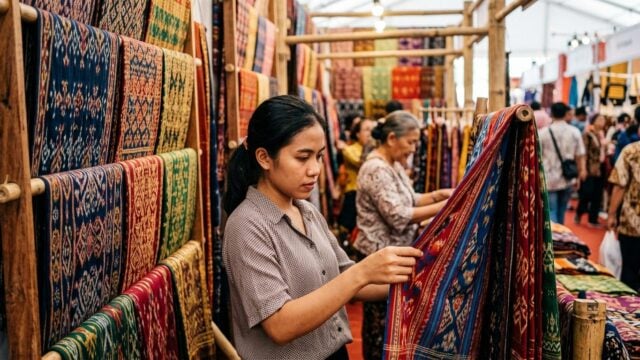
PANGKALPINANG — Cual weaving, a Bangka Belitung cultural identity recognized as an intangible cultural heritage, will receive major national attention. PT Timah (Persero) Tbk and the Bangka Belitung Islands Provincial Government have confirmed the region’s signature fabric will be featured at the 2026 Dekranas Craft and Textiles Exhibition next month.
The decision is more than a routine participation. It is about opening the door to a much wider market for local artisans while preserving a tradition that risks being forgotten in the digital era.
“An important step to expand promotion and improve marketing of regional craft and textile products,” said Subekti Saputra, head of the Bangka Belitung Islands Provincial Industry and Trade Office, when met in Pangkalpinang on Wednesday.
Big Stage in Makassar
The Dekranas Craft and Textiles Exhibition will run from July 9 to 12, 2026, at Trans Studio Mall Makassar. The main event is scheduled for July 10 and will be opened directly by Selvi Ananda, Chair of Dekranas as well as the wife of the Vice President of the Republic of Indonesia, together with the central Dekranas management.
The timing of the exhibition is no accident. The event is part of the series marking the 54th Family Welfare Movement (HKG) PKK anniversary and the 46th anniversary of Dekranas — a national moment that guarantees high visibility and participants from across Indonesia.
This means Bangka Belitung’s Cual weaving will not only be displayed, but presented before potential buyers, businesspeople, media, and market decision-makers from various regions. Opportunities for direct business connections are wide open.
Cultural Heritage, Economic Asset
Why was Cual weaving chosen? Because its status and potential are clear. The fabric is an Intangible Cultural Heritage (WBTB) that serves as an identity for the people of Bangka Belitung.
“Cual weaving motifs are rich in cultural meaning and have high artistic value,” Saputra explained. It is not just a beautiful traditional fabric — the product carries stories, philosophical values, and skills passed down through generations.
That combination opens market opportunities. Modern consumers, especially in the middle-to-upper class segment and export markets, increasingly seek products with a story and cultural authenticity. Cual weaving has all of that.
“It has great potential to continue developing into the national and international markets,” Saputra said, underscoring an ambition that is realistic yet promising.
Triple Helix Collaboration
The success of promoting Cual weaving cannot rely on the government alone. Saputra, who also serves as daily chair of the Bangka Belitung Provincial Dekranasda, stressed the importance of synergy among three parties: local government, business, and MSME players.
Here, PT Timah plays a crucial role. The country’s largest mining company is not just a sponsor — it is a strategic partner in local economic empowerment.
“So far, we have collaborated a lot in various exhibitions and development activities,” Saputra said, while appreciating PT Timah’s consistent support. Such cooperation reflects corporate commitment to communities around their business operations.
The concrete impact: empowering Cual weaving MSMEs, diversifying local income, and preserving cultural heritage within a modern economic framework. In other words, culture does not stand apart from prosperity, but becomes an economic engine.
Market Target and Expansion
The 2026 Dekranas exhibition is the first structured stepping stone for expanding the Cual weaving market. Saputra expressed a clear hope: “Regional products become more widely known, the community economy continues to grow, and market opportunities become broader.”
The first phase is the national market. With the Makassar exhibition drawing thousands of visitors from various provinces, the potential for penetration across Indonesia opens up. The next phase is international — a market already known to favor authentic traditional craft products from Southeast Asia.
To get there, consistent quality, strong branding, and MSME production capacity must continue to improve. Collaboration between the government (facilitation, regulation), companies (funding, networks), and artisans (production, innovation) is the key formula.
30-Day Outlook
Over the next month, exhibition preparations will enter an intensive phase. It is expected that there will be an official announcement regarding the number of booths prepared, display design, and sales targets. There may also be a pre-event or mini roadshow in Pangkalpinang to encourage artisans and MSMEs to participate actively. Local and national media are likely to cover this moment more deeply, especially ahead of the exhibition date. There is also potential for additional cooperation with national retail brands or e-commerce platforms to expand Cual weaving sales reach after the exhibition.
📝 Leave a Comment
Comment as . Reviewed by an admin before it appears.