
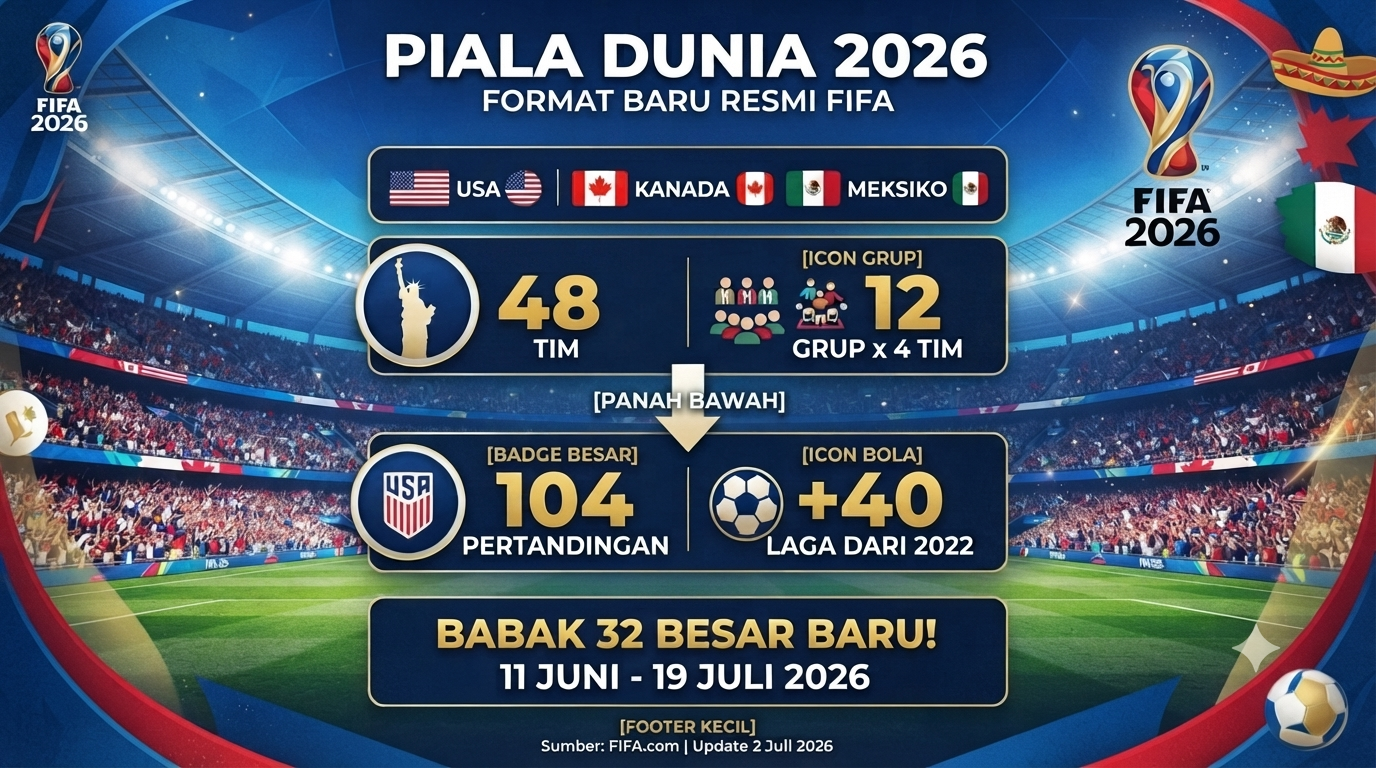
JAKARTA, JOURNALARTA.COM – The world’s most prestigious football tournament, the 2026 World Cup, officially kicked off on June 11, 2026, with the most radical change in modern football history. FIFA has introduced a new format that expands the competition from 32 nations to 48 participating teams.
This change in the number of participants has a direct impact on the competitive map and the number of matches to be played. If the Qatar 2022 edition offered fans just 64 matches, this time football lovers will be treated to a total of 104 games over 39 days in three host countries: the United States, Canada, and Mexico.
⚽ Read also: World Cup 2026 — Bagan, Schedule Hari Ini & Klasemen Live
New 48-Team Format: The Biggest in History
The addition of teams has completely changed the tournament bracket. FIFA has divided the 48 teams into 12 groups, with four teams in each group. The knockout stage now begins not with the Round of 16, but with a new and highly crucial Round of 32.
To make this massive change easier to understand, here is a detailed statistical comparison of the 2026 World Cup with previous editions:
| Format Component | Old Format (1998-2022) | New Format (2026) |
|---|---|---|
| Number of Teams | 32 teams | 48 teams |
| Number of Groups | 8 groups x 4 teams | 12 groups x 4 teams |
| Total Matches | 64 matches | 104 matches |
| Tournament Duration | ~32 days | ~39 days |
| First Knockout Round | Round of 16 | Round of 32 (New) |
| Knockout Qualification | Group winners & runners-up | Group winners & runners-up (24 teams) + 8 best third-placed teams |
This system gives a second chance to teams finishing third in their groups. Under the new 2026 World Cup statistical regulations, the eight best third-placed teams will join the 24 group winners and runners-up in the Round of 32.
Basic Tournament Stats and Match Results
The 2026 World Cup is scheduled to run from June 11 until the final on July 19, 2026. A total of 16 cities in three countries are ready to host intense matches. One consequence of the new format is that teams reaching the final will have to play eight matches, one more than under the old system.
Several group-stage matches have already delivered late drama:
- Belgium 3-2 Senegal (July 1, 2026, group stage after extra time)
- Morocco 1-1 Netherlands (June 29, 2026, Morocco won 3-2 on penalties)
- France 3-0 Sweden (June 30, 2026, France won outright in regulation)
Host Nations and Main Stadiums
The three host countries are working together to provide world-class stadiums for this football celebration. Mexico is relying on the legendary Estadio Azteca in Mexico City, with a capacity of around 83,000 spectators. The stadium also hosted the historic opening match between Mexico and South Africa on June 11, 2026.
Meanwhile, the United States has prepared MetLife Stadium in New Jersey, with a capacity of around 82,500 spectators, which has been designated as the venue for the final. Canada is relying on BC Place in Vancouver to stage a series of group-stage and early knockout matches.
Confederation Slot Distribution and New Debuts
The increase in the number of teams is a major boost for confederations outside Europe and South America, which have long struggled to send representatives. According to FIFA’s official allocation, the slots for each confederation are as follows:
- UEFA (Europe): 16 teams
- CAF (Africa): 9 teams + 1 playoff slot
- AFC (Asia): 8 teams + 1 playoff slot
- CONMEBOL (South America): 6 teams + 1 playoff slot
- CONCACAF (North & Central America): 3 teams + 3 host slots + 2 playoff slots
- OFC (Oceania): 1 team + 1 playoff slot
- Intercontinental Playoff: 2 teams
This more even slot distribution has created new history, with several debut nations qualifying for the World Cup stage for the first time: Curaçao, Jordan, Uzbekistan, and Cape Verde.
Group-Stage Tiebreaker Rules
With the introduction of the best third-placed teams system, tiebreaker rules in the group stage have become vital. FIFA has set strict regulations to determine the standings if two or more teams finish level on points:
- Total points earned.
- Head-to-head goal difference among the teams concerned.
- Number of goals scored in group matches among the teams concerned.
- Fair play points (based on accumulated yellow and red cards).
- The latest FIFA world ranking.
In group-stage mathematics, collecting 4 points from 3 matches almost guarantees a place in the Round of 32. Teams that earn only 3 points still have a chance to advance, provided they have a very strong goal difference.
Has your favorite team already secured a spot in the Round of 32 under this new format? Share this 2026 World Cup statistics update with your watch party group so you don’t get confused by the competition among third-placed teams in the standings.
Frequently Asked Questions (FAQ)
Q: How many teams are in the 2026 World Cup?
A: The tournament features 48 teams divided into 12 groups of 4 teams each. The teams advancing to the Round of 32 are the 24 group winners and runners-up, plus the 8 best third-placed teams.
Q: How many total matches are in the 2026 World Cup?
A: There are a total of 104 matches, 40 more than the Qatar 2022 World Cup, which featured only 64 matches.
Q: When does the 2026 World Cup start and end?
A: The tournament runs from June 11 to July 19, 2026, across three host countries: the United States, Canada, and Mexico.
📝 Leave a Comment
Comment as . Reviewed by an admin before it appears.