Google Gemini Now Controls Humanoid Robots—and Oracle Is Adding It to Enterprise Cloud
Google DeepMind's Gemini AI can now command robots to perform complex physical tasks like screwing lightbulbs and organizing shelves. Meanwhile, Oracle is…
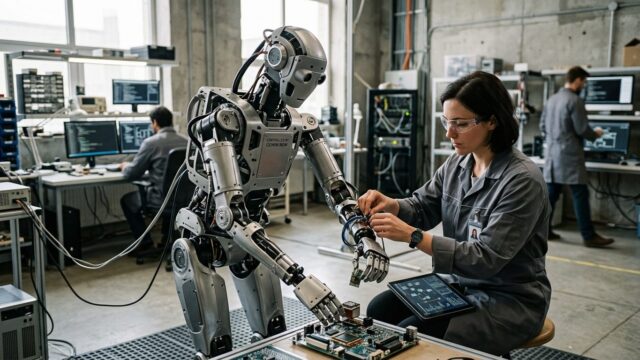
MENLO PARK — Google's artificial intelligence just learned to use its hands. The company's DeepMind division has released Gemini Robotics 2, an AI system that can command humanoid robots to perform nuanced physical tasks—from screwing in lightbulbs to tying trash bags and tidying shelves—without human intervention once trained.
The breakthrough extends beyond robotics labs. Oracle announced Thursday it would integrate Google Gemini models into Oracle Cloud Infrastructure, giving enterprise customers access to the AI alongside existing offerings from Meta, OpenAI, and others. The move signals AI's migration from screens into the physical world and reflects intensifying competition among cloud giants over where companies will run their AI workloads.
How Gemini Controls Robots
Gemini Robotics 2 combines three distinct AI components. A vision language model processes images and video to understand the robot's environment and communicate with humans about tasks. Two vision language action models then translate that understanding into physical movement—controlling full-body motion and hand or gripper functions.
Google trained the system using human teleoperation (workers controlling the robot remotely), video examples, and simulations. In a demonstration, Apptrovik's Apollo 2 humanoid, equipped with hands from Sharpa, autonomously reorganized shelves using the combined model. The company acknowledges that frontier AI models still require specific training to handle complex novel tasks; they cannot yet perform an unlimited range of activities without targeted instruction.
"It's another milestone in our path towards what we call physical AGI, which means we get a robot to do anything that a human can," Carolina Parada, head of robotics at Google DeepMind, told WIRED.
Google's robotics ambitions reflect a strategic bet that AI's full potential lies beyond digital interfaces. The company previously partnered with Boston Dynamics, the legged-robot pioneer, to integrate AI into those machines.
Oracle Broadens AI Marketplace
Oracle's decision to add Gemini to its cloud platform mirrors a broader strategy: rather than betting everything on a single proprietary AI model, Oracle is building a marketplace where customers can access multiple leading systems—Gemini, Llama from Meta, models from xAI and Alibaba—all within its cloud infrastructure. This approach lets enterprises use different AI tools while keeping their data and applications locked within OCI.
Oracle shares climbed more than 6% at market open on the news. The move intensifies competition with Microsoft and Amazon, both racing to dominate enterprise AI workloads in the cloud.
GM Counters With Custom In-Vehicle AI
General Motors is moving in a different direction. The automaker plans to launch its own proprietary in-vehicle AI assistant later this year—one designed to be far more integrated with vehicle functions than its current Gemini implementation.
GM launched Gemini in millions of 2022-and-newer vehicles this year, where it handles basic conversational tasks, plays games, and controls climate and radio settings. But the coming native assistant, built with an unnamed large language model provider, will combine voice interaction with GM's vehicle telemetry, OnStar intelligence, and predictive maintenance capabilities.
"We'll be launching a more deeply integrated native AI assistant that combines conversational AI with GM vehicle knowledge and OnStar intelligence to create capabilities that go beyond what a general purpose assistant can do," Anna Santos, GM's director of product management for voice and AI/machine learning, told CNBC. She declined to name the new system.
The shift underscores a widening split in AI deployment: while Google and Oracle are cementing Gemini's role as a platform-agnostic enterprise tool, automakers and other hardware makers are building AI systems tailored to their specific products and user bases.