Magnitude 5.0 Lombok Earthquake Felt Across Bali, No Tsunami Risk
A magnitude 5.0 Lombok earthquake woke residents and was felt in Bali. Indonesia’s BMKG reported no tsunami threat and one small aftershock.
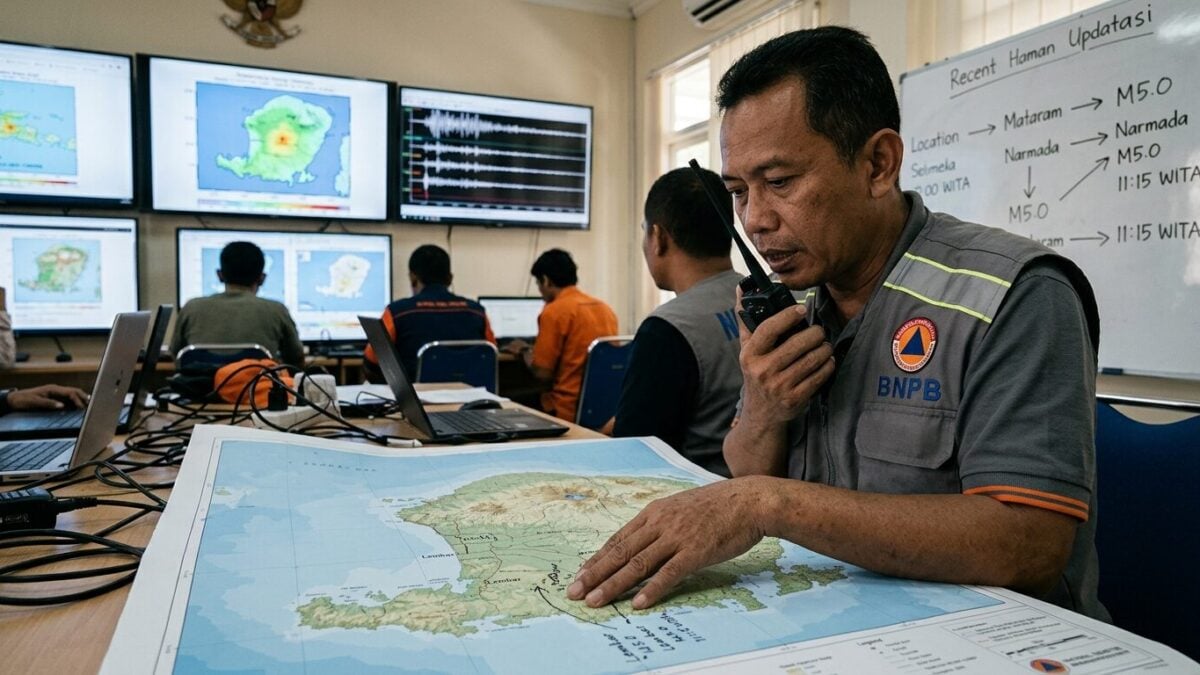
MATARAM, Indonesia — A magnitude 5.0 earthquake off West Lombok jolted residents awake early Wednesday and was felt as far away as Bali, but Indonesia’s meteorological agency said it posed no tsunami threat.
The quake struck at 4:15:26 a.m. local time on Oct. 7, 2026, according to the Mataram Geophysics Station of Indonesia’s Meteorology, Climatology and Geophysics Agency (BMKG). No casualties or building damage had been reported in the initial update. The shaking reached intensity IV-V on the MMI scale in Mataram, where some residents ran outside.
Shaking reached Bali
BMKG revised the earthquake’s magnitude from 5.2 to 5.0. Its epicenter was 14 km southeast of West Lombok, at coordinates 8.81 degrees south and 116.16 degrees east, with a depth of 82 km.
The agency classified it as an intermediate-depth earthquake caused by rock deformation within a plate. Its mechanism was a normal fault in the Indo-Australian Plate subduction zone, BMKG said.
Shaking reached intensity III-IV in Central Lombok, where many people inside homes felt it. In East Lombok, North Lombok, West Sumbawa and Sumbawa, the intensity was III MMI, comparable to the vibration of a large truck passing nearby.
In Bali, the shaking registered II-III MMI in Kuta and II MMI in Denpasar, where some people inside buildings felt it. The spread of the tremor across the islands prompted concern among residents, but BMKG said the quake had no tsunami potential.
One aftershock recorded
BMKG recorded one aftershock measuring magnitude 1.3. The report said it occurred within 30 minutes of the main quake, although the listed time of 3:45 a.m. local time precedes the main shock’s reported time of 4:15:26 a.m.
Monitoring was led by Mataram Geophysics Station chief Sumawan and BMKG’s director of earthquakes and tsunamis, Wijayanto. The agency advised residents to stay calm, watch for aftershocks and check their homes for damage.
The guidance has direct consequences for people returning to sleep or entering homes after the shaking: anyone who finds large cracks in a building’s structure should stay out until conditions are checked. BMKG also warned against unverified reports and directed the public to its official account, @infoBMKG, its website, BMKG.go.id, and the InfoBMKG app.
Seismic activity in the region
Lombok lies in the Pacific Ring of Fire and regularly experiences earthquakes. NTB recorded 422 quakes in September 2026, according to the source report, with activity attributed mainly to Indo-Australian Plate subduction, the Flores Back-Arc Thrust and the active Tambora fault.
The report compared the event’s mechanism with an NTB earthquake in 2021, describing both as intermediate-depth intraplate deformation rather than a megathrust quake. Lombok was also struck by a magnitude 7.0 earthquake in 2018.
“Cukup kaget langsung lemas,” one student said, describing the moment the shaking began.