Webb Traces Record-Distant Fast Radio Burst to a Surprisingly Small Galaxy
A signal that flashed across the universe in a fraction of a second has now been traced to a galaxy far smaller than astronomers expected.
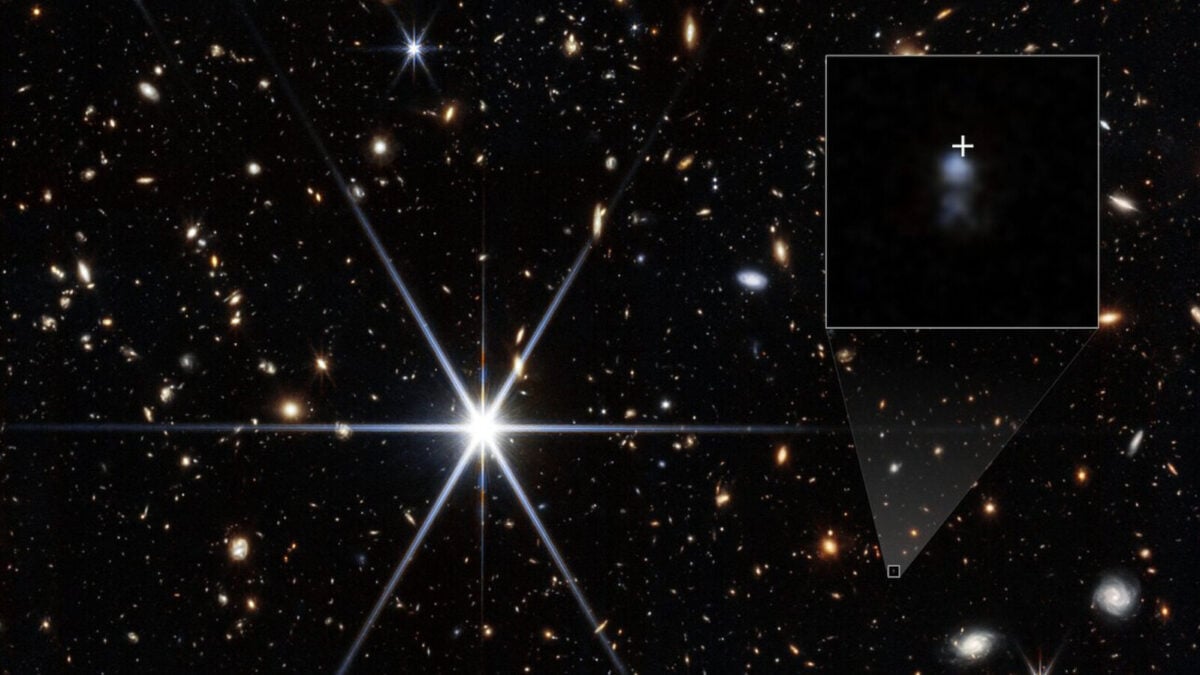
A signal that flashed across the universe in a fraction of a second has now been traced to a galaxy far smaller than astronomers expected. The James Webb Space Telescope’s identification gives researchers a new clue about where fast radio bursts come from—and challenges the picture drawn by earlier detections.
The burst was first detected in 2024 by South Africa’s MeerKAT radio telescope array and was the most distant fast radio burst observed at the time. Webb later used its near-infrared instruments to identify a galaxy in the signal’s apparent direction. Measurements of the galaxy’s stretched light place the burst about 3 billion years after the Big Bang.
A different kind of host galaxy
That timing puts the event in an era when star formation across the universe was at its peak. But the host galaxy itself is roughly 1,000 times smaller than astronomers had expected.
The contrast matters. Earlier fast radio bursts were found in massive galaxies that were actively forming stars, and those events occurred billions of years later in cosmic history. This detection points to a burst from a much earlier period and a markedly smaller galaxy.
A sharp mismatch. It suggests the known examples may not capture the full range of environments where these bursts occur.
Brief signals, lasting questions
Fast radio bursts are intense pulses of radio waves from deep space. They last less than a second, yet can release as much energy as the sun emits over three days. First discovered in 2007, they remain poorly understood.
Astronomers have proposed different explanations for how the bursts are produced, but the supplied findings do not identify which mechanism caused this event. Pinpointing its host galaxy instead adds a new piece of evidence: the phenomenon can occur in a small galaxy from the universe’s early history, not only in the large, star-forming systems seen in previous detections.
The galaxy’s estimated age places the burst about 3 billion years after the Big Bang.
Source: engadget.com