Indonesia looks mosque loudspeakers for quake alerts
Researchers are testing whether mosque loudspeakers can carry earthquake warnings to hard-to-reach communities in Indonesia. The five-year trial has connected…
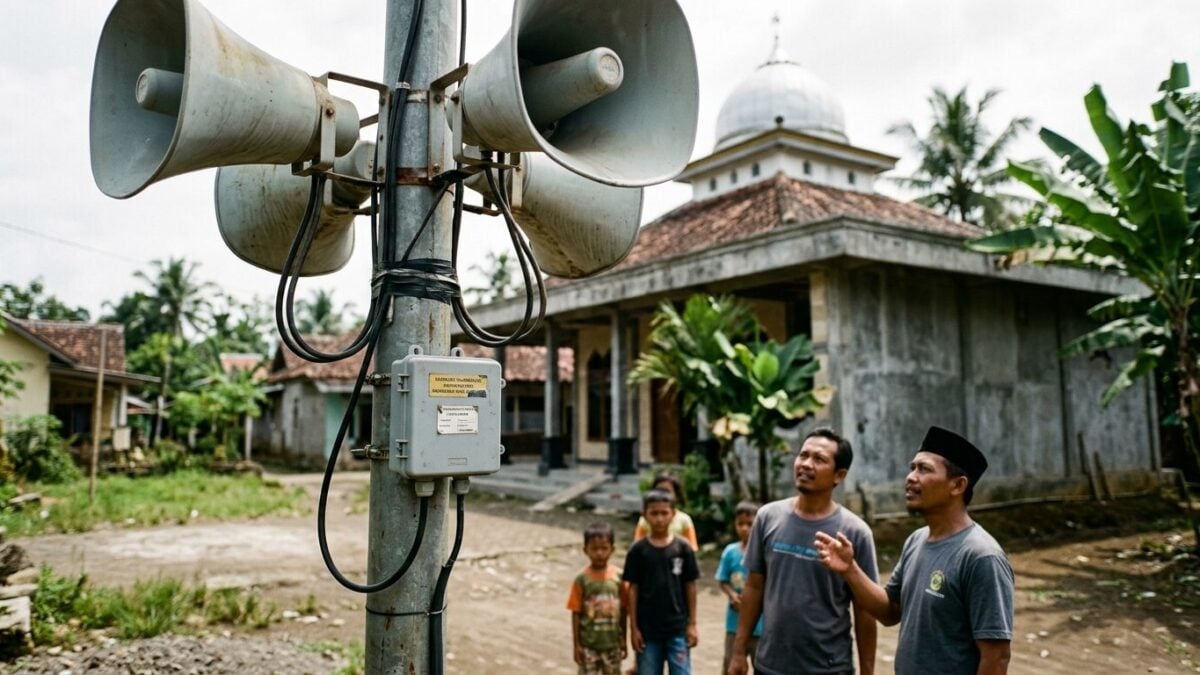
Indonesia’s distance and remote communities make earthquake alerts difficult to deliver quickly. Researchers are testing whether mosque loudspeakers can help warn people before shaking arrives, though the system is not yet issuing alerts to the public.
The five-year trial has connected several mosques to a seismic sensor network. The project, which runs until 2030, is assessing whether speakers commonly used for the call to prayer can also function as earthquake alarms.
“Every community has a mosque,” project lead Dr Inoue Hiroshi told The Guardian. Inoue, a disaster scientist at Japan’s Disaster Prevention Research Institute at Kyoto University, is working with the Indonesian government on the research.
The trial could make use of infrastructure already present in communities. Indonesia has hundreds of thousands of mosques, whose loudspeakers broadcast the call to pray five times a day. The speakers are regularly maintained, a practical advantage in a country where reaching remote areas poses a challenge for disaster agencies.
That matters because warning systems depend not just on detecting a hazard, but on getting a message to people in time. Mobile phones are used in many modern preparedness plans, but earthquakes can disrupt the communications infrastructure they rely on. Mosque speakers offer a potential alternative using equipment already maintained by local communities.
Indonesia looks mosque loudspeakers as part of wider alert research
“The advantage of a mosque speaker is that they’re existing and well maintained,” Inoue said. “For any disaster infrastructure, maintenance is the big challenge … but the mosque speaker is maintained by the people”.
Indonesia has had a tsunami early warning system since 2008. The earthquake initiative is different: tsunami threats affect coastal areas and can be predicted minutes or even hours ahead, while earthquake waves move through the ground at high speed.
A village 50km from an earthquake’s epicentre could have only five to 10 seconds to respond, said Andi Eka Sakya, senior researcher at the Indonesian government-affiliated National Research and Innovation Agency and the Indonesian head of the joint research team. He described the proposed system as a possible “breakthrough”.
Still, the trial has not reached the public-alert stage. “It’s still a prototype, and they don’t issue warnings to the public yet,” Sakya said. “The ultimate goal is actually to alert the people so that they can respond as early as possible.”
The research team is also considering alarm systems in school loudspeakers, along with radio and television transmissions. The work includes comparing behaviour and survival strategies in Indonesia and Japan, both of which lie on the Pacific Ring of Fire and are frequently affected by earthquakes.
Japan’s official disaster guidance emphasizes “drop and cover,” such as taking shelter under a table and staying indoors. In contrast, Inoue said, people in Indonesia have often survived by escaping outside, reflecting the risks posed by low-rise homes built with unreinforced masonry. He said some two-storey buildings have had their first floor crushed while the second floor remained relatively intact.
“The way people react is they quickly escape out of the room,” Inoue said. “They know how to survive.” The project is scheduled to run until 2030.
Source: theguardian.com