Stock Market News Oct: Nasdaq Has Worst Week Since June
U.S. stocks fell Friday as technology shares faced pressure from concerns over borrowing costs and debt tied to the artificial intelligence boom. The Nasdaq…
U.S. technology shares tumbled Friday, and stock market news oct was dominated by mounting concern over debt financing for the artificial intelligence boom. The Nasdaq Composite fell 2.14%, taking its weekly loss to roughly 4.5%—its worst week since June.
The S&P 500 dropped 1.09% on Friday and lost almost 2% for the week, also its worst weekly performance since June. The declines came just 10 days after the Nasdaq and S&P 500 reached record highs, according to CNN.
Investors weighed higher borrowing costs against the amount of debt some companies are taking on to expand data centers and computing capacity. Oil prices also rose Friday, with Brent crude touching $110 per barrel for the first time since May, adding to concerns about inflation and the possibility of further interest-rate increases by the Federal Reserve.
AI financing fears weigh on technology stocks
CoreWeave, a company that rents computing power to businesses involved in artificial intelligence, has become a focal point for market anxiety. CNN reported that the company carries tens of billions of dollars in debt to fund its growth and that its bond yields recently surged to levels signaling distress or increased default risk.
“It’s unclear that (CoreWeave) is going to get a sufficiently good return to pay down the debt that they borrowed,” Gil Luria, head of technology research at D.A. Davidson, told CNN.
Luria said he sees demand for AI as real and growing, but said that outlook sits alongside concerns about expensive financing and steep interest rates. He described companies such as CoreWeave as “the subprime tranche of the AI trade,” saying they were selling off first as investors questioned the pace of the buildout.
Nvidia CEO Jensen Huang backed CoreWeave in comments to Bloomberg on Thursday, helping its shares rally that day. The gain did not last: CoreWeave stock fell almost 12% Friday and lost one-quarter of its value over the week, CNN reported.
The pressure reaches beyond newer data-center operators. Investors are reassessing whether the expected returns from AI will justify the cost of building out the technology, a shift that has put chipmakers and other companies tied to that investment under pressure.
Chipmakers and global markets feel the strain
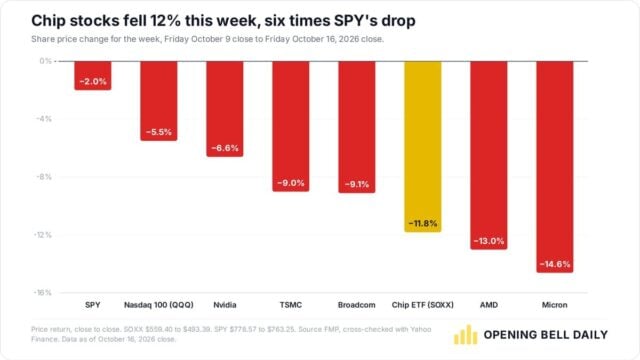
A closely watched semiconductor stock index fell 3.8% Friday, extending its losing streak to eight days. It dropped 11.4% for the week, its worst weekly showing since April 2025, and stood more than 20% below its June peak. The index was still up more than 50% year to date, CNN reported.
Investors had sent chip stocks higher on expectations of a major AI expansion and a shortage of chips. But concerns about rising costs and the possibility that data-center expansion could face obstacles have challenged that outlook. CNN also reported that Chinese memory chipmaker CXMT announced progress on advanced memory chips earlier in the week, unsettling investors who had counted on U.S. and South Korean firms to retain market share and pricing power.
“The market sells first, asks questions later,” Thomas Martin, senior portfolio manager at Globalt Investments, told CNN. “That’s why you get the volatility.”
South Korea’s Kospi, heavily weighted toward chipmakers SK Hynix and Samsung Electronics, fell 14.5% over the week, its worst weekly performance since 2008. The index had risen as much as 116% year to date in June, but had since erased its gains over the past six months and stood up 35% year to date, according to CNN.
For investors, the sell-off shows how concerns about financing and future returns can spread from debt-heavy AI infrastructure companies to chipmakers and broader indexes. The next test cited by market analyst Daniela Hathorn is whether upcoming Big Tech earnings show that large AI investments are generating enough revenue and cash flow to justify their cost.
Source: finance.yahoo.com