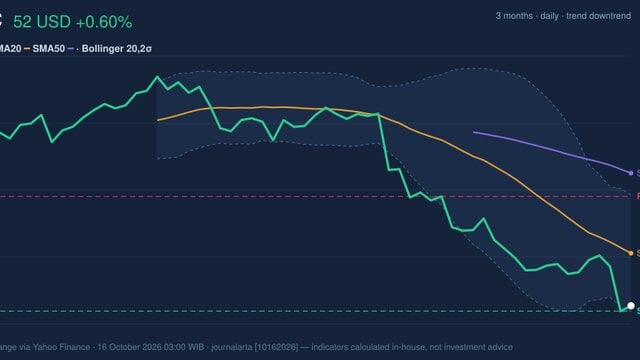
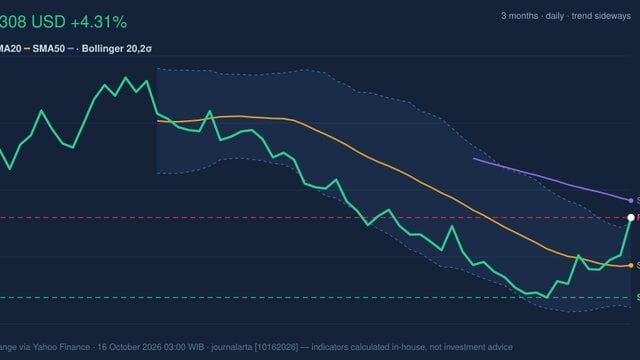
Stock Market Week Chip Selloff Widens as AI Debt Fears Grow
Chip stocks recorded a sharp weekly decline as broader U.S. indexes also fell. The iShares Semiconductor ETF dropped 11.8%, while the S&P 500 lost 2.0%…
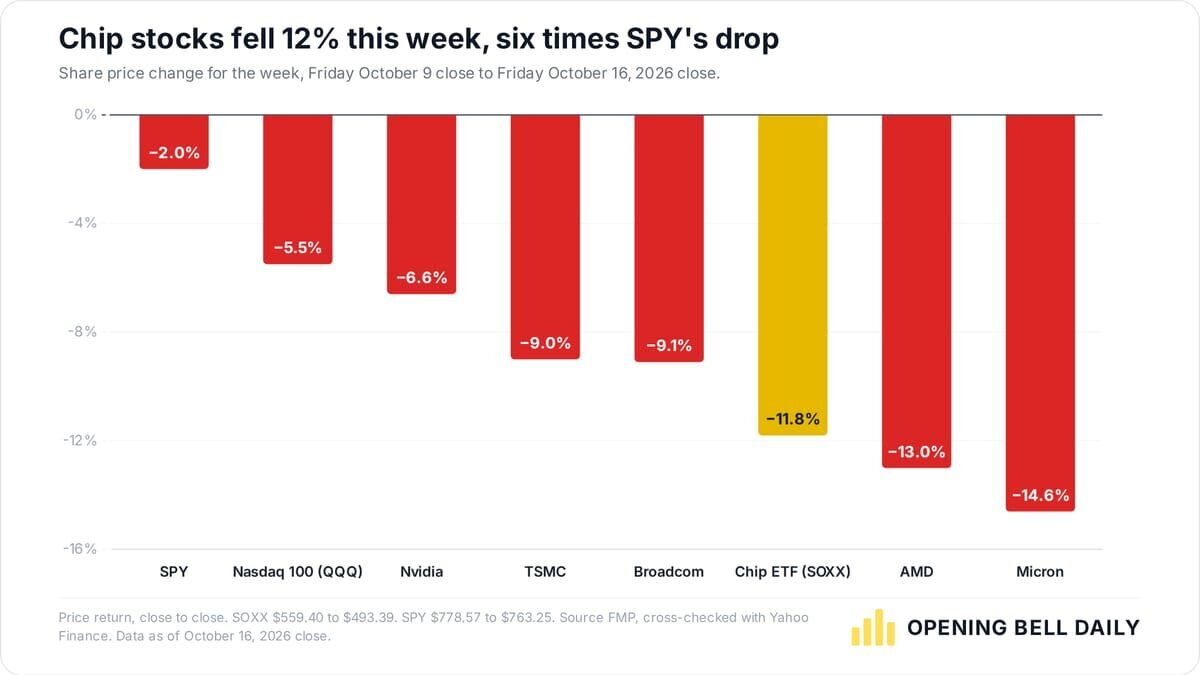
The stock market week chip selloff pushed the iShares Semiconductor ETF down 11.8% through Friday, October 16, six times the S&P 500’s 2.0% weekly decline, according to Opening Bell Daily. Micron fell 14.6% and AMD dropped 13.0%, as concerns about AI financing and chip demand weighed on technology shares.
The declines reached beyond semiconductor companies. The Nasdaq Composite lost 2.14% on Friday, leaving it down roughly 4.5% for the week, its worst weekly performance since June, CNN reported. The S&P 500 fell 1.09% on Friday and nearly 2% for the week, also its worst week since June.
Investors have had little time to digest the reversal. The Nasdaq and S&P 500 reached record highs just 10 days earlier, CNN said. The benchmark indexes then stumbled as higher borrowing costs raised questions about debt-financed parts of the artificial-intelligence boom.
Semiconductor shares take a sharp hit
Opening Bell Daily reported that the iShares Semiconductor ETF closed at $493.39 on Friday, down from $559.40 on October 9. The S&P 500 benchmark cited in the same report slipped from $778.57 to $763.25 over that period. The Nasdaq 100 ETF, QQQ, lost 5.5% for the week, and every chipmaker on the publication’s chart fell more.
CNN reported a separate weekly decline of 11.4% for a closely watched semiconductor index, its worst weekly performance since April 2025. The index fell 3.8% on Friday, marking its eighth consecutive day of losses. The publication said the index remained up more than 50% year-to-date, despite falling more than 20% from its June peak.
The pressure matters because chipmakers have supplied a large share of the market’s gains. Opening Bell Daily said Nvidia, Micron, AMD and Intel added about $2.35 trillion in market value through October 15, representing 28% of the combined gain in S&P 500 stocks. A sharp reversal in those shares can therefore weigh on a wider group of investors, not only holders of individual chip companies.
That turn came quickly. The scale is stark.
Investors had bid semiconductor shares higher on expectations of a large AI infrastructure buildout and a chip shortage that could lift profits. CNN said those expectations now face concerns about rising costs and whether the data-center expansion could be hampered by political disputes. The report also pointed to investor debate over whether lower-cost, efficient chips from China could challenge assumptions about U.S. and South Korean companies’ market share and pricing power.
Debt and demand concerns spread
AI-related borrowing has become another pressure point. CNN identified neocloud providers, which rent computing power to companies involved in the AI boom, as a source of market anxiety. CoreWeave, a company backed by Nvidia, has tens of billions of dollars in debt, according to CNN, while its bond yields recently rose to levels that signal distress or a higher risk of default.
“It’s unclear that (CoreWeave is) going to get a sufficiently good return to pay down the debt that they borrowed,” Gil Luria, head of technology research at D.A. Davidson, told CNN. He said demand for AI was real and growing, but that investors were weighing it against concerns about financing and steep interest rates.
Nvidia CEO Jensen Huang publicly expressed optimism about CoreWeave on Thursday, telling Bloomberg that he was optimistic about the company, CNN reported. CoreWeave shares rallied that day, then fell almost 12% on Friday. CNN said the stock lost one-quarter of its value during the week.
Oil added to concerns about inflation and borrowing costs. Brent crude touched $110 per barrel on Friday for the first time since May, CNN reported, raising concern that inflationary pressure could push the Federal Reserve to raise interest rates further.
The weekly losses put pressure on portfolios tied to technology and broad U.S. indexes, while leaving investors to weigh competing signals: continued demand for AI against debt costs, chip competition and uncertainty over the pace of data-center construction. CNN quoted Thomas Martin, senior portfolio manager at Globalt Investments, saying: “The market sells first, asks questions later.”
Source: openingbelldailynews.com