Fossils Suggest Armored Amphibian Lived Entirely at Sea 237 Million Years Ago
Researchers describe Gerrothorax maritimus from two nearly complete skeletons found in China’s Guizhou Province. The armored, flat-bodied amphibian lived on…
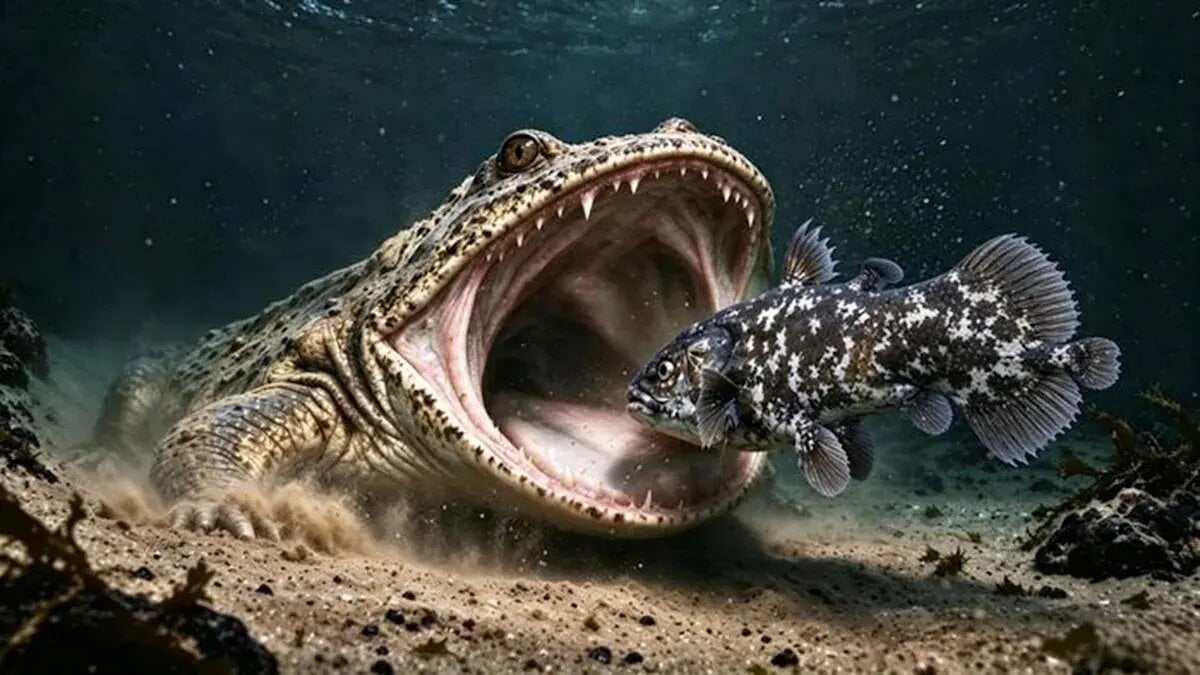
Nearly 237 million years ago, an armored amphibian lived entirely at sea, fossils suggest. Researchers identified the animal as Gerrothorax maritimus from two nearly complete skeletons found in China’s Guizhou Province, in sediments from an area that was once ocean.
The discovery offers fossil evidence for a fully marine amphibian, a way of life not previously documented in the fossil record. The team says the animal lived on the seafloor, far from large land masses, and may have waited for prey before sucking it in.
Skeletons preserve clues to its life
The fossils date to the Late Triassic period. Their preservation allowed researchers to reconstruct a broad, flat body, almost 3 feet (0.9 meters) long, covered in bony armor. The animal was roughly the size of a giant salamander, but its body was much chunkier.
Ryosuke Motani, the study’s corresponding author and a professor of Earth and planetary sciences at UC Davis, said it was large for an amphibian. Its body mass was similar to a giant salamander’s, he said, although that living animal has a more elongated shape.
The team’s interpretation draws on several clues. The fossils came from deep-sea sediments, and the skeletons retained their fingers. Motani said carcasses floating at sea usually dry out and lose limbs before sinking; the intact remains therefore suggest these animals died near where they lived.
Chemical tests added support: strontium isotope ratios in the fossils closely match those of Late Triassic oceans.
Armor and gills may have helped
Modern amphibians are tied to freshwater in part because their permeable skin lets them breathe and take in water. More than 8,000 living amphibian species are known, but none are known to live in fully marine environments; fewer than 2% show any salt tolerance, the researchers note.
The team proposes that Gerrothorax maritimus overcame that constraint with its armor and a more fish-like biology. The bony covering may have kept seawater from soaking through its skin. The researchers suggest it drank seawater through its mouth and absorbed it through its digestive tract, while gills present in the Gerrothorax genus could have filtered out salt.
Its skull shape and armor also point to a bottom-dwelling suction feeder, according to the researchers. Motani compared its proposed hunting style to that of the wobbegong, a modern bottom-dwelling carpet shark: it may have waited on the seafloor and sucked in prey that passed nearby.
The study team includes researchers from the University of California, Davis, Peking University and the Geological Museum of Guizhou. Motani said the animal is an unusual addition to an ecosystem the team has been reconstructing, which has so far mostly yielded marine reptiles and fish. The discovery was published in Nature Ecology & Evolution.
Source: yahoo.com