How long does take laser: Moon trip takes 1.21 seconds
A laser beam takes between 1.21 and 1.35 seconds to travel from Earth to the Moon, depending on the Moon’s position in its orbit, SlashGear reports. Reflectors…
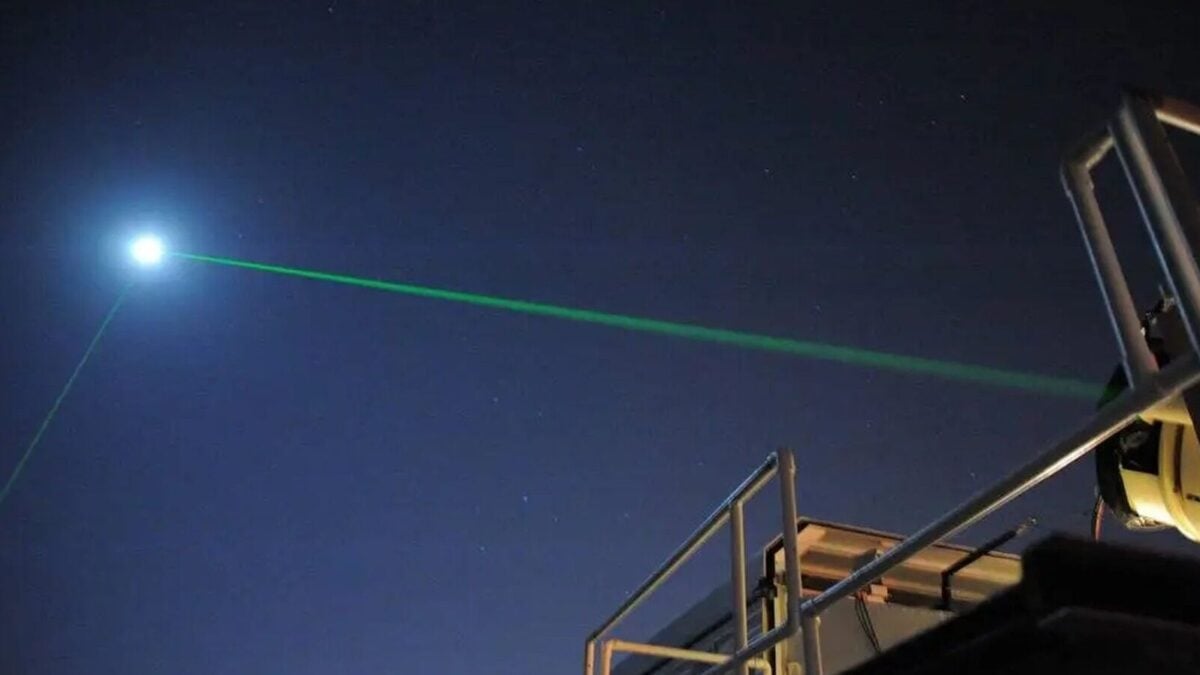
A laser beam takes between 1.21 and 1.35 seconds to reach the Moon, depending on its position in orbit, according to SlashGear. Reflectors on the lunar surface have allowed scientists to measure the light’s journey and track the changing distance between Earth and the Moon.
The trip is brief, but a return beam takes longer. Light takes about 2.5 seconds to complete the round trip, SlashGear reports, using measurements made with reflectors placed on the Moon.
How long does take laser to reach the Moon?
The Moon averages around 238,855 miles from Earth. Its distance varies from about 226,000 miles at its closest to 251,000 miles at its farthest, which accounts for the range in travel time.
A laser beam is light, so it travels at the speed of light. SlashGear gives that speed as 670,616,629.3844 miles per hour. The tightly focused beam can travel in one direction without scattering, unlike the broader light from a bulb or flashlight.
That difference matters for the measurement. Scientists can send a beam toward a reflector and detect light returning to Earth, allowing them to measure the distance between the two bodies over time.
Lunar reflectors turn a short trip into a measurement
Five reflecting panels are currently on the Moon, SlashGear reports. The first was left by Apollo 11 astronauts in 1969 and contained 100 corner-cube mirrors. The Soviet robotic rover Lunokhod 1 carried 14 mirrors when it reached the Moon in 1970.
The Apollo 14 crew placed another panel with 100 corner cubes in 1971, and the Apollo 15 crew placed one with 300. The Soviet Lunokhod 2, equipped with 14 mirrors, was left on the Moon in 1973.
These reflectors send laser light back toward its source. Repeated measurements help scientists follow changes in the Earth-Moon distance. SlashGear reports that the two bodies are moving about 1.5 inches farther apart each year.
The older mirrors have become less effective, likely because moon dust from tiny meteorite impacts has covered them. NASA launched the Lunar Reconnaissance Orbiter in June 2009 to study the Moon from orbit, carrying a newer reflector that NASA described as “the size of a paperback novel.”
The reflector took over a decade to hit its mark with a laser. The beam reached it in August 2020, according to SlashGear.
Another NASA laser mission has a different purpose. In a 2020 account, NASA said its Lunar Flashlight CubeSat was designed to shine lasers into permanently shadowed craters near the Moon’s South Pole to look for surface ice. Its four-laser reflectometer uses near-infrared wavelengths that water readily absorbs.
NASA said the spacecraft could identify ice on the surface, but not below it. A beam reflected from bare rock would indicate a lack of ice, while absorbed light would point to ice in the dark regions. The distinction matters for plans to assess lunar water as a potential resource for future exploration.
Source: slashgear.com