
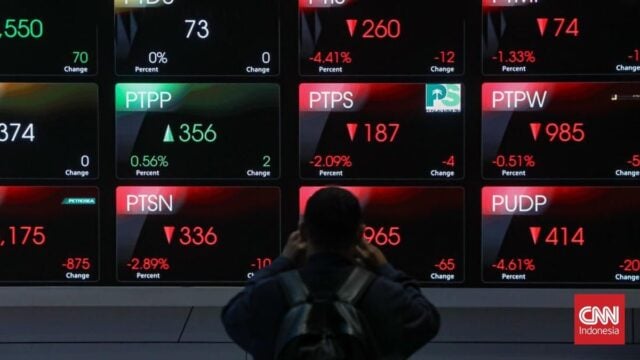
JAKARTA — The Jakarta Composite Index (IHSG) came under heavy pressure in today’s midday trading. The domestic benchmark slipped to the 5,920 level, reflecting negative sentiment that is dominating the market floor and triggering massive sell-offs across multiple sectors.
Data from the Indonesia Stock Exchange (BEI) showed that the majority of stocks on the trading board were in the red. As many as 447 shares posted sharp declines from the previous session’s close, while only 197 issuers managed to gain and another 142 stocks moved flat. The correction hit the valuation of companies listed on the national bourse, with total market capitalization now at Rp10,374.72 trillion.
Market Pressure Distribution
The dominance of pressured stocks shows selling pressure that is spread across almost all sector lines. High trading volume amid a negative trend often indicates a large-scale transfer of share ownership, with market participants tending to choose assets considered safer or taking profits (cash out) temporarily.
| Market Condition | Number of Issuers |
|---|---|
| Declining Stocks | 447 |
| Advancing Stocks | 197 |
| Flat Stocks | 142 |
This condition is not just a normal daily fluctuation. When more than two-thirds of issuers on the exchange weaken, investor portfolio risk becomes very high. The phenomenon is forcing market participants, both institutions and retail investors, to re-evaluate their short-term investment strategies to avoid the potential for deeper losses amid extreme market volatility.
Real Impact on Investors
For investors, the IHSG’s drop to 5,920 is a warning sign that cannot be ignored. When the market is volatile, the stakes become even higher. Investors holding stocks with strong fundamentals may see the decline as an accumulation opportunity, while those trapped in speculative stocks are forced to bear deep price corrections due to panic selling.
The condition has a direct impact in the form of shrinking portfolio asset values. In addition, the negative sentiment could trigger uncertainty over foreign capital flows. If foreign investors continue to record net sell activity, pressure on the rupiah and liquidity in the domestic stock market will increase further in the short term.
Technical Factors and Outlook
Technically, the 5,920 level is a crucial area closely watched by analysts. A break below this psychological level adds to the mental burden on market participants. Without a strong positive catalyst from domestic economic data releases or exchange-rate stability, the index is indeed vulnerable to being trapped in a prolonged correction.
Market participants are now waiting to see whether there will be intervention from major institutional investors or market stabilizers to dampen panic. Index movement history shows that after large-scale selling, a consolidation phase or a slight rebound often follows. However, the effectiveness of such recovery depends heavily on certainty that foreign capital will flow back into the domestic market within the next 7 to 30 days.
Looking ahead, IHSG’s movement will be heavily determined by macroeconomic sentiment released over the next month. If inflation remains under control and public purchasing power is not significantly disrupted, there is room for the market to recover its position. However, investors are still advised to maintain a reasonable cash ratio (cash level) and avoid making decisions based purely on panic amid this high uncertainty.
📝 Leave a Comment
Comment as . Reviewed by an admin before it appears.