IHSG Slumps 3.56% After MSCI Keeps Indonesia on Watch
IHSG drops 3.56% after MSCI keeps Indonesia in Emerging Markets and warns on transparency, free float, and liquidity.
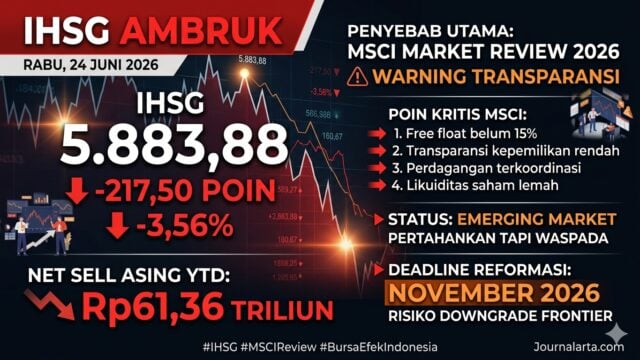
JAKARTA, JOURNALARTA.COM — IHSG fell 217.50 points, or 3.56%, to 5,883.88 on Wednesday, June 24, 2026, after MSCI kept Indonesia in its Emerging Markets bucket but warned that major market flaws remain unresolved. The move came right after MSCI released its review at 5:00 a.m. WIB, and foreign investors quickly turned into net sellers.
The drop was the sharpest for the benchmark since January 2026, when MSCI first froze any increase in the weighting of Indonesian stocks. It also deepened a correction that had already been building for weeks. By June 5, IHSG had fallen 8.69% to 5,594.765, while foreign net selling in 2026 had reached Rp61.36 trillion.
MSCI keeps Indonesia in Emerging Markets, but the warning stings
MSCI did not move Indonesia out of Emerging Markets, a relief for local policymakers. But the tone was anything but soft. The index provider said the reforms so far were only “a step in the right direction” and warned that “time is running out” for more meaningful progress.
The company flagged four main issues: low share ownership transparency, several issuers still missing the minimum 15% free-float threshold, signs of coordinated trading activity, and thin liquidity in parts of the market. In plain language, MSCI is telling investors that some Indonesian stocks still do not trade the way a large global index wants them to.
That matters because MSCI benchmarks influence where global funds place money. If a market falls out of favor, passive and active managers can trim exposure fast. For Indonesia, that means the warning is not just technical. It reaches pension funds, sovereign-style allocations, and the broader cost of capital for listed companies.
Why the free-float issue now sits at the center
Transparency is the biggest red flag in MSCI’s review. Based on Indonesia Stock Exchange data at the end of 2025, around Rp187 trillion, or roughly US$10 billion, in additional shares would need to be placed with the public so all issuers meet the 15% free-float rule. That is not a small adjustment. It would require real action from controlling shareholders.
MSCI also wants clearer information on beneficial ownership. Foreign investors want to know who really controls a company, not just what appears on the surface. And when the market shows signs of coordinated trading, the concern rises further. Funds dislike uncertainty. They dislike it a lot.
Goldman Sachs has estimated that a downgrade to Frontier Market status could trigger as much as US$13 billion in capital outflows. That is not a forecast of what will happen next week. It is a warning about what a loss of confidence could eventually cost if reforms stall.
What it means for investors, the rupiah, and bonds
The selloff did not stay on the stock screen. The rupiah weakened as investors digested the MSCI note, while the 10-year government bond yield rose to 7.27%, signaling that traders demanded a higher return for holding Indonesian debt. Large-cap stocks also felt the pressure, especially names tied to family-controlled groups that had already been under MSCI scrutiny.
That is the direct hit for ordinary market participants. When foreign money leaves, prices move faster, financing becomes more expensive, and volatility rises. Retail investors may see sharper swings in blue-chip shares. Companies face a tougher road if they want to raise funds through the market. And for policymakers, the message is blunt: fixing the plumbing matters as much as pushing growth numbers.
Analysts said the MSCI decision was not a clean vote of confidence. Tan Altundag, an investment manager at Pictet Asset Management, said the unchanged status does not automatically rebuild trust or stop outflows. “This is not a clear sign of recovery. The conditions to get back into this market are still quite high,” he said, adding that his firm currently places Indonesia below benchmark weight.
Gary Tan, a portfolio manager at Allspring Global Investments, called the review broadly in line with expectations, though still cautious in tone. Mirae Asset Sekuritas said global pressures are adding to the strain, including higher world oil prices and expectations that the U.S. benchmark rate will stay elevated.
Regulators race to answer MSCI’s concerns
Since MSCI first flagged the issue in January 2026, the government, the Financial Services Authority, and the Indonesia Stock Exchange have moved to tighten the market. BEI has given issuers deadlines to meet free-float requirements, with delisting threats for firms that fail to comply. OJK and BEI have also stepped up monitoring to catch suspicious or coordinated trading.
At the same time, policymakers have tried to broaden demand. Insurance firms and pension funds were allowed to increase equity allocations, while Danantara Indonesia was asked to place more money in the stock market as a stabilizing shareholder. Bank Indonesia and the Finance Ministry have also worked to keep bond yields stable and attractive for foreign investors.
Trading activity, for now, has not frozen. Between June 2 and June 5, 2026, transaction frequency rose 14.11% and volume increased 8.66%, even as the index slid 8.69%. That shows the market is still active. It just has a heavy selling bias. November 2026 is now the date investors will watch most closely.