Oil Price Drops to $60 a Barrel? 7 Stocks That Could Benefit
Oil price drops to $60 a barrel can lift margins for several stocks, from PGAS to UNVR. Here’s why they may benefit.
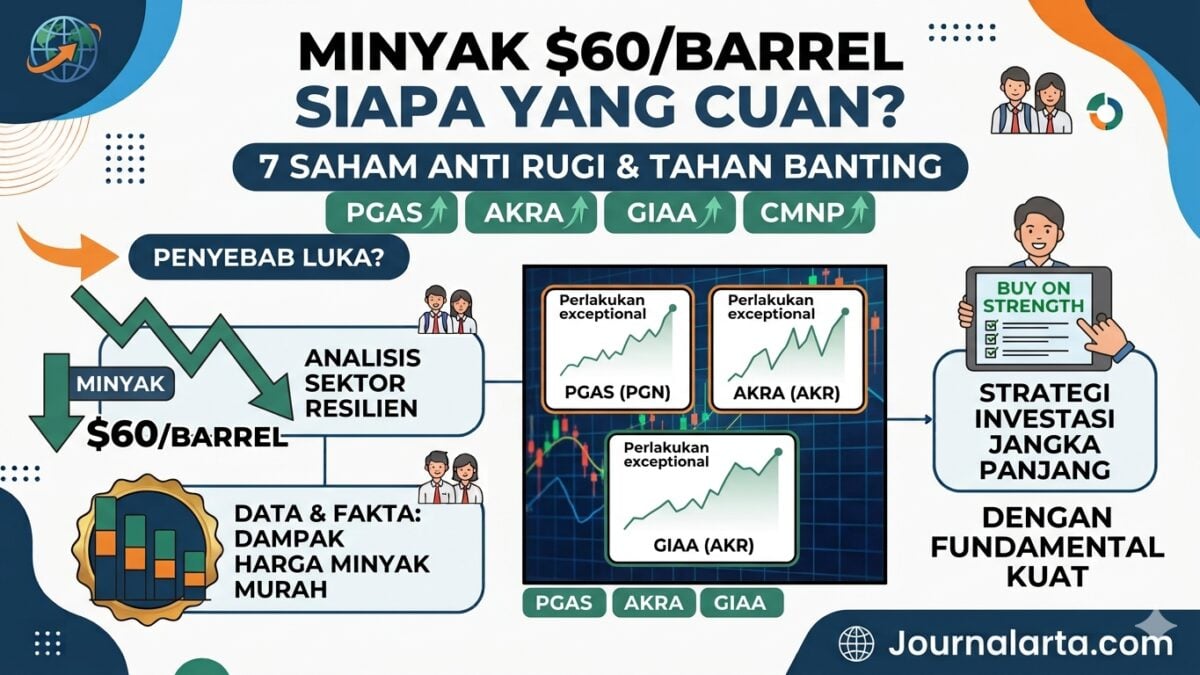
JAKARTA, JOURNALARTA.COM – When global oil prices weaken, the first reaction from many market participants is panic, especially among holders of energy stocks. But there is another side that often gets missed: lower oil prices can actually be a windfall for several business sectors.
The logic is simple. For companies that use oil and its derivatives as a major operating expense, cheaper crude means lower costs, wider profit margins, and, in some cases, stronger consumer spending power.
Here are seven stocks projected to reap sizable gains if benchmark Brent crude falls to the $60-per-barrel range.
Why Can Some Stocks Gain When Oil Prices Fall?
Oil prices sit at the center of costs for many industries. When that core expense falls, business efficiency improves. Three sector groups feel the effect most clearly:
1. Distribution companies: They buy inventory at lower prices but sell it before prices adjust fully, so the profit spread widens.
2. Transportation services: Fuel and jet fuel account for 30–40% of total operating costs. A drop in prices cuts expenses quickly.
3. Processing industries: Factories that use oil, gas, or derivatives as raw materials and production energy become more cost-efficient.
7 Stocks Most Likely to Benefit If Brent Reaches $60
Below is a breakdown of the rationale and potential upside for each issuer:
1. PGAS - Perusahaan Gas Negara Tbk
This is a unique case and often called a paradox. Even though it operates in the energy sector, PGAS tends to benefit when oil prices fall.
- Why it benefits: Most of its gas selling prices to PLN and industrial customers use a reference formula tied to the average Brent price over a certain period. Meanwhile, gas purchase costs from upstream producers adjust more quickly to lower market prices.
- Impact: If Brent falls to $60, PGAS’s cost of goods sold declines faster than its selling price. That widens profit margins.
- Projection: Potential share price rise from around Rp1,800 to Rp2,100 per share.
2. AKRA - Atlas Resources Tbk
As a distributor of fuel and industrial chemicals, AKRA has a dynamic that tends to work in its favor when commodity prices correct.
- Why it benefits: The company buys fresh inventory at lower prices but sells to customers under pricing contracts that remain in effect for about one month.
- Impact: There is a roughly one-month time lag before selling prices adjust, so during that period the margin spread becomes very large. Inventory markdown losses occur only once, followed by wider margins over the next few months.
3. GIAA - Garuda Indonesia Tbk
Jet fuel is the biggest cost item for an airline.
- Why it benefits: Jet fuel makes up around 35% of total operating costs. Its price moves in line with Brent and the MOPS index.
- Impact: If Brent falls to $60, jet fuel prices could decline by around 15–20%. Every 1% drop in jet fuel prices is estimated to save about Rp200 billion a year. If that is paired with stronger passenger load factors, the chance of returning to profit becomes much more open.
4. CMNP - Citra Marga Nusaphala Persada Tbk
Although it does not use oil directly as a raw material, the toll road sector still gets an indirect lift.
- Why it benefits: When fuel becomes more affordable, people tend to travel more, go on holidays more often, and ship goods more frequently.
- Impact: Traffic volume on toll roads rises. That automatically lifts toll revenue without adding much in operating costs. A similar effect also applies to issuers such as JSMR and WSKT.
5. AUTO - Astra Otoparts Tbk
Lower oil prices bring two benefits at once for auto parts makers.
- Why it benefits: First, raw materials for components such as plastic and rubber, which come from oil derivatives, become cheaper. Second, affordable fuel encourages consumers to buy new vehicles or repair the ones they already own.
- Impact: Production cost pressure eases and market demand improves, supporting stronger net profit growth.
6. INKP - Indah Kiat Pulp & Paper Tbk
Paper mills are among the most energy-hungry industries.
- Why it benefits: Heating and processing require energy supplies from oil or gas.
- Impact: If oil prices fall to $60, production costs are estimated to drop by around 5–7%. That savings flows straight into net income because paper selling prices usually do not change sharply in the short term.
7. UNVR - Unilever Indonesia Tbk
The consumer goods producer also stands to gain.
- Why it benefits: A large share of production costs is tied to plastic packaging, fragrance materials, and detergents, all of which come from oil derivatives.
- Impact: Cost of goods sold falls, so gross profit margins improve. The company does not need to cut retail prices immediately, which makes the spread wider.
Rough Calculation: How Much Savings Could Add Up?
Assuming Brent falls from its current level of $73.76 to $60 per barrel, a drop of about 18.6%, here is a rough picture of savings and profit upside:
1. GIAA: Jet fuel savings are estimated at around Rp1.5 trillion a year.
2. PGAS: Margin expansion of about 2–3%, equal to roughly Rp800 billion in extra profit.
3. AUTO: A production cost decline of around 3% could lift net profit by 10–12%.
Risks to Watch
A drop in oil prices to $60 is often seen as the sweet spot for the economy and the stock market. But there are conditions that can break that logic:
1. Signs of recession: If oil falls sharply below $40 per barrel, it may signal collapsing global demand caused by an economic crisis. In that environment, almost all stocks can fall even if operating costs are cheaper.
2. Rupiah weakness: If the oil price decline comes alongside a stronger US dollar that pushes the exchange rate past Rp17,000, imported raw material costs may still feel expensive and wipe out the benefit.
3. Fundamental problems: Stocks such as GIAA may benefit from lower fuel costs, but if debt burdens remain heavy, the extra profit can be absorbed by obligations and risk stays high.
Conclusion
Do not view lower oil prices only as bad news. At the $60 to $75 per barrel range, this can create new investment opportunities. For investors who do not hold energy stocks, monitoring and building positions in the names above could be a way to keep profiting while the commodity is correcting.
Disclaimer: This article is an informational analysis and is not a recommendation to buy or sell stocks. Investment decisions remain the responsibility of each market participant.
Frequently Asked Questions
Q: Why doesn’t PGAS lose money when oil prices fall?
A: Because gas purchase costs fall faster than the decline in selling prices, so the profit spread widens.
Q: Will GIAA definitely profit if jet fuel gets cheaper?
A: It can significantly reduce losses and improve the chances of profit, as long as passenger load factors remain healthy.
Q: When does this stop being favorable?
A: If oil falls too far below $40, signaling a recession, or if the rupiah weakens sharply.
Q: Are the stocks above safe to buy now?
A: Always check the latest debt levels and financial statements of each issuer to make sure the fundamentals are stable.