
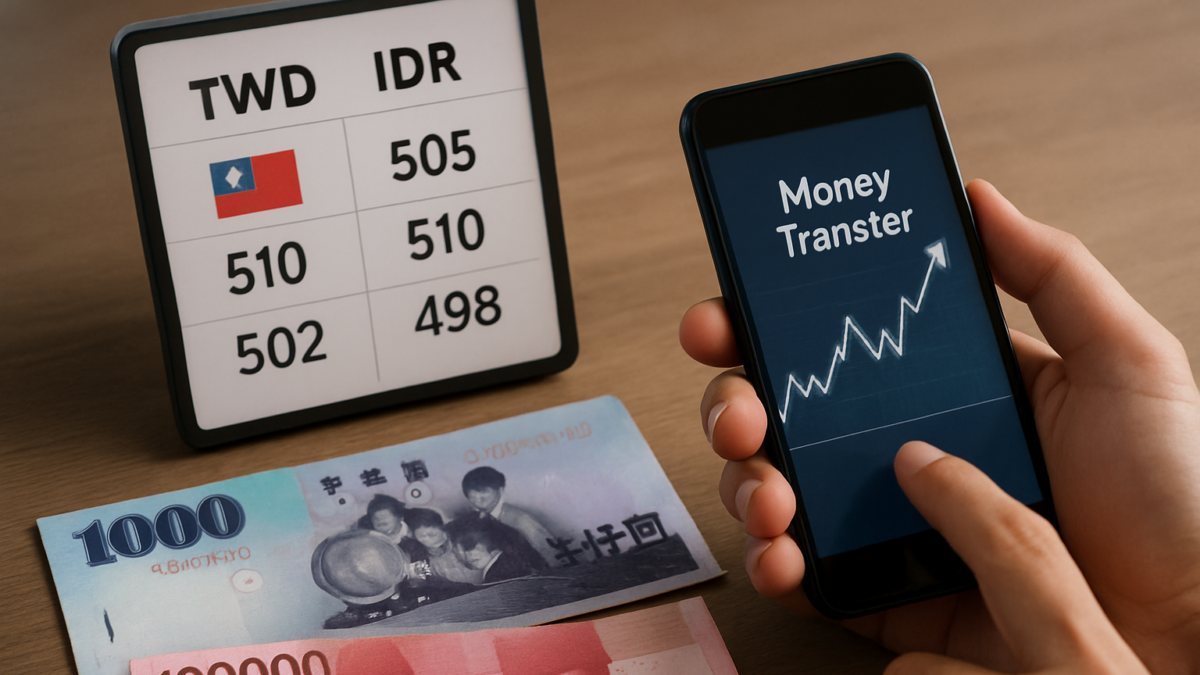
JAKARTA — For anyone sending money from Taiwan, the TWD to IDR rate can decide how much rupiah lands in the receiver’s account. Today, that exchange rate sits in the Rp4,700 to Rp4,750 range per 1 TWD, depending on the provider.
The difference may look small. It is not.
For people who remit money every month, even a narrow gap between banks, money changers, and digital transfer apps can change the final amount by a meaningful margin over a year.
Why the TWD to IDR rate matters
Cross-border transfers are never just about the headline exchange rate. The final amount depends on a mix of market movement, service fees, and the spread each provider adds to the rate.
Taiwan’s currency tends to move with investor sentiment around the island’s export-heavy economy, especially semiconductors and manufacturing. When global markets turn nervous, investors often shift into safer assets such as the U.S. dollar, and that can weaken the TWD against the rupiah.
There is also the spread. Banks and exchange services buy and sell foreign currency at slightly different prices. Big banks usually keep their spread around 0.5% to 1%. Money changers can charge 2% to 3% or more. On a transfer of TWD 10,000, a 2% difference can shave off about Rp100,000 from the amount received.
TWD to IDR today: rate comparison
| Provider | Buy Rate (Rp) | Sell Rate (Rp) | Spread |
|---|---|---|---|
| Bank Mandiri | 4,695 | 4,755 | 60 |
| BCA | 4,700 | 4,750 | 50 |
| Bank Negara Indonesia | 4,688 | 4,758 | 70 |
| Money changer (average) | 4,680 | 4,770 | 90 |
| Wise | 4,705 | 4,705 | 0 |
Note: The figures above are an illustration of today’s common exchange levels. Actual rates change every minute while the market is open. For real-time quotes, check each bank’s website or mobile app directly.
When is the best time to send TWD to IDR?
Timing is not exact science, but some patterns help.
Early morning in Indonesia, around 7 a.m. to 9 a.m. WIB, often brings more stable pricing than later in the day. At that time, Taiwan’s market has just closed and Asian markets are processing overnight developments. Volatility tends to ease, which can help keep spreads from widening too much.
Try to avoid sending money during major economic announcements. Inflation data from Taiwan, interest-rate decisions by the central bank, or sharp geopolitical news tied to Taiwan and China can move the TWD by 1% to 2% in a matter of hours. When that happens, banks often widen spreads to cover their own risk.
Weekends usually bring thinner liquidity, too. From Friday afternoon to Sunday, money changers may offer less attractive rates. If the transfer is not urgent, Tuesday and Wednesday are often the better days because trading activity is steadier and rates tend to be more competitive.
Choosing the right transfer channel
Not every transfer method works the same way. The best choice depends on how much you send, how fast the money must arrive, and how much paperwork you can handle.
Local banks such as BCA, Mandiri, and BNI are the safest and most transparent. Fees are usually shown clearly, often in the Rp50,000 to Rp150,000 range. Their rates are fair, and spreads are smaller. This option suits larger transfers and senders who can wait one to two working days. The trade-off is cost. For small transfers, bank fees can feel heavy.
Local money changers often post better rates than major banks because their overhead is lower. But the service usually requires an in-person visit. There is less digital documentation, so misunderstandings can be harder to resolve. This route may fit smaller, urgent transfers of up to TWD 10,000.
Digital transfer apps such as Wise, Remitly, or OFX often track the mid-market rate more closely, with little or no spread baked in. Fees are shown upfront, so you can see the total before clicking send. Transfers can arrive within one to two hours when the receiving bank supports it. This is the clearest option for people who care most about speed and transparency.
Practical tips to avoid losses on TWD to IDR transfers
First, do not rush just because the rate looks “good.” The TWD to IDR pair has moved between Rp4,600 and Rp4,900 over the past three months, so a rate around Rp4,720 is still within a normal band. Transfer when you need the money, not because you are trying to guess the exact top or bottom.
Second, compare at least three sources before sending. A Google search for “TWD to IDR” gives a quick reference point, then check the live rate on your bank’s site and on a transfer app. A difference of Rp50 per unit sounds tiny, but on TWD 50,000 it can mean Rp2,500,000 in total value difference. That is real money. Lunch money. Rent money.
Third, watch daily limits and transfer fees. Some banks cap international transfers online at the equivalent of USD 10,000 per day. If you need more, you may have to visit a branch or complete extra verification. Money changers usually do not have a formal digital cap, but larger transactions may still trigger requests for ID or proof of income.
Fourth, keep every receipt. Save the rate screenshot, reference number, and confirmation email. If the money is delayed or the recipient says it has not arrived, those records make follow-up far easier.
What could move TWD to IDR next week?
Traders are watching a few possible catalysts. Taiwan is due to release manufacturing and export data next week, and weak numbers could pressure the TWD. The central bank’s tone also matters. If officials sound cautious about inflation and rates, currency traders will pay attention immediately.
Geopolitics can still jolt the market. Any tense statement from Beijing or Washington may push investors away from risk and weigh on the TWD. A calmer tone, by contrast, can support the currency.
For larger transfers above TWD 100,000, waiting for fresh economic data and calmer trading conditions may make sense. For smaller transfers, the difference from one half-day to the next is usually less important. The bigger question is simple: which channel gives you the best value right now, without hidden costs? That is the number to watch next.



📝 Leave a Comment
Comment as . Reviewed by an admin before it appears.