Donaldjohanson Asteroid Spins Unevenly in NASA Flyby
NASA’s Lucy found the Donaldjohanson asteroid spinning unevenly, with clues to an ancient collision, brief water exposure, and a younger age.
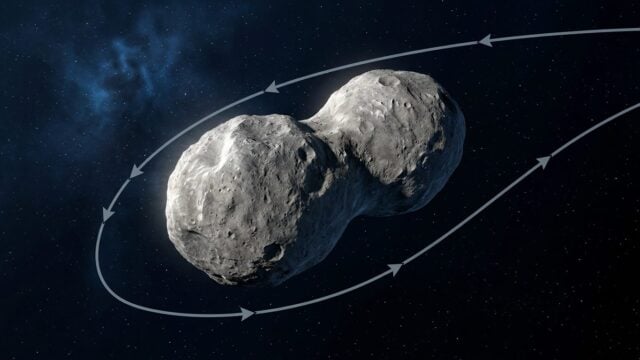
JAKARTA — The Donaldjohanson asteroid spins unevenly, and NASA’s Lucy spacecraft caught it up close on April 20, 2025, during a flyby on its way to Jupiter’s Trojan asteroid swarm. At a distance of about 650 miles, Lucy recorded the peanut-shaped body in detail, revealing ancient impact scars, sunlight-driven changes, and signs that it once briefly came into contact with liquid water.
The finding matters because Donaldjohanson offers a fresh look at how small asteroids evolve. This is not just a rock floating in space. It carries a long record of collisions, changes in spin, and chemical traces that help scientists reconstruct the early solar system.
Lucy saw the Donaldjohanson asteroid spin like a wobbling top
Data collected by Lucy show that Donaldjohanson does not rotate in the simple way many people imagine. Instead, it moves like a top that has gone off balance. It tumbles end-over-end every 10.5 Earth days, while also rocking back and forth along its long axis every 26.5 days.
Earlier observations from Earth only captured repeating changes in brightness. That led astronomers to think Donaldjohanson was a stretched object that completed one rotation every 10.5 days. Lucy showed that was only part of the story. The rest appeared when the spacecraft moved closer and sent back high-resolution images.
“Every subtle difference gives another clue about the story of our origins,” said Simone Marchi, Lucy deputy principal investigator and lead author of the study at the Southwest Research Institute office in Boulder, Colorado. The study was published on June 18 in the journal Science.
Donaldjohanson asteroid shape points to two merged lobes
Lucy also revealed that the Donaldjohanson asteroid is not a single rounded object. It is made of two lobes joined together by a narrow neck. Scientists call this a bilobate shape. That form usually appears when two fragments from an old collision drift together and merge under their own gravity.
Researchers estimate the process began about 155 million years ago. Fragments from a major impact slowly gathered into a new body. After that, the asteroid kept changing. Solar radiation nudged it over millions of years, and those tiny forces were enough to alter the way it spins.
Scientists suspect Donaldjohanson once spun at least 10 times faster than it does now. Over the last 20 million to 60 million years, its rotation slowed. That shift changed the balance between centrifugal force and gravity. Loose material slid downhill, reshaping the surface and softening the look of some craters in Lucy’s images.
Solar YORP effect changed the asteroid’s spin
The slowdown likely came from the YORP effect, a subtle process driven by sunlight. When the Sun heats an asteroid’s surface, the energy is released again as infrared radiation. The push is tiny. Almost nothing, really. But over vast spans of time, it adds up.
On an irregular body like Donaldjohanson, those small forces do not cancel out neatly. They create a torque that slowly changes rotation. The same process can speed up or slow down other asteroids. Bennu, for example, spins once every four hours. Ryugu takes about seven hours for one turn. Both are thought to have spun more slowly before YORP accelerated them.
Lucy used this encounter as a key rehearsal before visiting Jupiter’s Trojan asteroids. Its next target is Eurybates on August 12, 2027. So this mission is not only about one asteroid. It is also a systems test, an operations check, and a dry run for the more complex stages ahead.
Brief water clues on Donaldjohanson asteroid surface
As Lucy raced past at about 30,000 miles per hour, its instruments detected iron-rich clay minerals on the Donaldjohanson asteroid’s surface. Minerals like these form only when liquid water is present. That immediately raises a crucial question: how long did the water stay there?
The answer appears to be short. If water remains too long, clay chemistry usually changes and iron is replaced by magnesium. But the clay on Donaldjohanson still carries a high iron content. That suggests liquid water was present only for a limited period, not for the long stretch seen on some other asteroids.
The contrast with Bennu and Ryugu is striking. Those asteroids contain magnesium-rich clays, a sign that they were exposed to water much longer, perhaps for millions of years, while still part of a larger parent body. The different chemistry points to different histories.
Why the Donaldjohanson asteroid matters for solar system history
Researchers say Donaldjohanson came from a rocky remnant of a carbon-rich, water-bearing asteroid that broke apart in a collision in the main asteroid belt. Bennu and Ryugu likely formed through a similar process in roughly the same region, but their ages and orbital histories diverged sharply.
Donaldjohanson is estimated to be about 155 million years old. Bennu and Ryugu are much older, at roughly 1 billion to 2 billion years. Their orbits are different too. Donaldjohanson has remained in the asteroid belt since its formation, while Bennu and Ryugu migrated into near-Earth orbits. That path is what made them good targets for sample-return missions.
Comparisons like these help scientists assemble the puzzle of the solar system’s origins. Asteroids preserve leftover material from planet formation. One small difference in composition, spin, or shape can become a major clue about when and where a body formed.
Lucy still has a long trip ahead to its next targets. But even one short visit to Donaldjohanson has already opened a complicated story: a body born from an ancient collision, twisted by sunlight, briefly touched by water, and now spinning in a way most space rocks do not. It is only about 155 million years old, and more answers should come as Lucy pushes deeper into its mission.