
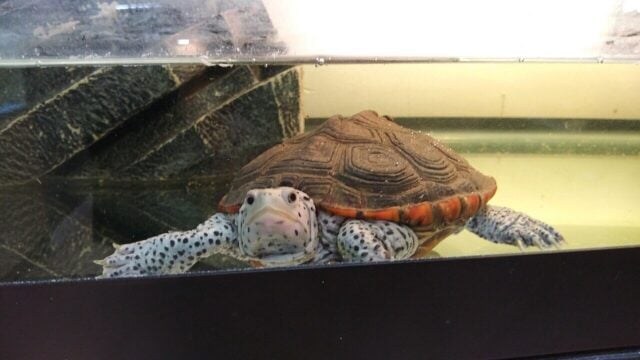
Researchers at Florida Atlantic University’s Harbor Branch Oceanographic Institute have found that a tiny parasite may offer big clues for protecting diamondback terrapins along the US Atlantic Coast.
The team analyzed genetic patterns in a flatworm that lives in the turtles and eastern mudsnails. The findings could help scientists investigate where terrapins live, how they move and whether their populations are connected.

Those questions are difficult to answer by tracking the turtles directly. The researchers say sampling the parasite in abundant mudsnails could offer a less invasive alternative.
Snails carry clues to turtles
Diamondback terrapins are North America’s only turtle species that lives exclusively in brackish coastal waters, including salt marshes and estuaries. The International Union for Conservation of Nature lists the species as vulnerable.
Historical harvesting, habitat loss, coastal development and accidental capture in crab traps have contributed to population declines. Better population data could help guide conservation efforts.

Senior study author Michael McCoy, a research professor at Harbor Branch, said the parasite may provide an “important window into the ecology of diamondback terrapins.”
The flatworm, Pleurogonius malaclemys, needs both mudsnails and terrapins to complete its life cycle. It reproduces inside snails before developing into visible cysts that can attach to a snail’s foot or shell.
Terrapins become infected when they eat infected snails. The parasite then matures and reproduces sexually in the turtles’ intestines.
Because the flatworm depends on terrapins for reproduction and dispersal, its genetic patterns may provide clues about turtle movement. The cysts also offer a way to detect terrapin presence without capturing the turtles.
Genetic divide near state border
Researchers collected flukes from mudsnails and terrapins across their shared range, from Massachusetts to northeastern Florida. They analyzed mitochondrial DNA, genetic material used to examine diversity and population structure.
Flukes appeared in mudsnails at 23 of 29 marshes sampled. External cyst prevalence reached 74%, compared with less than 4% for internal infections.
The analysis showed a genetic division near the North Carolina–South Carolina border. That is about 186 miles (299 kilometers) south of a previously proposed boundary between northern and Carolina terrapin subspecies near Cape Hatteras.
The result raises questions about existing terrapin classifications, though researchers say the genetic boundaries may be more complex than previously understood.
Limited turtle movement may help explain the separation among parasite populations. Female terrapins, the most mobile group, have been documented traveling no more than 8.5 kilometers, or about 5.3 miles.
The study was published in the journal Ecology and Evolution.