Betelgeuse could outshine Venus after swallowing companion
Betelgeuse could briefly shine brighter than Venus if it engulfs its companion star, a new preprint suggests. Researchers modeled several possible companion masses and found that each could produce a bright eruption, potentially visible in daylight, within the next 10,000 years.
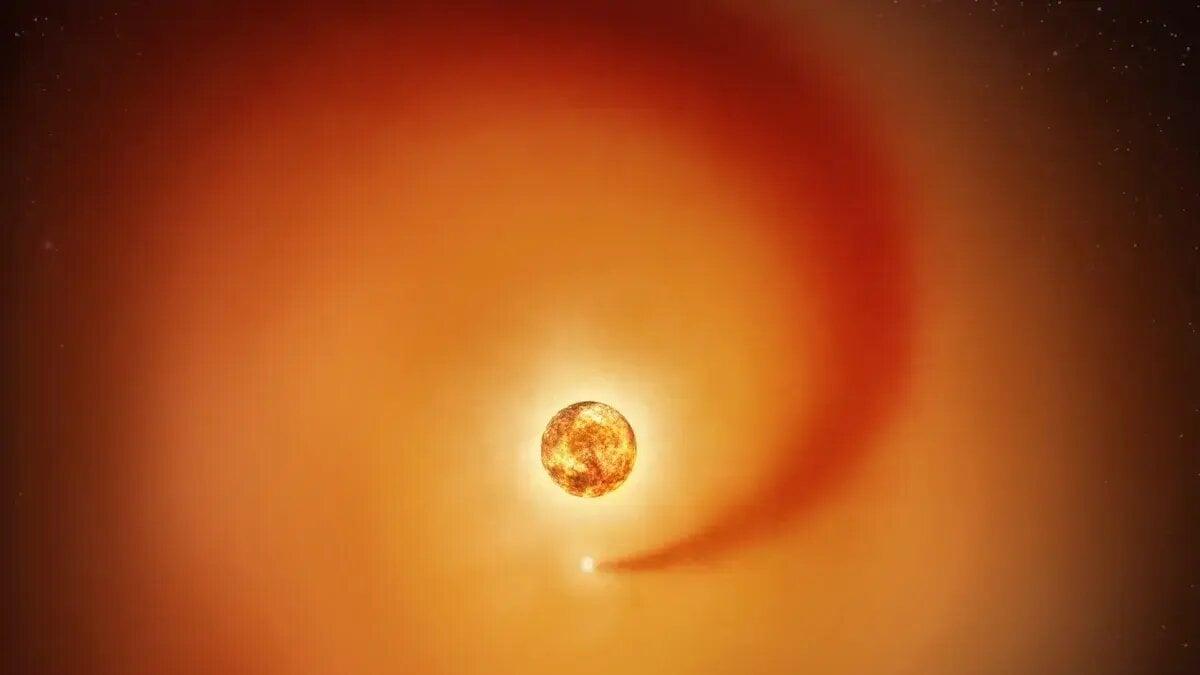
Betelgeuse could outshine Venus as seen from Earth if it engulfs its companion star, a new preprint study suggests. The eruption could occur within the next 10,000 years.
It would be brief. The brightening would last only a couple of days, though it could make Betelgeuse visible during daylight.
Betelgeuse is a red supergiant at the shoulder of the Orion constellation. It is the 10th-brightest star as seen from Earth and will probably eventually explode as a supernova.
Simulations point to bright eruption
Study lead author Naunet Leonhardes-Barboza, a graduate student at the University of California, Santa Cruz, and her colleagues modeled how the star system might evolve.
Their simulations examined how the companion could spiral inward and be torn apart after Betelgeuse engulfs it. The researchers tested three possible companion masses, from 0.7 to two times the mass of the Sun.
Every modeled mass produced a luminous red nova, a bright eruption associated with the stars merging. A more massive companion produced a more energetic and luminous outburst.
The eruption could appear 1.5 to three times brighter than Venus does from Earth, Leonhardes-Barboza said. “It would be really noticeable,” she said.
Jared Goldberg, an astrophysicist at the Flatiron Institute's Center for Computational Astrophysics, did not take part in the study. “For future generations, it'll be incredible to behold,” he said.
Companion changes the picture
Researchers have found indications of a hidden companion to Betelgeuse in recent years. Evidence became particularly compelling during the summer.
Its possible presence raised questions about the final stages of the larger star's life, Leonhardes-Barboza said. Her team explored whether the two stars would merge.
Betelgeuse drew attention during its Great Dimming in 2019, when it appeared to fade. Astronomers later found that dust formed from material the star had ejected had obscured it.
A guide for other searches
The predicted merger could also help astronomers searching for similar events elsewhere, Goldberg said. More distant red supergiants might be detected only when a comparable eruption makes them brighter.
Linking that kind of outburst to a merger gives observers a guide for telescope searches and data analysis, he said.
Leonhardes-Barboza said the system offers a rare chance to study stars before a merger. Astronomers already have extensive data about Betelgeuse and could continue following the system until the stars merge.
 Take the quizWhat Kind of Holiday Spender Are You? Take the Black Friday QuizStart →
- 1U.S. Emergency Alert Test Nov. 17 Is Not a Power Outage

- 2Michael Clarke Says Sandpapergate Scars Drew Steve Smith to New York

- 3Gold Silver Price November: Futures Rise Near Yearly Lows

- 42027 NFL Mock Draft Puts Ohio State’s Jeremiah Smith at No. 1

- 5GTA 6 New Zealand Time Trick Is Not Guaranteed to Work

 Lifestyle · Food & Health4 Reasons to Eat Oatmeal, According to Nutrition Experts
 Lifestyle7 Signs Your Social Battery Is Running Low (and Why You Keep Cancelling Plans)
 Lifestyle · Food & HealthThanksgiving Food Safety: How Long Leftovers Last and the Safe Turkey Temperature
 Lifestyle7 Quiet Habits of Emotionally Intelligent People, According to Psychologists