Nasdaq Falls 13.5% From Peak as S&P 500 and Dow Near Correction
The Nasdaq Composite closed November 19 at 23,879.20, 13.5% below its October high. The Dow is down 9.7% and the S&P 500 down 8.2% from their peaks, as Nvidia's slide after CEO Jensen Huang's resignation weighs on markets.

The Nasdaq Composite is in a correction, and the S&P 500 and Dow Jones Industrial Average are close behind. As of the November 19 close, the Dow was down 9.7% from its high and the S&P 500 was down 8.2%. A correction is a drop of at least 10% from a peak.
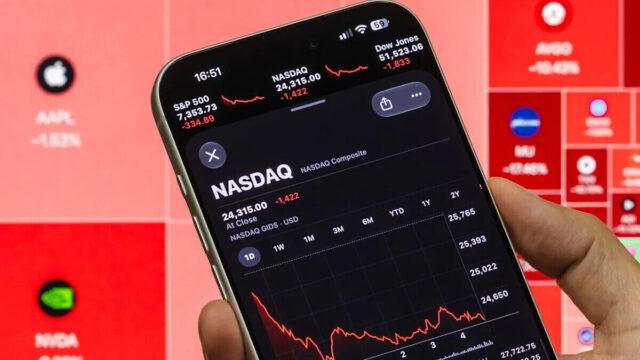
The Nasdaq closed at 23,879.20 that day, 13.5% below its all-time high of 27,722.75, set on October 6. The Nasdaq and S&P 500 both hit records in early October.
The Nasdaq has fallen 10.1% in just three weeks.
The level that means a bear market
A bear market is a prolonged decline of at least 20% from a high. For the Nasdaq, that line sits at 22,178.20.
Short, sharp drops do not always qualify. The Nasdaq fell more than 20% during the March 2020 COVID-19 sell-off and the April 2025 tariff-driven sell-off, but both were brief. The 2022 slide in growth stocks, when the Nasdaq dropped 33%, was a true bear market.
A crash has no fixed definition. It usually means a sudden fall in a major index. Daniel Foelber, a Motley Fool analyst, wrote that a drop to the 20% level over the next few weeks would be fair to call a crash, given the peak came only six weeks earlier.
Nvidia drags on the market
Nvidia, the world's most valuable company for most of this year, has lost roughly a third of its value in three weeks. The fall accelerated after founder and CEO Jensen Huang, who led the company for more than 33 years, suddenly resigned.
At its peak, Nvidia made up around 8% of the S&P 500. It is now 5.4%. Foelber noted that its influence reaches further, through companies that supply, compete with or do business with it.
Gold and Bitcoin have also fallen quickly, according to Foelber.
What one analyst suggests
Foelber, who holds Nvidia and ASML shares, moved his view on Nvidia from buy to hold. He cited open questions about a national security risk, how the company will be restructured and whether it can keep top talent. He said earnings growth may slow under a more operations-focused leader such as Colette Kress.
He pointed instead to ASML, which makes chip-manufacturing equipment, and to two low-fee funds: the Vanguard Growth ETF and Vanguard Mega Cap Growth ETF. He also said investors should expect faster, more severe swings, and should only buy stocks they are comfortable holding if volatility worsens.
 Take the quizWhat Kind of Holiday Spender Are You? Take the Black Friday QuizStart →




 Markets · FintechHow to Calculate Compound Interest: Formula, Examples and the Rule of 72
 Lifestyle · Food & HealthNormal Blood Pressure Chart by Age: Healthy Ranges Explained
 Lifestyle · Food & HealthWhat Is Raynaud’s Syndrome? Why Fingers Turn White in the Cold
 Lifestyle · Food & Health4 Ways Walking After Meals Helps Your Body, Doctors Say