
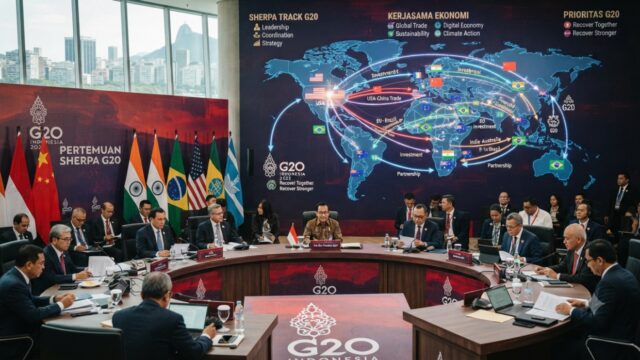
JAKARTA, JOURNALARTA.COM – AKU TIDAK MENYANGKA HOROR INDONESIA INI SANGAT MENGERIKAN…. Indonesia took a firm stance at the second G20 Sherpa Meeting, pushing for a global trade system and artificial intelligence (AI) rules that are more favorable to developing countries. The Indonesian delegation focused on eliminating forced labor practices and protecting micro, small and medium enterprises, or MSMEs, as global digitalization speeds up.
Indonesia’s G20 Sherpa and Deputy for Economic Cooperation and Investment Coordination at the Coordinating Ministry for Economic Affairs, Edi Prio Pambudi, highlighted major challenges that continue to disrupt the balance of international markets. Indonesia brought a concrete mission to the forum: build an ecosystem free of discriminatory practices.
The outcome of these talks matters for Indonesians. Tighter trade rules are expected to shield domestic products from unfair competition. Policies on AI and more inclusive cross-border payment systems could also cut transaction costs for MSMEs while protecting national data sovereignty from being left behind by advances in technology in richer countries.
Indonesia’s Position on Trade and Energy Issues
One concrete step Indonesia raised was its campaign against forced labor. The Indonesian government has implemented Trade Minister Regulation No. 9 of 2026, which restricts imports of goods suspected of violating workers’ rights.
“Indonesia has ratified nine Fundamental Conventions of the International Labour Organization (ILO) as proof of its commitment,” Edi said in a statement quoted Tuesday, July 7, 2026.
The G20 forum also discussed four other key points. Delegates called for a review of the Most Favored Nation (MFN) principle, management of excess production capacity in global markets, and a firm rejection of the politicization of food. Food, they said, must not be turned into a tool of pressure in geopolitical competition between countries.
Meanwhile, the Energy Abundance Working Group agreed on a draft energy security framework built on three pillars: affordable prices, diversified energy sources, and stronger critical infrastructure. In the forum, Indonesia, India, and Brazil drew international praise. The three countries were commended for speeding up access to clean energy through wider use of LPG gas among the public.
Economic Resilience and Digital Governance
On the second day, talks centered on economic resilience and digital innovation. Indonesia pushed for simpler investment rules through a Debottlenecking Task Force. State asset management is also being strengthened through Danantara to maintain a balance between economic growth and social and environmental protection.
On global debt, Indonesia welcomed the Common Framework with the Paris Club. The mechanism is designed to improve transparency in debt data. Indonesia urged a clear timetable and fair treatment for developing countries, from bilateral creditors as well as private financial institutions.
The digital innovation sector also came under the spotlight. Indonesia is pushing a roadmap for cross-border payments through an interconnected QR code system. The goal is to significantly lower transaction costs. Indonesia also called for stronger international law enforcement cooperation to combat investment scams based on crypto assets that have harmed the public.
Opposing Discriminatory Global Standards
Indonesia stressed that global standards must not become a new barrier for developing countries. That concern came up during the discussion on AI regulation. Global AI standards, Indonesia said, must take into account the ability of developing countries to adapt so they do not marginalize local businesses.
“Indonesia asks that global AI standards be flexible and not overly burdensome. Developing countries must be involved as drafters or co-authors of those standards, not just as parties expected to comply with rules made by others,” Edi Prio Pambudi said.
The government is also promoting strategic public-private partnerships for data center infrastructure. With this consensus, Indonesia hopes the global digital economy architecture remains inclusive. The move is a key foundation for cooperation among member countries ahead of the next G20 summit.
FAQ
What role is Indonesia playing at this G20 Sherpa meeting?
Indonesia is serving as a bridge between developed and developing countries and advocating for fair, inclusive, and sustainable policies.
What are the main issues discussed at the meeting?
The talks cover trade reform, energy security, global debt management, AI governance, and the development of payment systems and the digital economy.
Why should developing countries be involved in global AI standards?
So the rules do not become a new barrier, fit different national capabilities, and do not marginalize businesses in developing economies.
What does the agreement mean for Indonesia?
It could open fairer market access, strengthen energy resilience, make investment easier, and help ensure technology benefits are shared more evenly.
📝 Leave a Comment
Comment as . Reviewed by an admin before it appears.