Airlangga Pushes Digital Economy to Boost Indonesia’s Growth
Airlangga says Indonesia’s digital economy, data centers, semiconductors, and digital talent are key to pushing growth above 8 percent.
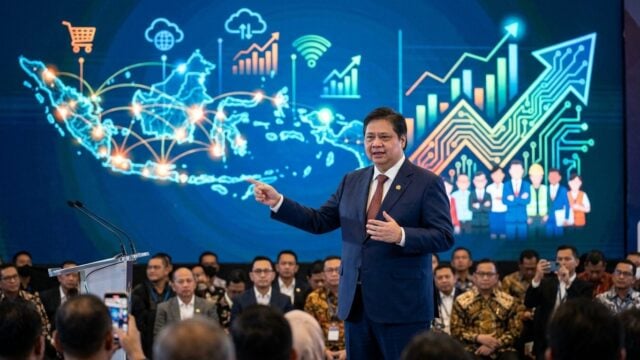
JAKARTA, JOURNALARTA.COM - The digital economy is becoming a new pillar for the government as it tries to push Indonesia’s economic growth above 8 percent. Coordinating Minister for Economic Affairs Airlangga Hartarto said that target will be hard to reach unless Indonesia strengthens its data centers, semiconductors, and digital talent.
The warning came during the 10th anniversary of IDPRO in Jakarta on Wednesday, June 24, 2026, where the government used the moment to reaffirm that policy direction. The impact is immediate for the technology industry, businesses, and the labor market, all of which are now competing for computing capacity, data storage, and chip design skills.
Airlangga spoke before data center industry players, academics, and policymakers. His message was short. Serious.
Digital economy as a growth engine
In his keynote speech, Airlangga stressed that Indonesia wants to grow by more than 8 percent, and one of the main engines is the digital economy. He said artificial intelligence, or AI, cannot work optimally without adequate infrastructure, especially reliable and efficient data centers.
“Indonesia wants to grow by more than 8 percent, and one of the drivers is the digital economy. And the key is of course artificial intelligence, or AI, while AI can only run at full capacity if its infrastructure, namely data centers, is built properly,” Airlangga said.
The statement matters because Indonesia’s computing needs keep rising. Technology companies, financial institutions, public services, and e-commerce platforms are increasingly dependent on storage that is secure, fast, and close to users. Without strong data centers, operating costs can rise. Services slow down. Competitiveness slips.
Airlangga also praised IDPRO for spending a decade pushing the national data center industry forward. He said the sector has shifted from a supporting role to a game changer in the modern economy. Growing data demand means data centers are no longer just a technical issue, but part of national economic strategy.
DEFA and the move upstream into semiconductors
The government is also pushing digital economic cooperation at the ASEAN level through the completion and signing of the ASEAN Digital Economy Framework Agreement, or DEFA, at an upcoming ASEAN Summit. The deal is expected to open a wider digital market in Southeast Asia and create more room for Indonesian expansion.
At the regional level, integrating digital rules could reduce cross-border barriers, especially for online trade, app-based services, and data flows. Indonesia sees major room for growth there. If DEFA moves smoothly, Indonesia’s position as ASEAN’s digital economy hub could grow stronger.
The government’s move does not stop at the downstream side. Jakarta is also moving upstream through semiconductor development. Through cooperation with British technology company ARM, Indonesia will develop chip design capabilities. It is seen as strategic because chip design determines how many modern devices perform.
Semiconductors are the backbone of future technology. AI, the Internet of Things, autonomous vehicles, and quantum computing all depend on increasingly advanced chips. Without its own design capacity, Indonesia will keep relying on foreign countries for a sector that matters deeply.
Target of 15,000 skilled workers in three years
The problem is simple: no industry can grow without people who understand the technical work behind it. That is why the government is targeting training for 15,000 young workers in semiconductors over the next three years. The program is aimed at producing digital engineers who can enter the technology supply chain and fill the industry’s growing needs.
Airlangga said the momentum to strengthen digital talent must be maintained. He believes Indonesia is relatively more prepared than several other ASEAN countries, but that edge could disappear if it is not pushed seriously.
“This momentum must be maintained. Among other ASEAN countries, I can say Indonesia is more ready. Therefore, digital talent development, data centers, and the semiconductor industry must continue to be encouraged so Indonesia does not fall behind in global digital economic competition,” Airlangga said.
The message underlines that the battle in the digital economy is no longer just about popular apps or the number of internet users. The real competition sits in infrastructure, chips, and human resources. Those three are tightly linked.
The event was also attended by House of Representatives Commission I member Nurul Arifin, Deputy for Economic Coordination Ministry Secretary Susiwijono Moegiarso, Expert Staff for Regional Development at the Coordinating Ministry for Economic Affairs Haryo Limanseto, IDPRO Chairman Hendra Suryakusuma, as well as representatives from ministries, data center industry players, businesses, academics, and development partners.
Looking ahead, the government faces a practical test: whether the push on data centers, semiconductors, and digital talent will continue through policy, investment, and vocational education, or stop as little more than a forum appeal.