Foreign Investors Record Rp61.36 Trillion Net Sell in 2026
Foreign investors’ Rp61.36 trillion net sell is weighing on the IHSG, with MSCI, rupiah weakness and global uncertainty adding pressure.
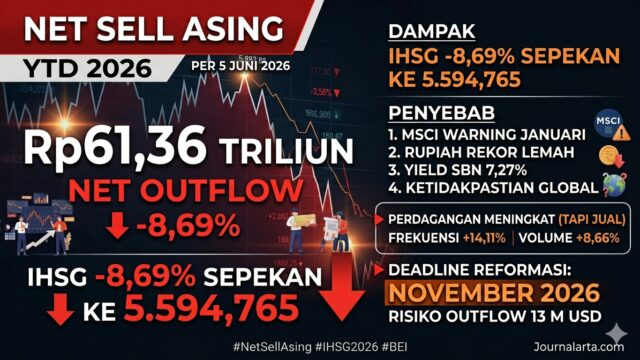
JAKARTA — Foreign Investors Record Rp61.36 Trillion Net Sell in 2026, according to trading data released by Bursa Efek Indonesia (BEI) on June 5, 2026. The figure captures net foreign selling from the start of the year through that date, and it has helped drag the Jakarta market lower.
The pressure is visible across the board. The Jakarta Composite Index, or IHSG, fell 8.69% in the week ending June 5, while market capitalization dropped 8.59% to Rp9,807 trillion. Average daily transaction value also slipped 5.71% from the previous week to Rp26.97 trillion, even as trading activity stayed busy.
Foreign selling keeps weighing on the market
BEI said foreign investors booked Rp3.73 trillion in net selling during the June 2-5 trading period alone. That pushed year-to-date foreign net sell to Rp61.36 trillion, a level that has become hard to ignore for local traders and fund managers.
The benchmark index closed June 5 at 5,594.765 after a sharp weekly slide. On the next session, early trading on June 8 saw the IHSG fall another 2.87% to 5,434, according to Mirae Asset Sekuritas. The weakness spilled into other asset classes too, with the rupiah coming under pressure and the 10-year government bond yield rising to 7.27%.
Why foreign money is leaving
Several forces are pushing overseas investors to trim exposure in Indonesia. One of the earliest triggers came from MSCI’s warning in January 2026, when the global index provider froze any increase in Indonesia’s weight and said structural problems could eventually lead to a downgrade from emerging market status to frontier market. Since then, about US$370 billion in market value has reportedly been erased.
Currency weakness has made the exit easier. The rupiah has repeatedly touched record lows as markets worry about fiscal pressure, Middle East tensions and the cost of large government programs. For foreign holders, a weaker rupiah cuts returns once investments are converted back into home currencies. That alone can change the calculus fast.
At the same time, rising bond yields have pulled some money toward sovereign debt. With 10-year government bonds yielding 7.27%, some investors see fixed income as more predictable than equities, especially when shares are swinging hard and global risk appetite is thin.
Global conditions are not helping. Tensions between the United States and Iran have lifted oil prices, while expectations that the US benchmark rate will stay elevated for longer have kept capital cautious. Emerging markets tend to feel that shift early, and Indonesia has not escaped it.
Busy trading, but the index still slips
One striking detail in BEI’s data is that the market has stayed active even as prices weaken. Average daily transaction frequency rose 14.11% to 2.41 million trades, while average daily volume increased 8.66% to 33.63 billion shares. Regular market transaction value through the end of May also climbed sharply to Rp602.9 trillion, up 114.3% from a year earlier.
That tells a clear story. Domestic investors have been absorbing some of the stock being sold by foreigners, which keeps liquidity alive. But liquidity is not the same as strength. When large foreign funds keep heading for the door, prices still struggle to rise, and rebounds tend to fade quickly.
So what this means for investors and households
For ordinary market participants, the impact shows up in portfolio values, mutual fund performance and the tone of the broader financial system. A weak IHSG can dent confidence in new listings, make fund managers more defensive and tighten the mood around banking, consumer and other large-cap shares.
The effect can also spread beyond stock prices. A softer rupiah raises imported costs, while a higher bond yield can increase financing pressure for companies and, over time, add to borrowing costs across the economy. Households may not watch every market move, but they feel the aftershocks through prices, credit conditions and investment returns.
Which stocks took the hit
The selling has been harshest in names recently removed from the MSCI Global Standard index, including Amman Mineral, Chandra Asri Pacific and Dian Swastatika Sentosa. Banking and consumer stocks have also faced selling pressure, showing that the outflow has not stayed confined to one corner of the market.
Tan Altundag, an investment manager at Pictet Asset Management, said MSCI’s decision to keep Indonesia as an emerging market was not enough by itself to rebuild confidence. “The conditions needed for investors to put money back here are still quite high,” he said on Thursday, June 25.
Authorities try to slow the bleed
BEI, the Financial Services Authority (OJK) and the government have stepped up coordination to reduce the pressure. Their agenda includes enforcing the 15% free float requirement, tightening trade surveillance and pushing issuers to improve ownership transparency. Officials are also leaning on Bank Indonesia and the Finance Ministry to keep government bond yields stable and competitive.
Domestic institutions are part of the response too. Insurers, pension funds and Danantara Indonesia have been asked to increase local stock purchases to help support demand. Mirae Asset Sekuritas said the effect may be limited if external conditions remain unfavorable, because local action cannot fully offset global risk-off flows.
Goldman Sachs has warned that if Indonesia fails to improve conditions before MSCI’s November 2026 review and gets downgraded, potential capital outflows could reach US$13 billion, or around Rp234 trillion. That is the next big test. And the market is already counting down to it.