
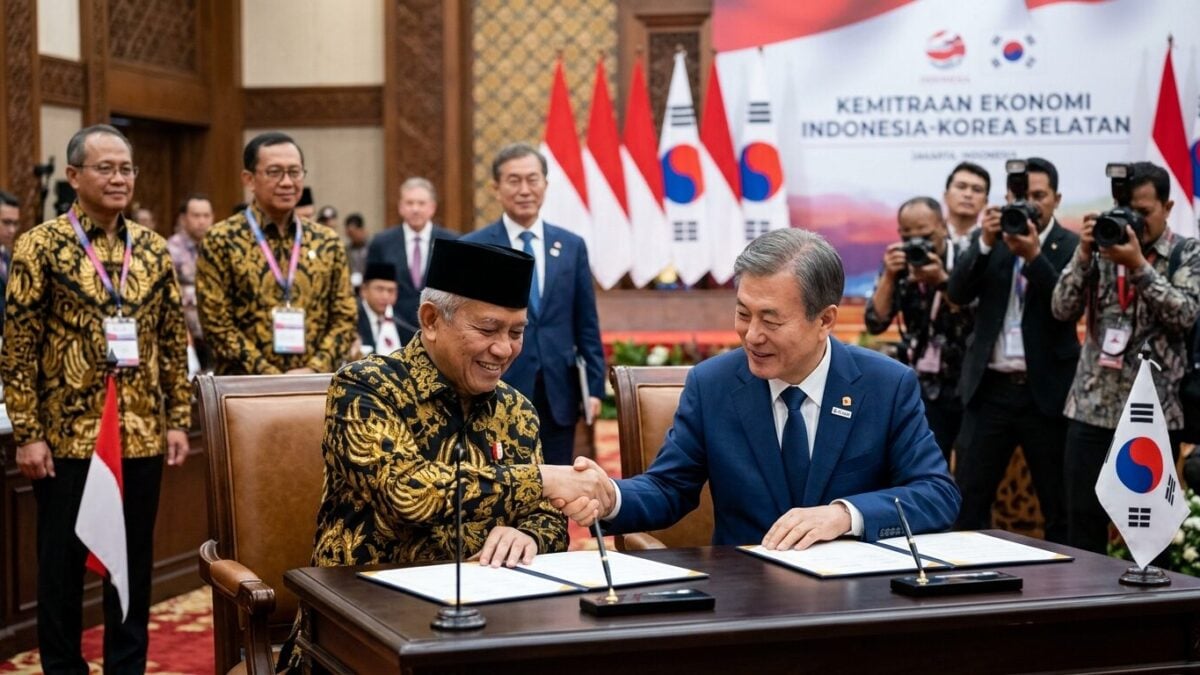
JAKARTA, JOURNALARTA.COM – The Indonesian government reaffirmed its commitment to deepen Indonesia-South Korea economic partnership through the Korea-Indonesia Economic Partnership Forum 2026 in Jakarta on Friday (June 26, 2026). Finance Minister Purbaya Yudhi Sadewa said Indonesia still has strong fundamentals to attract investment and expand cooperation with Seoul.
The forum served as a key platform for the government to outline the national economic outlook and present five concrete steps to South Korean business players. The message was clear: Indonesia wants a deeper partnership, not just routine trade.
Indonesia’s economy seen as resilient to shocks
Purbaya said Indonesia’s economy has remained solid amid global uncertainty. In the first quarter of 2026, the economy grew 5.61 percent and inflation stood at 3.08 percent. He said those figures show domestic economic resilience is still intact.
“Indonesia’s economic performance remains stronger than several peer countries. That resilience is reflected in high growth and relatively low inflation,” he said at the forum.
The government also highlighted several key supports. Indonesia’s trade balance posted a surplus for 72 consecutive months through April 2026. Foreign exchange reserves were also said to be enough to cover 5.5 months of imports. At the same time, financial system liquidity remains safe and credit disbursement is still moving.
The data matters for foreign investors, including those from South Korea. Stable macroeconomic conditions often become the first filter before investors decide to commit long-term capital. When economic indicators stay steady, risk costs also fall.
Five steps to attract investment
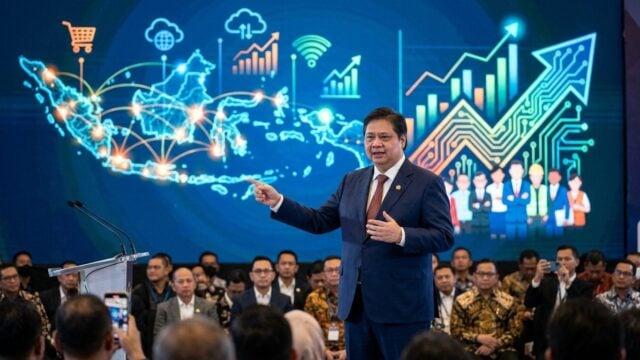
At the forum, the Ministry of Finance offered five strategies to strengthen Indonesia-South Korea economic partnership. The main focus was investment, trade, infrastructure, downstream industrialization, and policy certainty.
First, the government formed a Bottlenecking Task Force to resolve operational and licensing obstacles. Purbaya said the process is monitored directly by the president so investment can move with greater certainty and avoid prolonged bureaucracy.
Second, the government pushed for better use of the Indonesia-Korea Comprehensive Economic Partnership Agreement, or IK-CEPA. The scheme allows tariff cuts and even tariff elimination, helping goods flow and supply-chain integration between the two countries move more efficiently.
Third, Indonesia invited South Korean businesses to tap infrastructure financing facilities through the Economic Development Cooperation Fund (EDCF). The commitment value reaches 1.5 billion US dollars for the 2022-2026 period. The funds are directed to clean water projects, sanitation, ICT infrastructure, and smart city development.
Nickel downstreaming becomes a main card
Fourth, the government is placing major attention on downstream industrialization and the electric vehicle ecosystem. Indonesia controls around 50-60 percent of the world’s nickel reserves, a key ingredient for EV batteries. That position gives Indonesia strong leverage in the global EV supply chain.
Purbaya encouraged South Korean companies to combine their technology with Indonesia’s natural resources to build an integrated battery ecosystem. The government wants the cooperation to go beyond raw material processing and move up to higher-value production.
Fifth, the government stressed long-term policy certainty. Purbaya said fiscal management will remain sound, policies will support green growth, and regulations will be designed to stay competitive for long-term investment.
That step is crucial for a market like South Korea, known for its aggressive manufacturing, energy, and technology sectors. Clear rules are usually a core requirement before corporations commit large capital. Without that, investors tend to hold back expansion.
Two-way gains for Jakarta and Seoul
The government believes stronger Indonesia-South Korea economic partnership will bring direct benefits to both countries. Indonesia gains capital, technology, and market access. South Korea gets raw material supply, investment opportunities, and broader industrial cooperation.
“Cooperation through advanced trade frameworks, strategic infrastructure financing, and a sustainable battery ecosystem will deliver real benefits for both Indonesia and South Korea,” Purbaya said.
The forum underscored the government’s policy direction: opening the door to investment as wide as possible while still demanding certainty, value creation, and sustainability. In a region where competition is getting tighter, Indonesia wants to position itself not just as a market, but as an industrial partner.
Source: Ministry of Finance of the Republic of Indonesia, June 26, 2026.
📝 Leave a Comment
Comment as . Reviewed by an admin before it appears.