
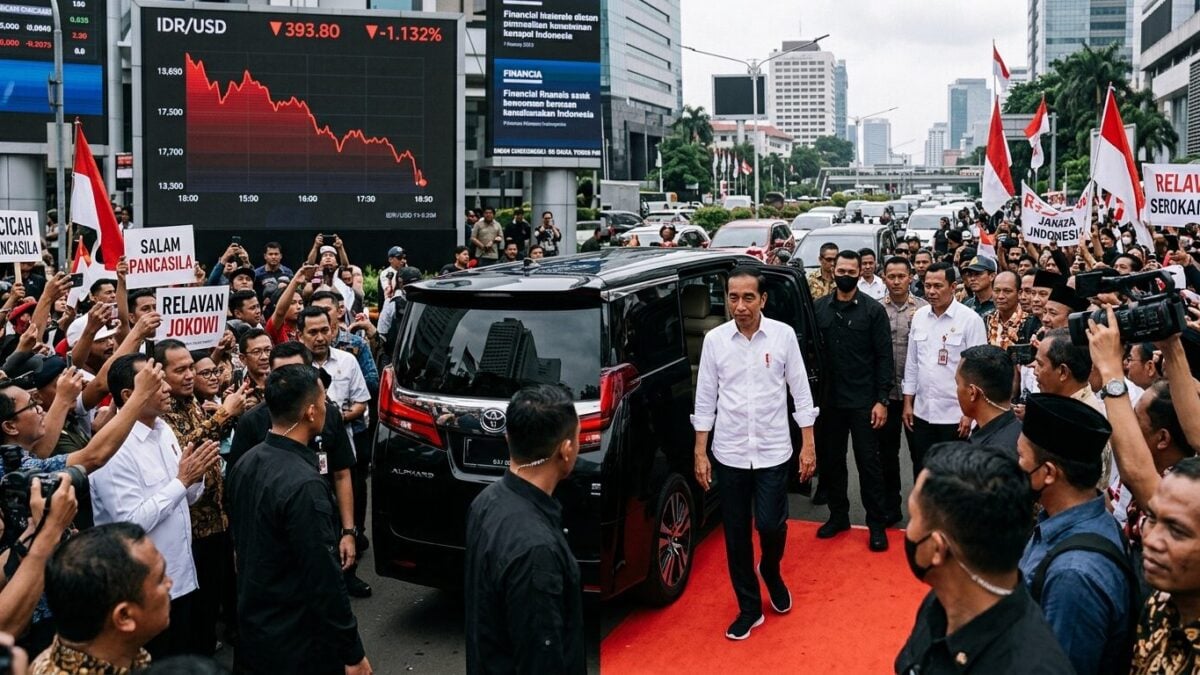
JAKARTA, JOURNALARTA.COM – Jokowi’s political safari is seen by Prof. Didik J. Rachbini as potentially fueling political uncertainty that could weigh on Indonesia’s economy. The Paramadina University rector said President Joko Widodo’s visits to several regions are not just political maneuvering, but may also affect market perception, investment, and government stability.
Didik framed the issue in a moment he considers sensitive. The rupiah and the stock market are under pressure, while political elites are moving quickly ahead of the 2029 power map. For business players, that kind of elite alignment matters. Big time.
Jokowi political safari and the signal to markets
In Didik’s view, Jokowi’s political safari, which began in Lampung and is said to continue to other regions, shows political activity that cannot be separated from power calculations. He said Jokowi’s influence remains strong inside government circles, so every move by the former president carries a broader resonance than an ordinary meeting.
“Jokowi once promised to go home to Solo, become an ordinary citizen and spend time with his grandchildren, but that ethical promise never happened. From the beginning the public, especially his political rivals, did not believe it, and now it has been proven that he is carrying out vulgar political moves as a sign that the coalition with Prabowo’s government will start to close the book,” Didik said in an official release received by the media on Sunday (6/28/2026).
He said that shift shows Jokowi is still choosing to stay active on the political stage. He described the step as standing on its own and potentially widening elite rivalry. For the state, the impact can spill into the most sensitive space: policy certainty.
Impact on the national economy
Didik said elite attention drawn to power maneuvers will reduce focus on the public interest, including the economy. He linked this to Vice President Gibran Rakabuming Raka’s frequent visits to the regions. In his reading, the intensity of the Jokowi family’s political moves keeps the political temperature high and drains government energy.
“Political moves made too early will become a pest that disrupts and can gnaw at the government. The political influence is clearly still there and remains quite strong, and it will continue to be reinforced by the attachment to his son’s position as vice president,” he said.
He argued that the political relationship between President Prabowo Subianto and Jokowi could weaken if their interests increasingly appear to move separately. That weakening, he said, could disrupt the government’s focus in carrying out economic programs, from state spending to the investment climate. Markets, he said, do not like uncertainty.
From an economic-political perspective, Didik explained that the relationship between an active president and a former president who still has influence is an important variable in reading the direction of the economy. Business players usually factor in coalition direction, bureaucratic stability, and policy firmness before committing capital. When room for interpretation widens, risk rises.
“I’m certain the effect is negative, bad, and will become a factor of political uncertainty for investment, business, and the business environment. All parties, especially entrepreneurs, capital owners, and those with interests in Indonesia, will certainly see the new dynamics of the alliance as elite political competition, which increases risk and in turn will certainly affect institutions, bureaucracy, policy, and economic expectations,” Didik said.
Economic fundamentals said to remain solid
Even so, Didik did not deny that several Indonesian economic indicators are still relatively healthy. Inflation, the trade balance, foreign exchange reserves, and economic growth are still considered fairly positive. That means the problem he highlights is not the economic foundation itself, but the non-economic pressure coming from the political arena.
For him, that is exactly where the danger lies. When the basic indicators still hold, political disruption can create an unnecessary negative sentiment. Markets read the direction of elites. Business reads consistency. When those two are disturbed, investment decisions are often delayed.
He ended his assessment with a sharp remark on Jokowi’s political safari. “So Jokowi, with his political safari, has nothing to do with the welfare and interests of the people, and in fact becomes a negative and bad factor in the national economy,” he said.
With that statement, Didik underlined that elite battles at the top are not just about parties or figures. They can affect the rupiah, investor confidence, and the government’s working rhythm. And at that point, politics is no longer floating in a vacuum.

📝 Leave a Comment
Comment as . Reviewed by an admin before it appears.