
JAKARTA — The era of robots that merely follow static commands is nearing an end. The industrial world is now moving toward physical AI, a technological leap in which machines can understand, make decisions, and interact with the physical environment autonomously.
Nvidia, the U.S.-based computing giant, is positioning itself as a key foundation behind this revolution. Its move to expand the robotics ecosystem is not just talk. The company has partnered with major global players such as ABB Robotics, FANUC, and humanoid robot developer Figure.
At the core of this strategy is a full-stack platform that brings together computing, open AI models, and simulation software. In short, Nvidia wants to ensure that every industrial company will eventually transform into a robotics company.
Why Physical AI Is Becoming an Industrial Key
So far, the main obstacle to adopting robots has been the high cost of testing and the risk of failure in the field. Before robots are deployed to factories or warehouses, they must be tested thousands of times. This process often takes years and requires substantial research costs.
This is where digital twin simulation becomes crucial. By using technologies such as Nvidia Omniverse and Isaac, developers can run high-precision simulations before robots are actually built. Imagine a factory with a digital twin.
There, robots can “practice” performing tasks for thousands of hours in just seconds. If an error occurs, no physical components are damaged. There is no material loss. Nvidia CEO Jensen Huang has said the company’s platform serves as the brain for intelligent machines.
And this is not limited to manufacturing. The technology is spreading into logistics and infrastructure. When robots have human-like reasoning ability, production efficiency can rise sharply.
For business players, this shift is not just a technology trend, but a survival strategy amid increasingly strict productivity demands.
Simulation and Humanoid Robotics
The biggest challenge in robotics is replicating human mobility and dexterity. Nvidia is addressing that challenge through Isaac Lab and foundation models such as Cosmos and GR00T. These models help robots learn new tasks with very little training time.
This development allows humanoid robots to become less rigid and more adaptive to changing environments.
For example, a robot that once could only move goods along fixed paths can now navigate cluttered warehouse aisles, recognize new objects, and even communicate with nearby human workers.
This is possible because machines now understand spatial context, not just rigid program code. Companies such as Boston Dynamics and AGIBOT are now using Nvidia’s computing infrastructure to speed up system validation. The healthcare sector is also beginning to take notice.
Major medical companies such as Medtronic and Johnson & Johnson are exploring the use of Nvidia-based simulation to train robotic surgical systems.
In operating rooms, where precision and safety are non-negotiable, the ability of robots to “learn” through high-level simulation is a vital breakthrough that can save lives.
Edge Computing Innovation and the Future
Industry dependence on a single integrated platform will help determine who the winners are in the future. By providing Jetson modules for real-time AI processing, Nvidia ensures robot intelligence exists not only in the cloud but directly at the point of operation (edge).
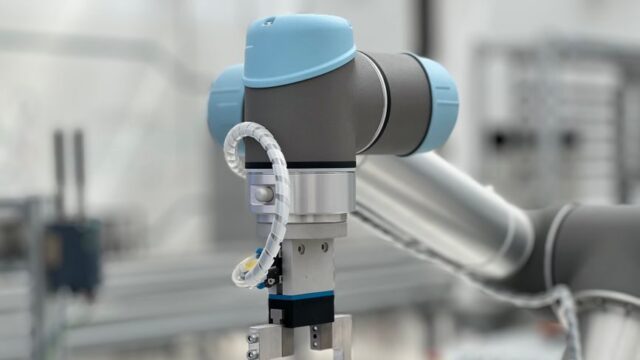
Why does edge matter? Because in the physical world, delay or latency is the main enemy. If an industrial robotic arm has to wait for data from a central server to decide where it should grasp an object, the system will slow down.
By processing data inside the machine itself, robots become more agile, safer, and more responsive. This trend shows that the economic value of robotics no longer lies only in physical hardware, but in the AI brain embedded within it.
Many industry analysts say we are shifting from an era of “blind” automation to an era of “aware” automation. Machines will become co-workers capable of adapting, not just passive tools.
As this technology matures, global collaboration between software developers and machine manufacturers will determine industry standards.
We are moving toward a world where automation is no longer about repeating tasks, but about machines’ ability to solve complex problems independently. This opportunity will continue to grow alongside innovations in robotics models that are faster and smarter.
In the future, the line between digital intelligence and the physical world will become increasingly blurred, bringing us into a truly autonomous manufacturing era.
Quick Summary
- What is Physical AI? Technology that enables physical machines to have artificial intelligence to understand and act in the real world autonomously.
- Why It Matters: It speeds up robotics adoption in industry through accurate simulation in digital twin environments, reducing development costs and failure risks.
- Impact on Other Sectors: The technology is starting to spread into medical, logistics, and infrastructure sectors to improve operational precision that standard machines could not previously achieve.
📝 Leave a Comment
Comment as . Reviewed by an admin before it appears.