
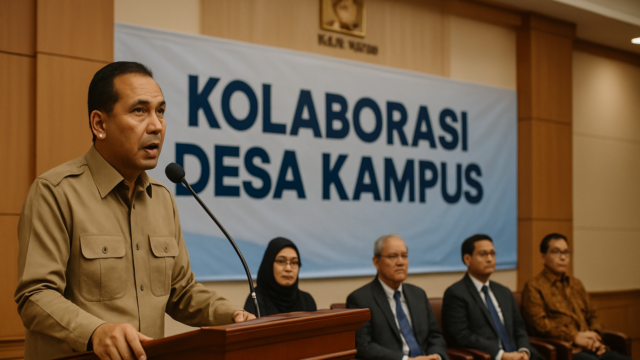
DEPOK — Village chiefs can no longer get by on field experience alone. They need to read data, understand research, and hold their own in a room full of academics. That was the blunt message from Deputy Home Affairs Minister Bima Arya Sugiarto as he opened the Village Chiefs on Campus Program — Batch I — at Universitas Indonesia on Tuesday (6/30).
The program marks a real shift in thinking: villages are no longer positioned as recipients of top-down assistance, but as intellectual partners on equal footing with academia. “Leaders need strong conceptual grounding — that’s why every leader must be supported by universities, research institutions, or educational bodies,” Bima said at Balai Purnomo, UI, Depok, West Java.
Why Village Chiefs Need to Be on Campus
The challenges facing village chiefs today go far beyond routine administrative work. They’re dealing with complexity that simply didn’t exist a generation ago: data-driven policy, digital technology, climate change, demographic shifts, food security, local economic transformation. Twenty years ago, a village chief could get by on inherited experience and common sense. Now? That’s not enough.
“Leaders who stop learning will struggle to keep pace with an ever-evolving development landscape,” Bima said firmly. That’s the driving logic behind this initiative, launched by the Directorate General of Village Government Development under the Ministry of Home Affairs. This isn’t a short training course — it’s a deep collaboration between village governance and higher education.
The numbers tell a sobering story. Only around 35 percent of Indonesia’s village chiefs have participated in any formal continuing education since taking office. The rest rely on experience and trial-and-error. This program is designed to change that statistic.
Villages and Campuses as Equal Partners
Bima was clear that this program works differently from traditional mentoring programs. “Today is about collaboration and co-creation. Villages and campuses learn from each other — exchanging information, exchanging perspectives on technology, governance, and how to apply it,” he said.
The structure is deliberately two-way. Village chiefs get direct access to cutting-edge knowledge, innovative technology, and ongoing mentorship to strengthen local governance. They learn research methodology, data analysis, and strategic planning from leading academics.
Universities, in turn, gain a real-world laboratory. Researchers no longer have to work from a narrow desk with secondary data. They go into the field, see things firsthand, and talk directly with village leaders who face real problems every single day.
“This is a win-win solution,” said UI Rector Dr. Ari Kunto at the opening. “Our university is committed to being a strategic partner to government in raising the quality of local leadership.”
From Theory to Practice: What the Program Covers
The Village Chiefs on Campus Program runs in an intensive format. Participants don’t just sit through lectures — they complete field research projects, work through case studies, and run policy simulations.
The curriculum spans six core areas: data-driven village governance and transparency; accountable village financial management and reporting; local economic empowerment and social business partnerships; natural resource management and climate adaptation; digital technology for public services; and transformative leadership with local conflict resolution.
Bima praised UI’s decision to open its doors to this collaboration. He said the move aligns directly with the Ministry of Home Affairs’ vision of building village leadership capacity in an era that demands data-driven, dynamic development approaches.
Village Chiefs as Local Heroes
One of the more striking moments in Bima’s remarks was his call to recognize village chiefs as genuine local heroes. They are the driving force of grassroots development, decision-makers whose choices directly affect thousands of families, and agents of social change within their communities.
“They are real heroes. I encourage the Rector to bring their stories of courage into the classroom as learning material,” he told the university’s leadership. The message carries weight — it pushes back against the tendency of national bureaucracy and urban academia to overlook village leadership.
Innovations born in villages — sustainable irrigation systems, communal waste management, organic farming models — deserve to inspire and inform university curricula. Villages aren’t just a fieldwork site for researchers. They’re a genuine source of wisdom and authentic, ground-up innovation.
Long-Term Impact and What Comes Next
Batch I of the program brings together roughly 100 village chiefs from across Indonesia. The government plans to scale up to 500 participants over the next three years.
The long-term ambition is significant: building a village leadership ecosystem grounded in knowledge, innovation, and cross-sector collaboration. Under this model, village chiefs won’t just execute routine administrative tasks — they’ll be transformative leaders who can spot opportunities, anticipate challenges, and steer their communities toward greater prosperity and sustainability.
The harder work ahead is making sure what village chiefs learn on campus actually takes root back home — and that ongoing mentorship and access to funding for new initiatives follow them there. This collaboration is just getting started. The future of village development now rests with leaders who are better equipped, and hungry to prove it.
Key Takeaways
- Indonesia’s Deputy Home Affairs Minister launched Batch I of the Village Chiefs on Campus Program at Universitas Indonesia, involving around 100 village chiefs nationwide.
- The program reframes villages as intellectual partners — not aid recipients — with a two-way learning model that benefits both village governance and academic research.
- Government plans to expand the program to 500 participants over three years, with the goal of building a data-driven, innovation-ready village leadership ecosystem.
FAQ
Who can join this program?
Currently, active village chiefs across Indonesia selected by the Ministry of Home Affairs in coordination with participating universities.
How long does the program run?
The program uses an intensive format combining campus sessions, field research, and policy simulations — exact duration per batch has not been publicly specified.
What do universities get out of this?
Direct access to village-level challenges and real-world data for research — turning villages into living laboratories for development studies.

📝 Leave a Comment
Comment as . Reviewed by an admin before it appears.