
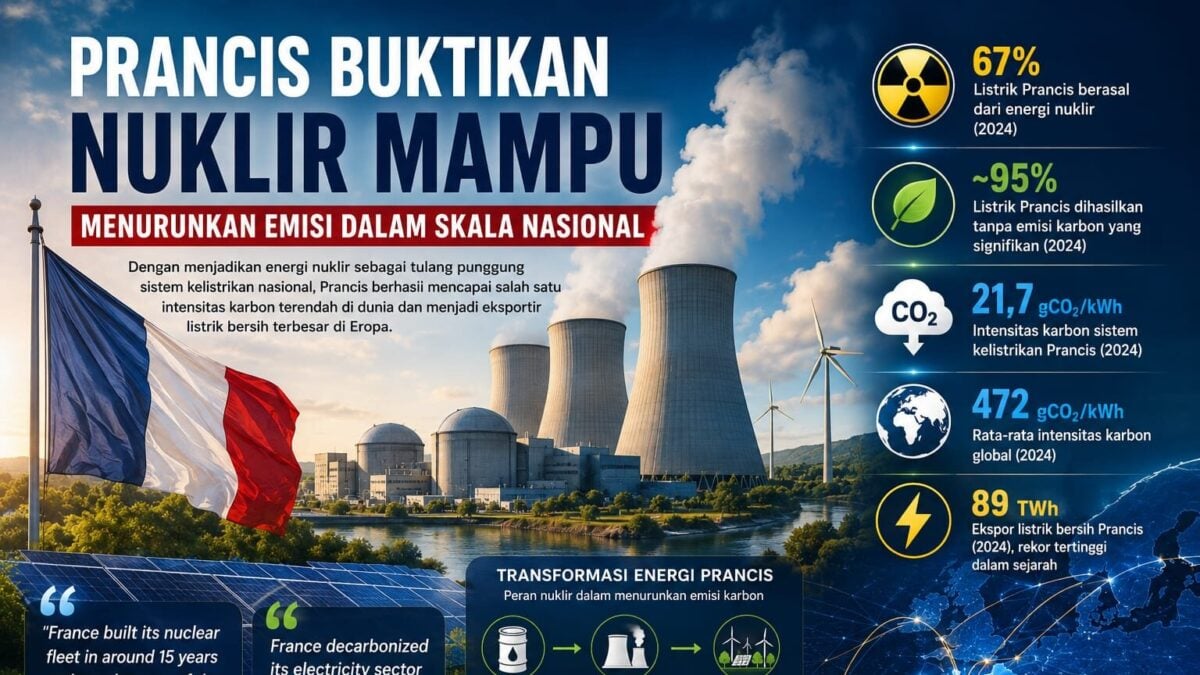
PARIS, JOURNALARTA.COM – Nuclear energy has transformed France’s electricity system on a massive scale. In 2024, France ended the year with about 67 percent of its electricity coming from nuclear power and roughly 95 percent of its generation coming from low-carbon sources.
That matters far beyond Paris. As many countries are still weighing how to cut emissions without making power more expensive or less reliable, France has long kept betting on nuclear reactors. The impact is still visible today: its power-sector emissions sit well below the global average, and France has become Europe’s largest exporter of clean electricity.
High upfront costs, big long-term returns
That shift began after the 1973 oil crisis. When energy prices spiked and dependence on imported fossil fuels looked increasingly risky, the French government launched the Messmer Plan, a large-scale program to build nuclear power plants.
In a relatively short time, dozens of reactors went up and became the backbone of the national electricity system. Our World in Data says France built its nuclear fleet in about 15 years. The process required heavy spending and firm political decisions, but the payoff has lasted for decades.
“France built its nuclear fleet in around 15 years and now has one of the cleanest electricity grids in the world,” Our World in Data wrote in its analysis of France’s energy system.
For France, this was never just about technology. It was about energy security. The country did not want to remain overly exposed to volatile oil and gas markets. Choosing nuclear power gave it a steady supply and relatively low emissions over the long term.
France’s power emissions are far below the global average
The national grid operator RTE said France’s electricity system had a carbon intensity of about 21.7 grams of CO₂ per kilowatt-hour in 2024. Compare that with the global average, which Our World in Data puts at around 472 grams of CO₂ per kilowatt-hour.
The gap is huge. It means electricity produced in France generates only a fraction of the emissions seen on average around the world. That is one reason France is often cited when other countries look for an energy transition path that can keep power supply large, stable, and relatively clean.
France’s low-carbon electricity mix does not come from nuclear power alone. Hydropower, wind, solar, and other low-carbon sources also support the system. Still, nuclear remains the main foundation. Without that reactor fleet, reaching 95 percent low-carbon electricity would be nearly impossible.
The success has also changed France’s role in the European energy market. In 2024, the country posted a record 89 TWh of clean electricity exports, the highest in its power-system history. That means France is not only meeting domestic demand, but also supplying neighbors when they run short on power.
A lesson for the global energy transition
France’s experience often comes up in debates over the future of energy. Some countries считают nuclear power too expensive and too complicated because of waste and safety concerns. But France shows one thing that is hard to dispute: when built consistently and run at national scale, nuclear power can cut electricity emissions quickly while keeping the system reliable.
Michael Shellenberger, founder of Environmental Progress, has called France’s achievement one of the biggest successes in modern decarbonization. He argues that the pace of France’s power-sector emissions decline should serve as a model for countries still struggling with high electricity demand and tighter climate targets.
“France decarbonized its electricity sector faster than any large country in history,” Shellenberger has said in discussions about the global energy transition.
For readers outside France, the numbers carry a clear message. Energy transition is not just about adding solar panels or wind turbines. It takes long-term policy choices, major investment, and the willingness to pick an electricity source that can support the grid for decades. France chose that path earlier than most, and the results now show up in its very low emissions.
As electricity demand rises for industry, households, and data centers, France offers a picture of where nuclear energy still fits in the decarbonization map. It is not free of controversy. But the results are real: stable, low-carbon, and large in scale.
“France’s success shows that rapid decarbonization is not a fantasy,” Shellenberger said.






📝 Leave a Comment
Comment as . Reviewed by an admin before it appears.