
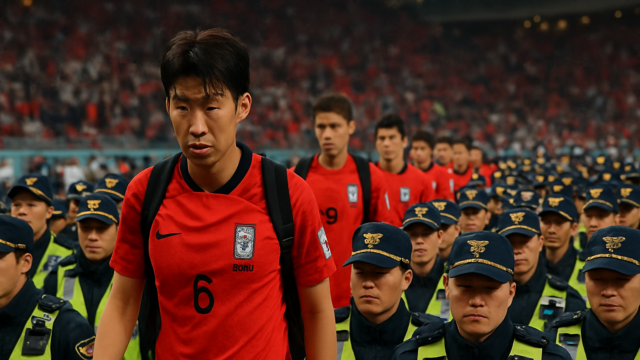
SEOUL — South Korea’s return from the 2026 World Cup was supposed to be a moment of sober reflection. Instead, it turned into an emergency security operation — after death threats against their coach spread rapidly across the internet.
Incheon Metropolitan Police confirmed they would deploy 160 officers on Tuesday (July 1) to escort the national team’s arrival at Incheon International Airport. The airport operator also prepared 25 additional security staff — including dedicated guards and subsidiary employees — to handle any contingency, The Korea Herald reported. No welcome ceremony. No red carpet. Just layers of police protection.
⚽ Read also: World Cup 2026 — Bracket, Today's Schedule & Live Standings
The Death Threat That Changed Everything
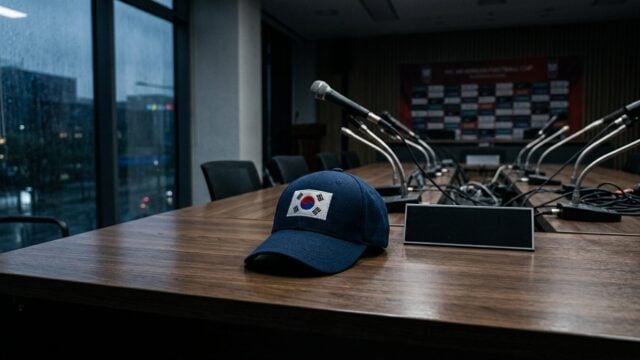
It started with a single post. Someone wrote online threatening to kill Hong Myung-bo, the head coach who resigned shortly after Korea was eliminated from the 2026 World Cup group stage on June 28.
Hong is no stranger to Korean football. He’s a legend — a veteran defender who played in four consecutive World Cups between 1990 and 2002, and the captain when the Taeguk Warriors reached the semifinals on home soil two decades ago. But all that legacy seemed to count for nothing within hours of the final whistle in the group stage.
Korean netizens immediately branded him “the worst coach in South Korean football history.” Some restaurants reportedly refused to serve him. The Chosun Daily reported that the social pressure against Hong had grown so intense that his personal safety became a police priority. Officers planned to route the players through a separate arrival lane from the general public, while managing order in the arrivals hall to avoid disrupting other passengers.
Ranked 34th: A Blow Nobody Saw Coming
South Korea entered the 2026 World Cup riding high expectations. A squad packed with players from Europe’s top leagues, plus what looked like decent depth on the bench, made fans optimistic. The tournament told a different story.
Three games. Then home.
Their final ranking: 34th out of 48 teams — knocked out before the round of 32, the first knockout stage that every group-stage qualifier enters. For a country that reached the World Cup semifinals on home soil in 2002, and has been one of Asia’s most consistent presences at the finals, this wasn’t just a bad result. It was one of the tournament’s most startling collapses.
For context: since 2002, South Korea had advanced past the group stage at three of the next five World Cups. The expectation of reaching the round of 16 had become almost a baseline assumption for Korean fans. When that assumption shattered completely, the reaction went far beyond ordinary disappointment.
President Steps In — This Is Not Normal
The fallout reached well beyond the pitch. President Lee Jae-myung directly ordered a formal investigation to examine the root causes of the national team’s failure — a step that is extraordinarily rare, if not unprecedented, in the context of modern Korean football.
That kind of political intervention sends a clear signal: this is no longer just a football federation problem. It has become a matter of state.
The Korea Football Association (KFA) now faces pressure from every direction — the public, the media, and the government — to conduct a thorough overhaul. Everything is on the table: the coach appointment process, team management, and a long-term player development program widely criticized for years of stagnation.
More Than a Score — This Is About Identity
Football in Korea is not ordinary entertainment. It’s national identity — the collective feeling of millions bound together by the red jersey of the Taeguk Warriors. When that identity feels betrayed, public reaction can surge well past rational limits.
The online threats against Hong Myung-bo are the most extreme symptom of that wound. But the broader wave of anger — online petitions multiplying by the hour, demands for KFA leadership resignations, heated debate across national media — shows the problem runs far deeper than one coach picking the wrong formation.
There’s a bigger structural question underneath it all: why has Korea, with its resources and talent pool, failed to build a consistently competitive team at World Cup level? Son Heung-min, now 33, has likely passed his peak. The next generation is unproven. And the KFA’s youth development system has long drawn criticism for underperforming.
What Comes Next
The players who landed Tuesday were met not by thousands of cheering supporters, but by hundreds of uniformed officers and a tight security cordon. It’s a bleak image — and a precise mirror of the pressure now bearing down on Korean football.
A government investigation, KFA restructuring, and a search for a new coach will dominate headlines over the coming weeks. But the most fundamental question stays the same: what does Korea want to look like at the 2030 World Cup? That answer needs to come faster than usual — because the window to rebuild won’t wait.

📝 Leave a Comment
Comment as . Reviewed by an admin before it appears.