
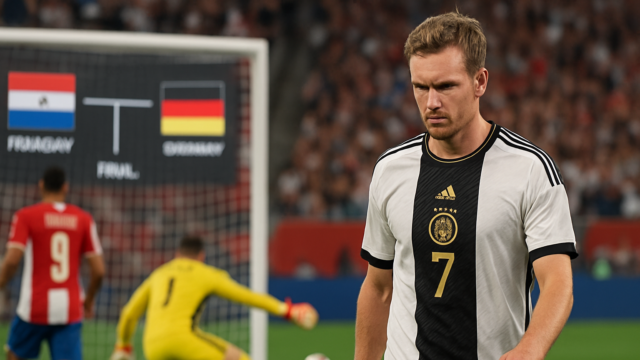
FOXBOROUGH — Twelve years ago, Germany lifted the trophy in Rio. Now, they’re heading home early for the third straight time from that same stage.
At Gillette Stadium in Foxborough, Tuesday (June 30, 2026), Paraguay ended Die Mannschaft‘s 2026 World Cup run in a penalty shootout — 4-3, after 120 minutes of play finished level at 1-1. This wasn’t just a loss. It was confirmation of a decline that has been building for years, with no end in sight.
⚽ Read also: World Cup 2026 — Bracket, Today's Schedule & Live Standings
120 Tight Minutes, One Decisive Night
From the opening whistle, Paraguay didn’t come to sit back. They pressed, controlled the tempo, and made it genuinely difficult for Germany to build from the back. Julyo Enciso broke the deadlock — a sharp run, the confidence to read space, and a cold finish. Exactly the picture of a team that knew precisely what it wanted from this game.
Germany responded. Kai Havertz equalized and forced extra time. But those added 30 minutes didn’t change the bigger picture: Germany looked stuck in the final third, short on fresh ideas to crack Paraguay’s tight, well-drilled defensive block.
Penalties became the only way through. And that’s where Germany fell apart.
Paraguay were perfect — four takers, four goals. Germany converted just three of their four attempts. The bags were already waiting outside the stadium before the final whistle blew.
The name on everyone’s lips as Paraguay’s hero that night: Orlando Gill. A player most fans outside South America might not have known before this tournament. Now he’s part of history. Paraguay advance to the round of 16, and the country’s government immediately declared a national holiday — a celebration that, honestly, was entirely deserved.
A Decline That Can No Longer Be Hidden
The numbers speak louder than any official statement.
| World Cup Edition | Germany’s Final Stage |
|---|---|
| 2014 (Brazil) | Champions 🏆 |
| 2018 (Russia) | Group Stage |
| 2022 (Qatar) | Group Stage |
| 2026 (North America) | Round of 32 (R32) |
Three World Cups. Three times failing to reach the quarterfinals. For a country that built its football on an integrated academy system, a clear playing philosophy, and a winning culture — that’s not just a bad run. That’s a structural crisis.
What makes 2026 feel sharper than 2018 or 2022: this time Germany at least made it out of the group stage. There was hope. A hint of progress. But that hope evaporated in a single night in Foxborough, in front of thousands of fans who made the trip expecting something different.
A group stage exit can be explained away as bad luck. But going out in the first knockout round — again — points to something much deeper.
Nagelsmann Stays On, Questions Remain
Coach Julyan Nagelsmann said he has no intention of resigning after the elimination. That’s understandable on a human level — no manager wants to walk away mid-storm, especially when a long-term project hasn’t had a proper chance to be tested. But German football fans are famously demanding, and pressure from the media and the federation will almost certainly intensify over the coming weeks.
The real question is bigger than the manager’s seat. Has Die Mannschaft lost its footballing identity?
The Germany teams that once struck fear into opponents weren’t just about big names in the starting eleven. They were feared for the system — organized pressing, rapid transitions from defense to attack, and above all: steely nerves in the most critical moments. Penalties, extra time, knockout games. That’s where Germany used to be most dangerous.
What we saw in Foxborough was the opposite. They couldn’t kill off the game when chances came, and when the pressure peaked — at the penalty spot — they cracked. That’s not purely about individual quality. It’s about collective confidence in a fragile state.
Paraguay’s Win Was No Fluke
For many, this result felt like a shock. But for anyone who followed Paraguay through the group stage, there was a clear foundation to it.
Paraguay came into this tournament with sharp tactical preparation. Enciso brought creativity and a genuine goal threat from midfield — the Brighton man has long been recognized as operating well above average by CONMEBOL standards. But what made Paraguay truly dangerous went beyond any individual. Collectively, they were patient, organized, and knew exactly when to draw opponents out and when to lock down space.
A flexible low block, quick counter-attacks through Enciso and company, and remarkable composure in the shootout — none of that was luck. That was preparation paying off.
History was made. A national holiday was declared. And Germany, once again, will watch the next round from home, left to figure out what went wrong.
A Signal for World Football
What happened in Foxborough is not an anomaly. It’s part of a pattern that has been taking shape for years: the old hierarchy of world football keeps shifting. Teams once considered second-tier at World Cups now arrive with video analysis, sophisticated tactical setups, and a fearlessness that matches any European giant.
Paraguay proved that on Tuesday night. Morocco proved it at Qatar 2022. This pattern isn’t stopping.
For Germany, the biggest question after Foxborough isn’t about a 2026 World Cup that’s already over — it’s about what foundation needs to be rebuilt before 2030 arrives, and whether there’s still enough time to answer it.


📝 Leave a Comment
Comment as . Reviewed by an admin before it appears.