Bangka Barat Administration Trains Students in Resam Weaving
Bangka Barat Administration trains students in resam weaving to preserve heritage and build skills for future craft businesses.
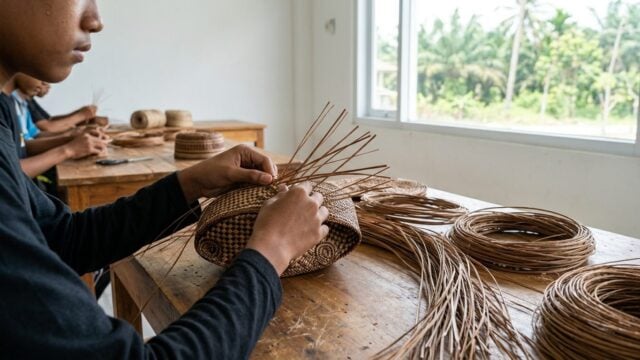
MENTOK — The Bangka Barat Administration Trains Students in Resam Weaving at SMKN 1 Mentok, as local officials race to keep a traditional craft alive and pass it to a younger generation. The program targets a shrinking number of artisans who still know the process from forest to finished kopiah.
The training matters beyond culture. It is also about skills, income, and whether resam fiber craft can still survive in a market that now expects fresh designs and faster promotion.
Why the Bangka Barat Administration Trains Students in Resam Weaving
Agus Setyadi, head of the Industry Division at the Bangka Barat Office of Industry and Manpower, said resam-fiber kopiah are closely tied to the identity of local communities. He said the government wants young people to understand both the craft and the value behind it.
“Kopiah made from resam fiber is one of Bangka Barat’s cultural identities. We provide this training so young people can be skilled while also helping preserve ancestral knowledge,” Agus said in Mentok.
The message is clear. If no one learns the technique now, the production chain could weaken fast. The region is already relying on older craftsmen, and that creates a gap that schools can help close.
Inside the workshop at SMKN 1 Mentok
Students did not stay in the classroom. They were taken to the Dendang Gallery, one of Bangka Barat’s craft centers, to learn directly from master weavers who have spent years working with resam, the fern known scientifically as Dicranopteris linearis.
The work is demanding. Students were shown how artisans search for the plant in the forest, split the stalk, take the inner fiber, soak it, smooth it with special tools, and then weave it into a kopiah. The whole process can take weeks.
Hard work. Real patience.
That detail matters because resam weaving is not a hobby that can be learned from slides alone. The fiber is stiff and unforgiving. One wrong pull changes the shape, weakens the texture, and cuts the quality of the final product.
The administration is also pushing students to think beyond the traditional form. Officials want designs that feel more casual and fit younger buyers, while still keeping the craft’s core identity intact. That opens a door for products with modern motifs and more flexible shapes that can be worn daily, not only on formal occasions.
What the numbers say about the craft sector
The Bangka Barat Office of Industry and Manpower says the local craft sector includes 626 active micro, small, and medium enterprise players. Of that total, 102 artisans focus specifically on processing resam fiber.
Most of them are already past productive age. That is the risk.
If the training works, Bangka Barat could build a new pipeline of makers who do more than copy old patterns. They could redesign, package, and sell the product in ways that suit current buyers without stripping away its heritage value.
| Village | Number of Resam Artisans |
|---|---|
| Kacung Village | 45 |
| Dendang Village | 23 |
| Tugang Village | 14 |
| Airbulin Village | 12 |
| Other villages (Ibul, Berang, etc.) | 8 |
Market value already gives the craft some weight. A finely woven resam kopiah can sell for hundreds of thousands to millions of rupiah per piece, depending on how tight and detailed the weave is. For families and young artisans, that is a real number, not just a cultural slogan.
The direct impact is easy to see. Students who pick up the skill now could turn it into side income, then a small business, and later a full craft operation tied to local tourism and hotels. That could keep money circulating inside Bangka Barat instead of sending it elsewhere.
Agus said the administration is preparing digital marketing schemes and partnerships with the hotel and tourism sectors so student-made products can reach buyers after graduation. For a craft that once depended on local tradition alone, the next step may come through screens, storefronts, and visitor demand. The region now has 102 resam-focused artisans to build from.